Showing posts with label ARFF. Show all posts

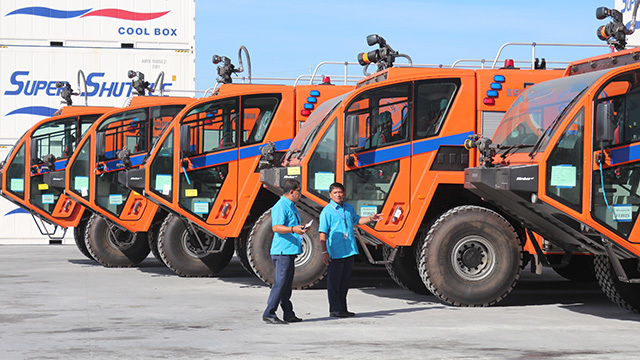
CAAP Procures 8 New 6x6 Oshkosh ARFF

Orders 7 More 

6 December 2024

The Civil Aviation Authority (CAAP) is adding fourteen class 5 6x6 Aircraft Rescue and Fire Fighting (ARFF) vehicles with 12,500 liter capacity for delivery to different airports across the country in a contract valued at 1.5 billion pesos.

The first trance of the project was awarded to Asian Aerospace, local partner of Oshkosh Corporation, based in the United States for the supply and delivery of eight Oshkosh 6x6 striker with a price tag of ₱100 million, for delivery in 2026.

Meanwhile, the second trance comprising seven 6x6 ARFF is currently bidded out, which is scheduled for delivery in 2027.

The new ARFF is expected to replace existing antiquated equipment at the designated airports and reposition other fire rescue vehicles to other airports that lacks or have inadequate fire fighting vehicles.

According to CAA and ICAO regulations, an airport (category 7) serving Airbus 320/321 aircraft must have at least 2 ARFF with water capacity of at least 12,100 liters, while airport (category 10) serving B777-300 or Airbus A350-1000 aircraft must have at least 3 ARFF with water capacity of at least 32,300 liters of water and aqueous agent.  


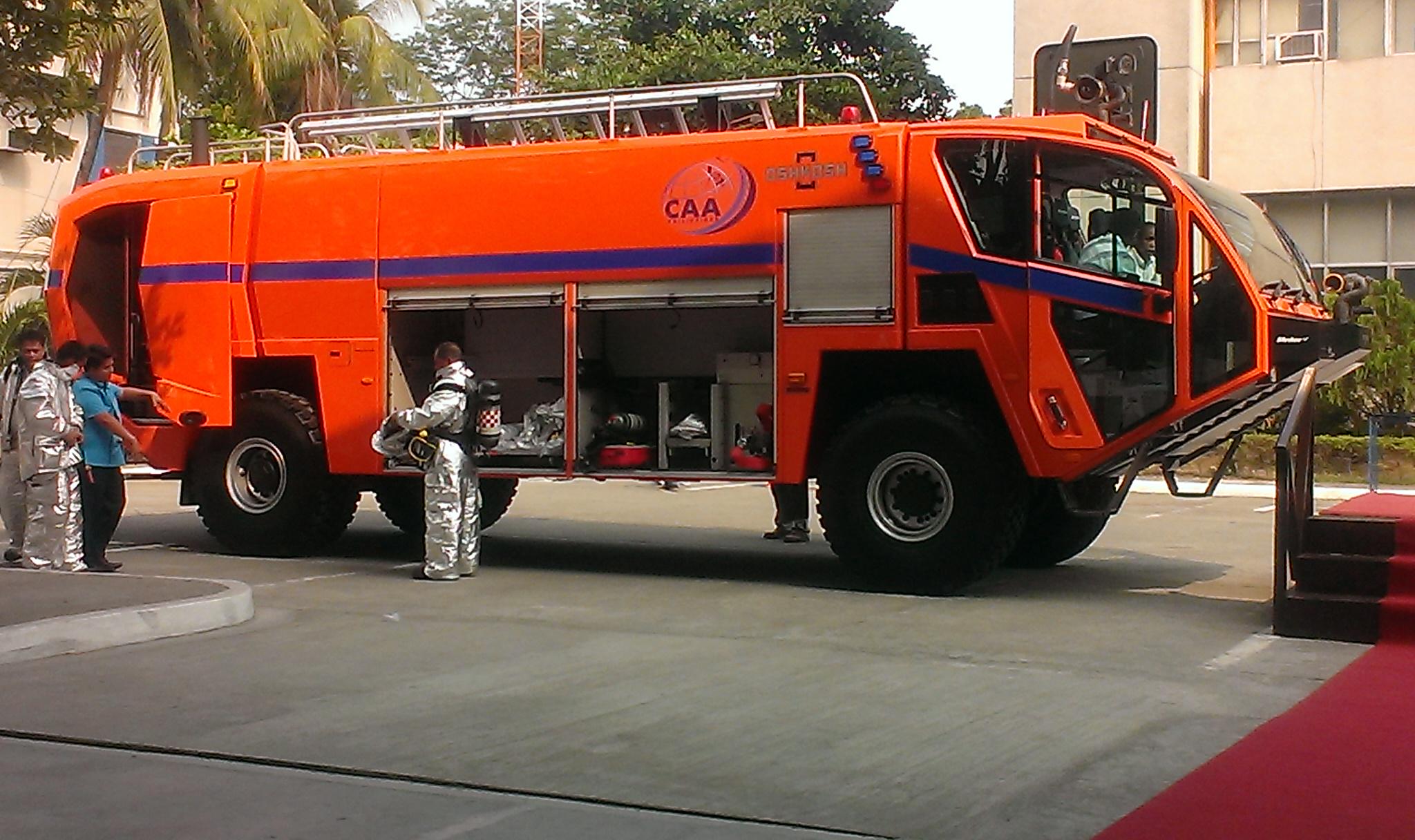
And The ARFF Is Orange

8 March 2015


CAAP has changed again colors of its ARFF equipments. The color of the day happens to be, well  Orange.


Oshkosh Wins ARFF Deal

23 February 2014
37 units of 4X4 ARFF Strikers will be distributed to CAAP Airports handling narrowbody jets across the country

America wins the bid for 41 units of brand new Aircraft Rescue and Fire Fighting (ARFF) vehicle intended to augment rescue capabilities of major commercial airports managed by Civil Aviation Authority of the Philippines (CAAP).

The ARFF procurement was part of the International Civil Authority Organization (ICAO) recommendations to improve safety standards of Philippine Airports which were found to be inadequate.

The original bid was won by Spanish firm Iturri S. A. and Protec Fire S. A., which offered the lowest bid but was subsequently disqualified for failure to comply with the requirement that the chassis of its fire engines should be noncommercial.

"The issue there was the chassis of the fire trucks, very clear in TOR, it should be customized chassis. I spoke to BAC chair it was clear in the papers submitted by Iturri that they were going to use commercial chassis,"  Transportation Secretary Joseph Emilio Abaya said.

Abaya explained further that Iturri and its partners failed to follow the procurement law.

Meanwhile, CAAP Director General William K. Hotchkiss lll said the deployment of the new ARFF is part of the upgrading of the Emergency Services Unit of CAAP on all major airports in the country to comply with the International Civil Authority Organization (ICAO), Federal Aviation Administration (FAA), and the European Union (EU) international aviation standards for aircraft and rescue fighting requirements.

4 units of 6X6 ARFF Strikers will be distributed to CAAP-managed International Airports across the country

Four groups participated in the bidding, but only two passed procedural and eligibility requirements – Iturri and US-based Oshkosh.

Iturri submitted the lowest bid of P984.2 million, below CAAP's approved budget of P1.239.5 billion, while Oshkosh gave an offer of P1.163.89 million.

However, while the Spanish company submitted the lowest bid, it failed to pass the post-qualification evaluation done by the committee in July as Iturri's fire trucks did not comply with the TOR, which called for "custom" or non-commercial chassis. 

CAAP BAC chairman retired Brig. Gen. Rodante Joya said Iturri's trucks had commercial chassis, whose width of 2.55 meters did not comply with the ICAO- and FAA-accepted width of 3 meters, and whose tires were "narrower", and may tilt over when running at high speed.

CAAP operates 81 airports across the country with 41 airports handling commercial flights. These commercial airports have a consolidated inventory of 97 fire trucks but only 80 units are working while 17 units were out of commission due to spare parts supply problems arising from obsolescence.

On the leftmost side is Dodge 350 fire truck followed by French-made Sides VMA105 acquired in the 90's together with International Harvester R190 ARFF acquired for use by Manila International Airport in 1968. These vehicles were found at Lumbia Airport in Cagayan de Oro, Philippines.
Some of the well maintained ARFF have acquisition date as far as year 1968 while bulk of the equipments existing are acquired at the time of President Ramos almost 20 years ago. Three ARFF vehicle (2x 6,000 and 1x 13,000 liters) were added to the inventory in 2013.

Iturri Files Graft Case Against CAAP Bids Officials

Wrong Chassis? or Wrong Company?


19 October 2013

By Cynthia D. Balana
Philippine Daily Inquirer
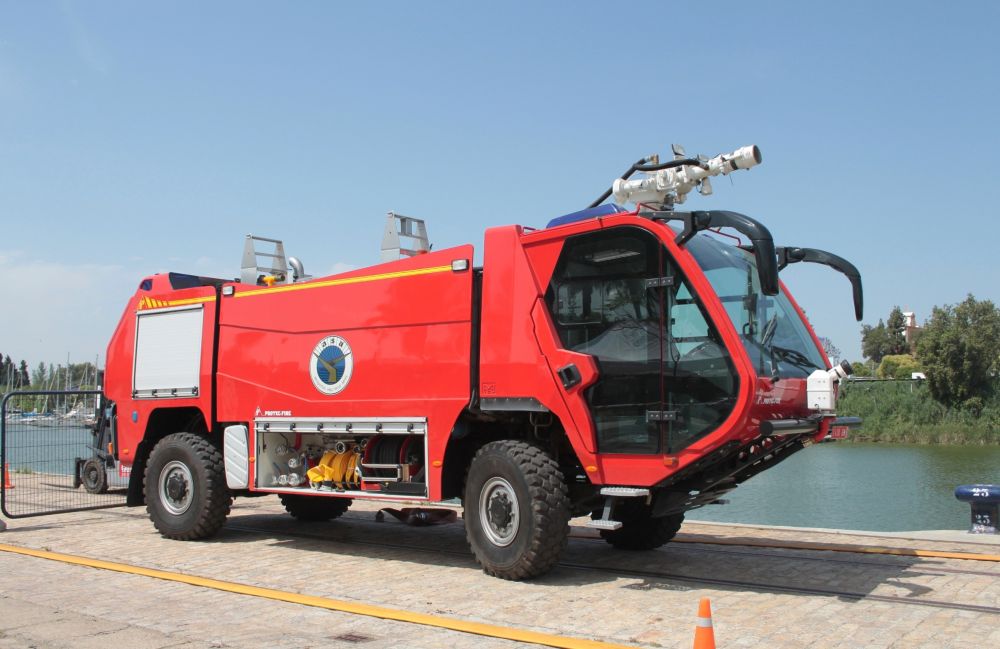
Iturri-Protec-Toro 4X4 Airport Rescue Fire Fighting Vehicle.                         Image courtesy from Gary Parkinson

Two Spanish companies and their local partner here have filed a complaint against officials of the Civil Aviation Authority of the Philippines (CAAP) for disqualifying them from a P1.24-billion airport fire truck procurement project.

Iturri S. A. and Protec Fire S. A., which have offices in Metro Manila, brought charges before the Ombudsman against the CAAP bids and awards committee for violations of the Anti-Graft and Corrupt Practices Act, the Code of Conduct and Ethical Standards for Public Officials and the Procurement Reform Law, among others.


They also asked that the following be investigated for possible criminal and administrative liabilities: retired Brig. Gen. Rodante Joya, the bids and awards committee chair; lawyer Abdiel Dan Elijah Fajardo, the committee vice chair; and committee members Raul Glorioso, Jose Luna, Concordia Pagkaliwangan and Edgardo Felisilda.


The two firms, with their Philippine joint venture partner, Palmer Asia, had already pre-qualified for the project.


The Iturri joint venture was declared the lowest bidder for the procurement of 37 units of aircraft rescue firefighting (ARFF) equipment and rapid intervention vehicles with an approved budget of P1.239 billion from the Department of Transportation and Communications, of which the CAAP is an attached agency.


The Iturri joint venture complainants asked that the Ombudsman issue a preventive suspension against the respondents so they would not be able to influence the outcome of the investigation.


They also asked that the Ombudsman stop the further bidding or rebidding of the project.


According to Iturri lawyer Hernan Nicdao, the joint venture was last June declared to have passed all the legal, technical and financial conditions set by the bids and awards committee.


Iturri then submitted the lowest bid for the project for just P978 million, or P260 million lower than the approved budget. Its bid was lower by P178.5 million from the P1.156 billion of the next lowest bidder.


On July 8, 2013, however, Iturri was disqualified by the bidding committee supposedly after finding that it had failed to comply with the requirement that the chassis of its fire trucks should be noncommercial.


The bidding committee apparently overturned the recommendation of the technical working group, which had deliberated on the bids for more than one month and unanimously recommended that the project be awarded to Iturri, Nicdao said.


“The sudden resort to too much technicality by the BAC in determining what a ‘noncommercial’ chassis is, is baffling, if not outright whimsical,” the complaint said.


“It was as if the definition was stretched too much, if only so that the Iturri fire truck chassis would be deemed as commercial,” it said.


Iturri appealed the disqualification and presented certificates from the Spanish government and other international agencies to prove to the committee that the chassis of their truck was not commercial.


In fact, it claimed to have been awarded contracts of this kind not just in Spain but also in the United Kingdom where it delivered the same noncommercial fire trucks it was offering the CAAP.