Gov't intervenes against PAL outsourcing

Assumes jurisdiction to prevent strike

April 28, 2010

The Department of Labor and Employment (DOLE) has assumed jurisdiction Tuesday to resolve labor dispute against retrenchment plan at Philippine Airlines (PAL) and ordered its management to defer the decision to terminate 3,000 of the company’s 7,500 employees on May 31, 2010 after the PAL Employees Association (PALEA) filed notice of strike against the ailing flag carrier.

DOLE also ordered PALEA to refrain from doing any act that could paralyze the operation of the airline to the detriment of its passengers pending the resolution of the dispute which remains to be the biggest challenge of the labor department to date.

The Labor Department has 30 days to resolve the dispute before the employees are permitted to legally strike under Philippine Labor Laws. The department said it would meet with both the union and the company’s management on April 30 to try to resolve the issues.

An airline is considered by jurisprudence as an industry indespensable to national interest that require the governments intervention to avoid disruption of air transport services.

The government has been asked to bail out the airline following the footsteps of Thai and Malaysia airlines but the government refused to invest in the flag carrier considering its present state of finances.

PAL recently announce the planned outsourcing earlier this month in a bid to boost its profitability amidst losses it incurred during the last three years, mainly because of fuel price increases and the worldwide recession that followed affecting travel demands around the world to which the airline was badly affected. Most of the airline's revenues were derived from its international operations.

The airline recently awarded the reservations and customer supports center to a PLDT subsidiary which service is expected to take effect on June 1.

PLDT Bags PAL Reservations

April 23, 2010

Telecom giant Philippine Long Distance Telephone company (PLDT) subsidiary ePLDT Ventus, has won the bid to provide reservations and call center service requirements of Philippine Airlines (PAL) which the airline earlier announced to be outsourced as part of the company’s restructuring and cost-cutting, program.

PAL president Jaime Bautista and ePLDT Ventus president Maulik Parekh signed the agreement yesterday. The contracts key feature is the provision for ePLDT Ventus to extend job offers to all affected employees of PAL’s reservations sales units in Manila and Cebu, and Mabuhay Miles Center, which will be phased out on June 1, 2010. Affected staff of PAL’s reservations sales and Mabuhay Miles Center will be given first priority in filling the approximately 600 agent positions at ePLDT Ventus.

The agreement calls for ePLDT Ventus to provide a dedicated team of call-center agents on a 24-hours-a-day, seven-days-a-week basis to service the broad range of PAL’s requirements.

These functions include reservations and ticketing, including schedule and fare inquiries, flight booking, change or cancellation of booking, issuance of tickets, and advance seat reservation; general inquiries, including flight arrival and departure information, inquiries about routes and destinations, documentation requirements, and journey-related information; and tour bookings, including inquiries and booking of the Swingaround and PALakbayan tour products.

Also outsourced to Ventus are the following functions: Mabuhay Miles services, including program information and member benefits, membership inquiries, profile updates, account status, award flight booking and ticketing; disruption handling, including notification of passengers in cases of flight schedule changes; fulfillment, including back-office services; and special services, including coordination of group bookings, arrangement of special passenger handling (medical cases, special meal requests, etc.), and email handling.

Interisland plane crashed in Pampanga

Kills three, saves three others

April 23, 2010


Clark - An Interisland Airlines Antonov 12BP cargo plane (UP-AN216, msn402001,cn51) crashed Wednesday in San Patricio village, Mexico town, Pampanga while attempting to land at its destination airport in Clark.

Three crew were killed and three others were rescued by villagers from the burning wreckage. Mexico town police head Superintendent Ferdinand Perez identified the fatalities as Russian ground engineers Mikolay Bannon and Vadim Yakimov and Bulgarian crew member Tzvitoslav Guetchevski whose remains were found "beyond recognition".

The survivors were pilot Yuri Tochocony, 50, co-pilot Dmitri Straminski, 39, and crewmember Bokadier Ruchev, 34.

Tochony said he and the two other survivors ran to safer ground after jumping from the plane. He further said that only one of the crewmen was at the cargo cabin in the middle section of the aircraft at the time of the crash, while he and the four other crewmen were inside the cockpit.

Initial investigation showed that the cargo plane which came from Mactan, Cebu on a routine chartered flight by the Pacific East Asia Cargo Company in behalf of cargo forwarder United Parcel Service (UPS) encountered a short circuit at about 8:50 p.m., triggering a fire inside the aircraft. Clark's tower lost communication with the aircraft at 9:10 p.m.

Russian pilot Yuriv Tochonyy called the tower for an emergency landing but was forced to make landing in Barangay Laput in Mexico, Pampanga and crashed landed about 22 miles (35 kilometers) south of Clark airport.

"The pilots were already in communication with the tower before they declared an emergency" said Alfonso Cusi, director-general of the Civil Aviation Authority of the Philippines. He added the plane was only 10 minutes away from landing when it crashed.

"The cause of the crash looks to be a technical problem with the aircraft's electrical system," says Cusi.

Aircraft investigators from the Civil Aviation Authority of the Philippines have already retrieved the plane's black box and voice recorder. However, investigators could not immediately examine the voice recordings in the black box because they were in Russian.

The aircraft owned by ATMA airlines of Kazakhstan was on a wet lease to Interisland, says Cusi. It first flew as CCCP-11976 in October 14, 1963.

Cusi said two task force were organized, with the first looking on the cause of crash, while the other team would look into documents and records of how the aircraft was able to obtain an Airline Certificate of Conveyance and airworthiness certificate.

Interisland operates a fleet of four aircraft mostly manufactured in the 60's for charter passenger service and cargo flights.

PAL, Gulf Air not keen on more Bahrain flights

Protest new ASA

By Lenie Lectura
April 22, 2010

FLAG carrier Philippine Airlines (PAL) is not interested in mounting flights to Bahrain even if the government’s air panel just recently concluded amending the air services agreement (ASA) between the Philippines and Bahrain.

A PAL executive pointed out that not even Gulf Air wants to fly to Bahrain given the many unutilized entitlements. “There is over capacity in Bahrain. There are so many flights between Manila and Bahrain. Gulf Air is not supporting the additional air entitlements. There is only one group that wants this and that is Bahrain Air,” said PAL president Jaime Bautista. Bahrain Air is the second flag carrier of the Kingdom of Bahrain. The low-cost airline currently flies to the Middle East, Africa and South Asia. It started operations in February 2008 and uses an Airbus A320 fleet.

On March 30, the Philippines and Bahrain amended the air pact between the countries. Under the new deal, four weekly flights to the Manila-Bahrain route were added. Of these new flights, three can only be utilized if there are corresponding flights that would be used in Clark, said Civil Aeronautics Board (CAB) executive director Carmelo Arcilla.

“Of the four, one entitlement was granted without any condition. The remaining three can be utilized only if these three entitlements will also be used in Clark,” said Arcilla.

The amended air pact with Bahrain brings to 54 the total number of flight entitlements with the Philippines. The Manila-Bahrain route now has 12 flight entitlements; seven flight entitlements to Cebu; 28 to Clark and seven to other points except Manila and Clark. “There is no need to add more rights in the Middle East. There are almost 70 weekly flights between Manila and the Middle East. All these have connecting flights to Europe. If this trend continues, we will not be able to fly to Europe anymore,” said the PAL official. The company discontinued flying to European destinations in the 1980s.

The flag carrier, however, is interested to fly to Siem Reap in Cambodia; Bombay in India, and a new route in China. “Cambodia has many tourist that in the Philippines. The market is for tourists. We would also want to fly to India via Bangkok but the Thailand government prohibits us to pick up passengers there, citing 5th freedom rights. We are now doing the ground works before we seek the assistance of the CAB to talk to its counterpart in Bangkok,” said Bautista.

The CAB is part of the Philippine air panel which negotiates for traffic rights with other countries.

The Philippine air panel is composed of officials from the departments of Transportation and Communications, Foreign Affairs, Tourism, and Trade and Industry, the CAB and representatives of the airline firms.

5J Buys Seven more A320's

Confirms Option

April 22, 2010

Delivery Schedules
  • 2010- three A320
  • 2011 - three A320
  • 2012 - four A320
  • 2013 - five A320
  • 2014 - seven A320
Toulouse - Philippine carrier Cebu Pacific has placed a firm order for seven more Airbus A320 aircraft powered by CFM56 engines in a deal worth $1.4 billion, Airbus announced Tuesday. This increases Cebu Pacific's A320 order backlog to 22 jets, set for delivery between the last quarter of 2010 and 2014.

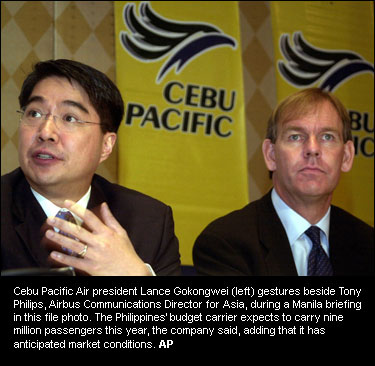
Lance Y. Gokongwei, president of Cebu Pacific operator Cebu Air, Inc., said in a press briefing yesterday that it will expand its fleet over a five-year period to meet growing demand for low-cost air travel.

“We are buying 22 more new aircraft and by 2014 we will have a fleet of 51 aircraft and the largest A320 fleet in the Philippines. The aircraft will start arriving between 2010 and 2014. The reason is that the demand for our services has been very good so we want to increase our capacity,” Mr. Gokongwei said.

Cebu Pacific has a current fleet of 29 aircraft majority of which belongs to the A320 family. They also operates 8 ATR 72-500 deployed to smaller airports across the country.

Rockwell Collins avionics was chosen by Cebu Pacific Air to provide a full suite of communication, navigation and surveillance systems as baseline equipment for the airline's 22 new Airbus A320 aircraft.

Mr. Gokongwei said the purchase of new aircraft would be covered by internally generated funds and export credit.

“The purchase doesn’t depend on the IPO. It’s actually a combination of funding strategies. We will reconsider the IPO after the elections but there really isn’t a definite timeline on that,” said Mr. Gokongwei.

Gokongwei further said that three Airbus A320s will be delivered in the last quarter of 2010; another three will be delivered starting June towards the end of the second half of 2011; four units by 2012 ; seven by 2013; and five by 2014.

By the end of 2014, Cebu Pacific’s fleet size would have grown to 51—composed of 10 Airbus A319s, 33 Airbus A320s, and eight ATRs. The airline now has 10 Airbus A319s; 11 Airbus A320s; and eight ATRs for a total of 29 aircraft.

“By 2014, Cebu Pacific will have the largest Airbus A320 fleet in the Philippines, and the second-largest in Southeast Asia. Cebu Pacific will also double its seating capacity in the next five years,” said Gokongwei.

Starting October 27, 2010, the airline will add new frequencies from Manila to Cagayan de Oro (six times daily), Zamboanga (thrice daily), Pagadian (five times weekly), Davao (six times daily), Tagbilaran (twice daily), Coron (12 times weekly) and Kalibo (16 times weekly). International flights to Taipei will become daily starting Oct. 31, 2010, and Jakarta flights will be four times weekly starting Dec. 19, 2010 while flights to Seoul will be twice daily starting Jan. 24, 2011.

The airline will also add more frequency to the following domestic destinations starting Nov. 24, 2010, and they are as follows:
  • Manila-Boracay (79 times weekly),
  • Manila-Cebu (13 times daily),
  • Cebu-Boracay (twice daily),
  • Cebu-General Santos (daily),
  • Cebu-Puerto Princesa (daily), and
  • Cebu-Bacolod (twice daily).

The Cebu-Zamboanga and Davao-Zamboanga routes will also be upgraded from an ATR72-500 to an Airbus A319, increasing capacity for its daily flights.

The carrier currently flies to 33 domestic destinations and 14 cities across Asia Pacific Region.

NAIA posts banner year in 2009 with 24 M passengers

Makes Manila as 51th Biggest airport in the world

From a passenger capacity of 4.5 million in 1981, the Ninoy Aquino International Airport (NAIA) complex has now become one of the busiest airport in the World transporting 24.5 million passengers making it on the 51th spot, up five notches based on the latest figures released by Airport Council International (ACI).

Despite worldwide economic recession plaguing the airline industry, the growth of passenger traffic at Manila airport has been phenomenal growing 11.5 percent this year as compared to worldwide passenger growth of +0.1%, and +1.2% for Asia Pacific region.

Official figures from ACI disclosed that in 2006 the airport handled only 17.7 million passengers making it the 72nd busiest airport in the world. Passenger volume went up further to 20.4 million passengers in 2007, and 22.1 million in 2008 landing it on the 56th spot.

The airport complex, consisting of 4 terminals, boast a combined capacity of 35 million passengers per year. Aside from its 5 resident domestic airlines, it is serviced by 30 international airlines handling around 200,000 flights and more than 24 million passengers in the year 2009. Further, there are additional seven foreign carriers expected to operate at Manila's premiere airport this year. and continues to be the main international gateway of the country, as it has been for the past decades.

Despite the emergence of new airports with international flight capabilities in the last two years, the NAIA complex handled about 90% of all international traffic in the country. Including domestic passenger movement, NAIA accounted for about 75% total passenger traffic.

Contributing to capacity building was the commercial start-up of Terminal 3 in July 22, 2008, with a soft opening that initially involved domestic flights from Cebu Pacific, followed by other domestic flights from PAL Express and Air Philippines.

Currently, the NAIA Terminal 3 is handling about half or about 7.5 million passengers of its designed capacity of 13 million passengers yearly.

Manila International Airport Authority (MIAA) General Manager Alfonso Cusi also cited the successful certification of the main international terminal, NAIA T1 to the global 9001:2008 ISO Standards of Quality Management Service as well as the continuing strength, secure and safe conduct of its airport operations through the terminal management concept.

Fast Facts:
* Total worldwide passenger growth of +0.1%
Fastest growing region was the Middle East at 5.8% followed by Africa (+4.9%) and Latin America Caribbean (+2.1%)
Asia Pacific and Europe grew by 1.2%
North America only region with decrease in traffic (-3.1%)
* Total aircraft movements handled by airports was 77 million, a decrease of 2.1%
* Total cargo handled decreased by 3.7% to 86 million tonnes
* 51% of airports worldwide registered positive passenger growth in 2008, together these airports represent 49% of total passenger traffic
* 520 airports with more than 5 million passengers experienced a decrease in passengers compared to only 21 airports in 2007.

PAL drops three non-core units

To pay $46 million maturing debts

April 19, 2010

Lean and Mean

Philippine Airlines (PAL) has announced Saturday that it will spin-off three non-core units effective June 1, 2010 to generate fresh cash as it reorganizes into a leaner, more efficient company.

PAL CCO Richard Miller, Standing second from left.
The affected units are in-flight catering services, airport services ( which include ground handling, cargo terminal/handling, and ramp handling), and call center reservations. All affected regular positions will be deemed abolished from PAL’s table of organization effective at the close of business hours on May 31.

“Given this grim scenario, PAL has no choice but to restructure. It must also sell and/or cease operations of non-core businesses since no airline in Asia, or the world for that matter, continue to operate non-core businesses” says PAL chief commercial group adviser Richard Miller in a press briefing.

The selling price was not however disclosed but the airline said it will be used to pay maturing debts.

The airline justified its restructuring plan due to adverse operating factors beyond its control which in fact plagued the airline industry worldwide. Among the problems raised by PAL includes liberalization of the commercial aviation industry, worldwide economic recession slowing passenger traffic movements which also was preceded by record-high oil prices in 2008-2009 period.

Debt Payments

The cost-cutting measures are designed for the survival of the national carrier which failed to generate new capital investments from new and existing stockholders particularly from the Tan Group which refused to raised fresh capital. The government is also not inclined to bail out the airline considering its current financial state.

“PAL has to meet its huge outstanding obligations as they fall due to prevent creditors from taking over the business,” Miller stressed.

PAL reported $350 million in losses during the last two fiscal years. Its remaining equity has also dropped to over $1.1 million as of February 2010 making investments in the airline almost worthless to generate confidence from new investors.

PAL already trimmed its net loss to $40.2 million in the first nine months of its fiscal year ending March 2010 from $330.2 million recorded the same period a year earlier. The company expects to break-even this year.

“PAL did its best to adjust to the harsh operating environment. It implemented a series of cost-cutting initiatives, including a manpower rationalization program in September 2009 that affected more than 400 executives and administrative employees.” Miller said.

In 2000, PAL sold its Maintenance and Engineering Department to Lufthansa Technik Philippines (LTP) as part of the company's rehabilitation plan.

Flat International Growth

PAL expects the growth projection this year to be almost flat, with total passengers carried expected to reach nine million by the end of its fiscal year on March 31, or almost the same as the 8.96 million passengers flow in the last fiscal year, mainly fueled by the domestic market which only account almost 25% of its gross revenue.

In 2009, the airline carried 8.96 million passengers, up 17.1 percent higher than what it carried in 2008. Currently,it flew 7.5 million passengers ending December 31, 37 percent of which are international passengers while the rest are domestic traffic.

Richard Miller said that from April 2009 to January 2010, the number of international passengers flown dropped six percent while those of domestic passengers grew 18 percent.

While international passengers account for only 37 percent of total passengers carried, PAL’s international business contributes 75 percent to total revenues.

Miller said that PAL will focus its expansion in Asia as it adds new regional routes to India and more China destinations.

3,000 jobs to be delisted from PAL's payroll

Some 3,000 workers are set to lose their jobs by end-May when the country’s flag carrier implements its spinoff-outsourcing plans, President Jaime Bautista’s letter to the union said.

The next phase of the restructuring program will affect PAL’s medical, information technology unit, and some human resource and administrative positions, added Bautista. But details of the next phase of the restrucurting program have yet to be finalized.

Palea president Gerardo Rivera said on Sunday that they were slightly caught by surprise with the content of Bautista’s April 16, 2010, letter “since he didn’t raise this during our meeting with him on April 8.”

He said Bautista even assured the Palea leaders that the ills of PAL—a $46.5-million obligation maturing by June 2010, among others—wouldn’t affect the manpower.

“Sure, there were what I call pocket outsourcing, with some jobs being outsourced, but not at this scale and imminence.”

In his letter, Bautista said the company has “implemented a manpower rationalization program affecting more than 400 executives and administrative employees” since September last year.

Rivera said the union “will not take this issue sitting down as the welfare of the families of those affected are at stake.”

He added that beginning Monday, the union would try to sit down with the management to find alternative options to this decision as they will try to exhaust legal means to respond to this issue.

He said only a thousand of the estimated total 4,000 PAL employees will not be affected by the layoff if it pushes through, mostly comprising the pilots and flight crews.

Manila Lands on 36th spot as Worlds Largest

Top 100 Airports by Seat Capacity Available on International Departing Flights for w/c 12/04/10
Ranking Departure Departure Airport Name Total Number

Airport Code
of Seats
1 LHR LONDON HEATHROW APT 807,923
2 CDG PARIS CHARLES DE GAULLE APT 658,509
3 FRA FRANKFURT INTERNATIONAL APT 613,714
4 HKG HONG KONG INTERNATIONAL APT 598,276
5 DXB DUBAI INTERNATIONAL 590,414
6 SIN SINGAPORE CHANGI APT 540,086
7 AMS AMSTERDAM 511,997
8 BKK BANGKOK SUVARNABHUMI INTERNATIONAL APT 453,766
9 ICN SEOUL INCHEON INTERNATIONAL AIRPORT 394,804
10 MAD MADRID BARAJAS APT 387,854
11 NRT TOKYO NARITA APT 383,618
12 MUC MUNICH INTERNATIONAL AIRPORT 340,665
13 TPE TAIPEI TAIWAN TAOYUAN INTERNATIONAL APT 310,305
14 FCO ROME FIUMICINO APT 298,446
15 LGW LONDON GATWICK APT 297,539
16 KUL KUALA LUMPUR INTERNATIONAL AIRPORT 294,441
17 JFK NEW YORK J F KENNEDY INTERNATIONAL APT 289,287
18 ZRH ZURICH AIRPORT 285,113
19 VIE VIENNA 268,386
20 IST ISTANBUL ATATURK AIRPORT 260,523
21 CPH COPENHAGEN KASTRUP APT 249,570
22 PVG SHANGHAI PUDONG INTERNATIONAL APT 241,768
23 DUB DUBLIN 230,962
24 DOH DOHA 230,440
25 YYZ TORONTO LESTER B PEARSON INTL APT 221,721
26 MIA MIAMI INTERNATIONAL APT 221,199
27 BRU BRUSSELS AIRPORT 220,976
28 BCN BARCELONA APT 214,601
29 STN LONDON STANSTED APT 208,762
30 ORY PARIS ORLY APT 197,279
31 MXP MILAN MALPENSA APT 196,706
32 PEK BEIJING CAPITAL APT 194,543
33 LAX LOS ANGELES INTERNATIONAL APT 190,813
34 DUS DUESSELDORF INTERNATIONAL AIRPORT 179,605
35 CAI CAIRO 158,345
36 MNL MANILA NINOY AQUINO INTERNATIONAL APT 154,986
37 ARN STOCKHOLM ARLANDA APT 153,411
38 GVA GENEVA 152,947
39 AUH ABU DHABI INTERNATIONAL APT 151,827
40 SYD SYDNEY KINGSFORD SMITH APT 149,958
41 LIS LISBON 148,498
42 EWR NEWARK LIBERTY INTERNATIONAL APT 148,202
43 BAH BAHRAIN 144,549
44 PRG PRAGUE 141,405
45 ORD CHICAGO O'HARE INTERNATIONAL APT 138,999
46 HEL HELSINKI 135,594
47 ATH ATHENS 134,282
48 MAN MANCHESTER INTERNATIONAL APT 132,497
49 SVO MOSCOW SHEREMETYEVO INTERNATIONAL APT 132,345
50 PMI PALMA DE MALLORCA 131,404
51 CGK JAKARTA SOEKARNO-HATTA APT 129,848
52 KIX OSAKA KANSAI INTERNATIONAL AIRPORT 129,364
53 OSL OSLO GARDERMOEN AIRPORT 128,593
54 KWI KUWAIT 128,356
55 JNB JOHANNESBURG O.R. TAMBO INTERNATIONAL 127,750
56 TLV TEL AVIV BEN GURION INTERNATIONAL APT 125,646
57 JED JEDDAH 123,940
58 ATL ATLANTA HARTSFIELD-JACKSON INTL APT 122,057
59 DEL DELHI 121,480
60 DME MOSCOW DOMODEDOVO APT 121,454
61 GRU SAO PAULO GUARULHOS INTL APT 121,392
62 BOM MUMBAI 119,687
63 AGP MALAGA 115,473
64 BUD BUDAPEST 111,116
65 SJU SAN JUAN LUIS MUNOZ MARIN INTL APT 106,126
66 MEX MEXICO CITY JUAREZ INTERNATIONAL APT 104,182
67 IAH HOUSTON GEORGE BUSH INTERCONTINENTAL AP 103,465
68 SFO SAN FRANCISCO INTERNATIONAL APT 101,880
69 TXL BERLIN TEGEL APT 98,196
70 RUH RIYADH 97,524
71 CUN CANCUN 97,501
72 LTN LONDON LUTON APT 96,628
73 EZE BUENOS AIRES MINISTRO PISTARINI 96,585
74 SGN HO CHI MINH CITY 95,499
75 WAW WARSAW 93,845
76 ALC ALICANTE 92,846
77 YVR VANCOUVER INTERNATIONAL APT 90,164
78 HAM HAMBURG AIRPORT 89,767
79 IAD WASHINGTON DULLES INTERNATIONAL APT 89,118
80 AKL AUCKLAND INTERNATIONAL APT 88,379
81 PTY PANAMA CITY TOCUMEN INTERNATIONAL 86,144
82 NCE NICE 85,859
83 BHX BIRMINGHAM INTERNATIONAL AIRPORT 85,643
84 MCT MUSCAT 83,694
85 CGN COLOGNE/BONN APT 83,502
86 BEY BEIRUT 79,686
87 CMN CASABLANCA MOHAMMED V APT 79,299
88 YUL MONTREAL PIERRE ELLIOTT TRUDEAU INT APT 78,163
89 CAN GUANGZHOU 77,219
90 AMM AMMAN QUEEN ALIA INTERNATIONAL APT 77,183
91 STR STUTTGART AIRPORT 75,753
92 LIM LIMA 72,966
93 MEL MELBOURNE AIRPORT 72,235
94 SXF BERLIN SCHOENEFELD APT 69,637
95 SHJ SHARJAH 69,326
96 DFW DALLAS/FORT WORTH INTL APT 68,233
97 RIX RIGA 68,151
98 CRL BRUSSELS S. CHARLEROI AIRPORT 67,418
99 DPS DENPASAR BALI 66,665
100 CMB COLOMBO BANDARANAIKE APT 66,465
Source:OAG MAX Online