Pilot Error

Never turn the plane to a dead engine




By Perseus Echeminada  

November 4, 2012

MANILA, Philippines - A combination of pilot error and a defective engine caused the crash of a Piper Seneca aircraft carrying Interior and Local Government Secretary Jesse Robredo off Masbate last Aug.18, investigators said.

Killed with Robredo in the crash were pilot Jessup Bahinting and student pilot Nepalese Khshitiz Chand. Robredo’s aide Police Senior Inspector Jun Abrasado survived the crash.

The plane was en route to Naga City from the Mactan International Airport in Cebu when it went down off Masbate.

A 14-page draft report of a five-man investigating body created by former Transportation and Communications Secretary Manuel Roxas II said the pilot lacked proficiency in handling aircraft in abnormal situations.

The report said that five minutes after take-off, the pilot sought permission from air traffic control to climb to 6,500 feet but was instructed to remain at 2,500 feet until 20 miles out.

Four minutes later the pilot reported the aircraft was at 2,300 feet. That was the last recorded communication of the plane with the Mactan air traffic control.

Data gathered by the Manila Area Control Center (MACC) showed that the Piper Seneca aircraft or flight X4431 was at 4,000 feet heading 353 degrees at 4:07 pm. After eight seconds it was still at the same altitude, moving 340 degrees.

The aircraft disappeared from the radar screen for a few seconds and reappeared at an altitude of 3,900 feet at 010 degrees.

“Twenty-four seconds later the aircraft was still at 3,900 feet altitude with a speed of 80 knots. This time the aircraft was 33.7 kilometers from Masbate and 91.1 km from Mactan. Seconds later the aircraft was monitored at 3,900 feet with speed of 70 knots and heading 345 degrees. This was the last data picked up by MACC before the aircraft disappeared from the radar display,” the report said.

At 4:25 p.m., the aircraft was reported to have crashed in the waters some 1.1 km from the Masbate airport runway 21. 

Survivor’s account
Based on Abrasado’s account, the pilot informed them of engine trouble 23 minutes after takeoff at 3:07 pm.

“Baka hindi umabot ang propeller natin sa Naga. Magbalik tayo Cebu (Our propellers might not be able to make it to Naga. Let’s go back to Cebu),” the pilot was quoted as telling his passengers.

But Abrasado said the plane appeared to be flying normally even on one engine. He texted a staff of Robredo requesting for airline booking for the secretary and himself for the next available flight to Manila.

“Later he (Abrasado ) sensed that the plane was changing direction and at the same time noticed an orange indicator on the instrument panel, initially blinking slowly, and later increasingly faster. Suddenly, he heard a noise and saw the right hand propeller stop, at the same time the orange indicator steadily lit,” the report said.

When Abrasado asked if they were returning to Cebu he was told by Bahinting that they were proceeding to Masbate. The captain reportedly told them of his three failed attempts to restart the engine.

“Suddenly, he (Abrasado) saw the plane slowly veering to the left for final approach to the runway but it seemed to him that the pilot miscalculated the runway and maneuvered the plane too late and they went past the runway,” the report said.

“Then Abrasado looked at the pilot and saw the latter turn his head to the right and glance to the rear over his right shoulder, and remembers seeing his face turn red and eyes wide open (bulging). The airplane turned right and ditched upward, followed by a swift vertical nosedive,” the report said.

Civil Aviation Authority of the Philippines investigator Cesar Lucero told The STAR that turning the plane to the right when the right engine was already dead was a fatal error of the pilot.

“The cardinal rule among pilots is never turn the plane to a dead engine,” he said. 

No pre-flight briefing
Also according to the report, no pre-flight briefing occurred at the Mactan International Airport.

The report also said the student pilot, who was not yet qualified to fly a Piper Seneca, was occupying the pilot’s seat.

Considering that the flight was for a VIP, the student pilot’s Indian flight instructor should have been on the flight and not his student.

The report also questioned the decision of the pilot to continue the flight 23 minutes after he sensed “propeller problem.”

“If the flight returned to Mactan, it would have landed safely with still two engines, as the loss of the right engine was after 38 minutes of flight after the initial propeller problem was noted,” the report stated.

The loss of the right engine was reported 33.7 km from Masbate airport and it took 17 minutes flying on a single left engine before the aircraft crashed 800 meters from the runway.

The report said witnesses testified that the landing gears of the aircraft were deployed.

“The last and fatal decision made was making a right controlled turn toward the dead engine, the aircraft manual says that if turn is made towards a dead engine the aircraft will pitch up about 15 degrees followed by a stall towards the dead engine,” the report said.

“Altitude is the insurance against stalls or spins. Without it recovery is impossible,” it said.

The other findings include: left engine idler shaft was loose, stud screwed to the crank case broken and the slotted nut missing; lock plate damaged; left magneto had evidence of burn; all piston rings stuck up; all piston heads and spark plugs had carbon deposits.

Results Not Setback but Progress

ICAO to end Audit in 2013

November 2, 2012

The Philippine government is bullish with the recent results of International Civil Aviation Organization (ICAO) audit which found the country deficient only of two Significant Safety concerns (SSC) from the previous 89 the UN aviation body reported few years ago. 

 Malacanang is confident of meeting all the safety concerns over Philippine aviation in time for the final audit of ICAO in the first quarter of 2013, according to Deputy Presidential Spokesperson Abigail Valte. 

“We would not consider this as a setback, because we already have implemented progresses” says Valte in an interview with state-run Radyo ng Bayan. 

"The feedback we have is, we have made significant progress on some of the areas of concern but there are still some things to be done. There is a final audit that will happen sometime in the first quarter of 2013 and we are optimistic that the significant safety concerns can be address in time for the final audit in the first quarter," Valte said. 

Valte remarked that the country's Civil Aviation Authority CAAP) will ensure that measures will be in place when ICAO makes the next audit in the first quarter of 2013. 

ICAO classified the Philippines in December 18, 2009 with “Significant Safety Concern” that requires Universal Safety Oversight Audit for failure to resolve issues relating to air safety oversight.

The UN aviation body created the Universal Safety Oversight Audit Program (USOAP) to address a UN-member country’s capability for providing safety oversight so that the traveling public can make an informed decision when using air transportation.

The mandatory audits of the safety oversight systems in all Contracting States, such as the Philippines, assesses whether critical elements of the safety program have been implemented and identify deficiencies which should be corrected. Follow-up visits are then done to confirm whether the measures were effective.

A final audit by ICAO signifies closure of monitoring activities as it declare a country's aviation safety policy compliant with international standards.

Flunked!

Philippines fails ICAO Safety Audit Again


By Recto Mercene

November 1, 2012

THE Civil Aviation Authority of the Philippines (Caap) will remain in Category 2 status as it has again flunked a review conducted by inspectors from the International Civil Aviation Organization (Icao). 


As such, Caap will remain in Category 2 status; the Icao team was said to have found two “significant safety concerns [SSC]” during its 10-day evaluation. The team said Caap “failed” in “aircraft registration and flight safety inspection.”

Flag carrier Philippine Airlines had hoped that the country’s aviation industry would revert to Category 1 status so that its newly purchased B777 would be able to fly to new routes in the United States and Europe.

The “Icao Coordinated Validation Mission” made the announcement during an exit briefing with Caap officials on Wednesday, according to airport sources. The sources said the team would return in February for another evaluation.

The team leader, Henry Gourdji, said an official statement would be sent to the Caap after 15 days.

The other members of the group were Jean Claude Waffo of aerodrome ground airfield facilities (AGA); Allan Tang, licensing; Vincent Lambottea, operations; Amal Hewawasam, airworthiness; Kong Cheong, airworthiness; and Sekhat Natarjan Chandr, AGA.

In 2007 the then-Air Transportation Office (Ato) was downgraded from Category 1 to Category 2 status after the Icao found 89 SSC during an inspection.

The resulting brouhaha forced the administration to abolish the Ato and created the Caap, under Republic Act (RA), 9497.

RA 9497 was explicit that the next Caap director general should be appointed “permanently” for six years, so that he/she would not be subject to political pressures.

But five years after it was created, the Caap has already had five director generals.

The latest, retired Lt. Gen. William Hotchkiss said upon assumption in June this year that he hopes to return Caap to Category 1 status before the end of the year.

“Hopefully, we might have some good news by Christmas. But I cannot say outright whether we will get into Category 1,” he said.

The Department of Transportation and Communications earlier said only two out of the 22 actionable items identified by the US Federal Aviation Authority as safety concerns remained unresolved.

These were the lack of qualified safety personnel and the absence of an integrated IT system to modernize the sector’s database.

The Icao group’s visit coincided with the breakdown of the very high frequency omni-directional range (VOR), a crucial navigational aid in major airports that caused the diversion to Clark of nine international flights and three domestic flights.

On October 9 the VOR conked out again, forcing at least 13 local and one international flight to be diverted to the Diosdado Macapagal International Airport.

Two years ago, the VOR/DME (distance measuring equipment) failed to be on air for two months after more than 12 years of service.

The Caap had to cannibalize the Subic VOR to replace the so-called defective elements, thus bugging the Manila VOR. The Manila International Airport Authority (Miaa) agreed to fund the purchase of a new VOR, estimated between P80 million and P120 million.

Then-Transportation Secretary Mar Roxas II approved the emergency purchase of a new VOR, which was also approved by the Miaa board during an full court (en banc) session.

Transportation Undersecretary for Planning and Operations Rafael Antonio Santos, signed in behalf of Roxas, the same source said.

However, it appears that the Caap failed to form a Bids and Awards Committee that would decide whom to award the right to purchase the VOR.

Many airline companies, especially the low-cost carriers, are complaining about the frequent diversions to Clark, Cebu and Laoag, which eat into their profits. They criticize the slow progress being made in the aviation sector, but are afraid to air their criticisms publicly for fear of backlash from administration officials.

EU: Friends don’t count in air safety

In response to the French lobby of lifting RP ban

 
Binay met with Siim Kallas, vice president of the European Commission and Commissioner of Transport, to discuss the European Union (EU) ban on Philippine carriers and report measures that the government has undertaken to improve the state of the Philippine aviation industry

October 31, 2012
By Eric B. Apolonio

The European Union has remained non-committal on the possibility of lifting the ban on Philippine carriers from flying to Europe.

EU Commissioner for Transport Siim Kallas even told Vice-President Jejomar Binay that “when it comes to air safety, we don’t’ have friends.”

Siim Kallas, however, assured Binay that the ban “was not meant to discriminate against non-EU carriers,” since European carriers were not immune from the same ban if they fail to meet the US strict air safety standards.

Kallas said that the Union had always put a premium on air safety and in “maintaining professionalism and “regularity of safety inspections.”

“When it comes to safety, we don’t have friends,” he said. The main issue for the Philippines, Kallas said, was “maintaining the professionalism and regularity of air safety inspections.”

The EU banned Philippine carriers from flying to Europe starting in April 1, 2010, following the decision of the United States Federal Aviation Administration to downgrade the Philippines’ rating to Category 2 from Category 1 starting on January 17, 2008.

The FAA said that the Air Transportation Office of the Philippines “did not fully satisfy international safety standards.”

Binay,  who was in Europe as part of his three-nation swing, including a visit to Vatican City, where he represented President Benigno Aquino III during the canonization of Pedro Calungsod, said he had assured Kallas that the country had already sought technical assistance from other governments to improve the Philippines’ air safety standards.

“I informed the commissioner that the Philippines had sought technical assistance from the French government to improve air safety standards, and that Philippine Airlines, which is now under new management, had just ordered 54 airbus aircraft in line with its re-fleeting program,” said Binay, who arrived on Monday from Europe via Hong Kong.

Binay said the current International Civil Aviation Organization-coordinated validation mission in Manila on October 24-28, 2012 to assess the current capabilities of the CAAP regarding safety oversight and in compliance with ICAO standards and Recommended Practices showed the country’s desires to lift the European Union ban on Philippine carriers.

In response, Kallas said the Union “was very interested in developing an air safety agreement with the Philippines.”

PR1 Departs Sydney

October 27, 2012


President Benigno S. Aquino III winds up five-day visit to New Zealand and the Commonwealth of Australia, as he prepares for departure to Manila yesterday via Philippine Airlines Airbus A330-300 (RP-C3333) flight PR001 at the Hawker Pacific Flight Center in Sydney International Airport.

PAF flies another C-130

October 27, 2012

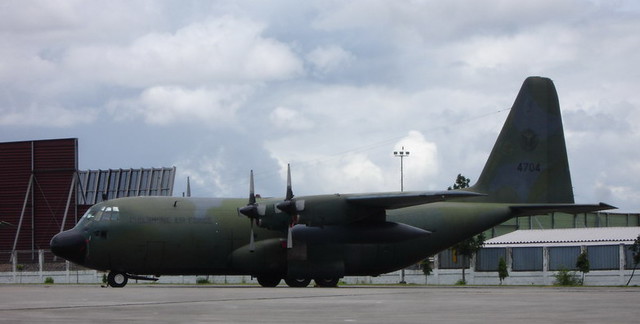
A Philippine Air Force (PAF) C-130H “Hercules” (tail number 4704) cargo plane has arrived in Manila last October 17 after being sent to the United States for “Periodic Depot Maintenance” last August 8 at a British Aerospace facility in Mojave, California. A budget of P190 million, funded through Foreign Millitary Sales, was allocated for the repair.

The C-130 left California October 14 and made stopovers at Hawaii, Wake Islands, and Guam in the Pacific before its arrival in the country. The crew consisted of Colonel Jose Mirandilla Jr., Deputy Wing Commander of the220th Airlift Wing, Lieutenant Colonel Ramil Oloroso as test pilot, Major Michael Edrik Encarnacion as pilot-in-command, Captains Ian Dexter Danes and Merrito Quijano as co-pilots


US Navy back in Subic

As China makes reconciliatory gestures to PH

October 26, 2012

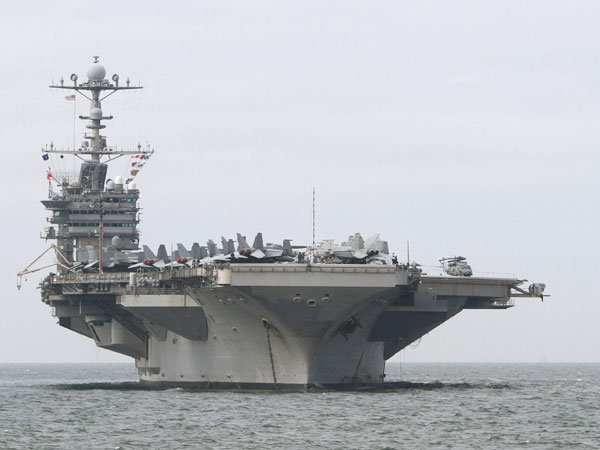
The nuclear powered US Navy aircraft carrier USS George Washington anchors in Manila Bay on Wednesday October 24. The Nimitz-class aircraft carrier together with two escort destroyers are here for a goodwill visit.


After confirming that Americans are indeed back at Subic, Chinese Vice Foreign Minister and Special Envoy of the Chinese Government Fu Ying wasted no time to call President Benigno S. Aquino III last week at Malacañang to impart the message from Chinese President Hu Jintao that China places great importance and value to the long-standing friendship with the Philippines.

Beijing began to have second thoughts on its expansionists plan and sent Vice Foreign Minister Fu to expressed the Chinese government’s desire to move Philippines–China relations forward to benefit the peoples of both countries.

The sudden change of tack by China in what W. Scott Thompson, geopolitics and defense expert, writing for New York Times and New Straits Times, called serious "miscalculations" on the Philippine resolve to protect its territorial sovereignty.

Thomson said that China flexed its muscle into the country after its President for nine years Gloria Arroyo, let the Chinese have whatever they wanted, in return for personal favours, like broadband project, which allegedly carried a 50 percent cut to President Arroyo before it blew up in their faces.

The United States military, particularly Admiral Samuel Locklear III, Chief of the US Pacific Command based in Hawaii, has said last July that the US is committed to develop a “minimum defense capability” for the Philippines, for which they are now building at Subic Bay transforming it into military logistic hub for Asia Pacific region guarded by three confirmed US nuclear submarines patrolling the South China Sea.

Locklear confirmed that the US Navy will have a semi-permanent rotational presence at Subic Bay, describing deployment as providing "peace of mind" for Southeast Asia amidst increase maritime insertions of Chinese Navy vessels into the South China Sea.

Navy Adm. Samuel J. Locklear III, commander of U.S. Pacific Command, arrives in the Philippines to meet with senior military officials in Manila, Sunday. The United States and the Philippines share a Mutual Defense Treaty, and the two nations work closely together through bi-lateral and multi-lateral training to enhance interoperability. U.S. NAVY PHOTO
US Air Force Brigadier General Mark McLeod of the US Pacific Command's (PACOM's) Director of logistics, engineering, and security, said that SBIA will likely be used to pre-position US logistics assets. Pacom is working with the Defense Department and the U.S. Agency for International Development to identify what materiel assets might be transferred to Subic as U.S. forces draw down in Afghanistan,.

“Part of what this office is doing is looking at the options of where we can forward locate humanitarian assistance capabilities in the theater,” says. McLeod, during an interview at the command’s Honolulu headquarters. “We want to posture them somewhere in the theater that would allow us to react very quickly.”

He said that the US was looking for a "very low-cost storage capabilities" for equipment and supplies in bulk readily available in case of armed conflicts in the Asia Pacific region.

Macleod further said that it might make more sense to forward equipment and supplies to a place where there is "easy access" as opposed to bringing it home and putting it in central storage facilities.

DFA Visiting Forces Agreement Director Edilberto Adan described the deployment as providing "peace of mind" for Southeast Asia in the wake of a series of renewed territorial disputes in the South China Sea.

Adan said the US will be developing Subic Bay International Airport (SBIA), and San Fernando Airport as military airport. San Fernando Airport is currently being used for general aviation and charter flights while Subic Bay Airport used to be the Asian hub of American cargo carrier Fedex.

While Philippine and US officials are keen to emphasise that neither increased military visits nor the rotational presence of US forces at Subic are a threat to any other country, they are clearly a point of tension with China. Several dozen USN ships have anchored in Subic Bay since April's escalation of the Spratly Islands territorial dispute between Beijing and Manila.

"We go to many places in [the] region, even the People's Republic of China itself," a senior US diplomat told Michael Cohen, a correspondent of Jane's Defence Weekly magazine. 

"All we offer is stability and security, and we certainly have shown a respect for sovereignty. We go when asked to leave, and do not claim what is not ours."

Huntington Ingalls Industries (NYSE:HII) subsidiary AMSEC recently signed an agreement in April 2012 with Korean shipbuilding giant Hanjin Heavy Industries subsidiary in the Philippines Hanjin Heavy Industries and Construction Philippines, Inc. (HHIC-PHIL) for maintenance, repair and logistics services works to the US. Navy.

Agusta Westland wins bid for Navy Choppers

October 25, 2012
The Philippine Navy is acquiring 5 AW 109 naval version choppers for anti-submarine warfare (ASW) operations.

The Department of National Defense (DND) is acquiring five naval helicopters from Agusta Westland to boost the Navy’s maritime security and disaster response capabilities.

The AW109KN version will be stationed on all frigate vessels acquired recently by the Philippine government, BRP Gregorio Del Pilar and BRP Ramon Alcaraz. The navy acquired from the United States (US) two Hamilton Class Coast Guard Cutters and converted it to frigate warships to patrol its maritime area. Two more missile-armed Maestrale Class frigates from Italy are expected to join the Philippine Navy starting next year. The other ASW choppers will be assigned to the Italian-Maestrale class frigates when they arrive in 2013.

DND Assistant Secretary Ernesto Boac said the project costs P2.2 billion and would be funded by the Armed Forces modernization program and the Department of Energy.

“The helicopters will improve the capabilities of the Navy. These will be used for maritime security, internal security operations and disaster response,” Boac said.

The fuselages of AW109 are made by PZL-Åšwidnik, the same company that manufactured the Sokol helicopters of the Philippine Air Force.

The first batch of  AW 109 helicopters is scheduled to arrive on Oct. 17, 2013 and delivery is expected to be completed by Dec. 17, 2013.