Showing posts with label Radar. Show all posts

US Funds Surveilance Radar

3 May 2015

The United States of America has provided the Philippines $20 million for the installation of its National Coast Watch Center (NCWC) powered by Surveillance radar from Israel.

Massachusetts-based company Raytheon had been awarded a contract to design and construct a National Coast Watch Center by the Philippine government last July 2014.

US Ambassador to the Philippines Philip Goldberg attended the inauguration of the NCWC last Tuesday, April 27.

“The center will provide critical information fusion and 24-hour operations to support enhanced awareness of the Philippines’ maritime domain. Future incremental improvements are planned to fully realize the potential of the center,” US Ambassador to the Philippines Philip Goldberg said.

The maritime and aerial data is connected to the US military servers in Honululu, Guam and Okinawa.

The construction of the National Coast Watch Center is Raytheon’s first border security-related contract in Southeast Asia. The radar installation will be completed before July 31, 2015.

The completion of the project would enable the Philippines to tremendously improved its surveillance operations for security threats by tying together more than a dozen radar stations and sensors, as well as on board ship radrs of the Coast Guard, and to provide a more comprehensive picture of ships and vessels operating in or near Philippine waters.

“Maritime domain awareness is crucial for the Philippines as it increases its abilities to thwart smuggling, illegal fishing, other criminal activities as well as improving defense capacity,” the US Embassy noted.

Air Search Radar ready by 2015


Radars from Israel to boost Phl sea watch
5 February 2014

By Alexis Romero

The Philippines will acquire three air search radars from Israel to boost its monitoring activities in the West Philippine Sea, where increasing Chinese military presence has been causing tension.

Security officials signed last week an implementation arrangement that would pave the way for the purchase of the radars from Israel Aerospace Industries Ltd.-Elta for P2.6 billion.

Israel will also lend the Philippines another radar “for immediate stop-gap solutions,” the source said.

The delivery of the three radars is expected within the next two years. The one to be lent by Israel would be ready in a year.

“The full requirement for national coverage involves nine radars but because of the capability of the three radars, we will only need seven,” the source said. It’s not clear if more deliveries are forthcoming.

COA Clears CNS/ATM Project

Slated for Completion in 2015

By Darwin G. Amojelar
July 2, 2013

MANILA - The Civil Aviation Authority of the Philippines (CAAP) can finally spruce up its communications, navigation and surveillance system after the government and a private contractor amended a contract that the Commission on Audit (COA) earlier blocked.

Under the contract amendment signed last week by the Department of Transportation and Communications (DOTC) and the Sumitomo-Thales Joint Venture, the P13.27 billion Communications, Navigation and Surveillance/Air Traffic Management (CNS/ATM) Systems Development Project can immediately restart construction.

The project has two packages: the first entails the design and construction of the ATM Center and ATM Automation System, as well as the final integration of the whole CNS/ATM system, while the second package involves the design and construction of a surveillance and communication system.

The DOTC expects the construction to be completed in two-and-a-half years.

The original contract between the parties was signed in December 2010, but COA issued a notice of disallowance in May 2011. After a review of its concerns, COA lifted the disallowance last March.

Begun in the previous administration, the project was suspended after COA discovered a duplication of the new Manila Area Control System (MACC) that the DOTC obtained.

The DOTC and the private contractor then worked on the contract amendment to update the project timeline, scope of works and prices.

The state-of-the-art CNS/ATM System will modernize aviation safety and security capabilities, increase airport capacity, and minimize flight delays and aircraft collision by providing safety alerts and warnings, managing the use of the airspace and air traffic flow, and enhancing the communications and monitoring capabilities of the CAAP.

“This project will bring the country closer to the highest of international aviation safety standards.  Ultimately, it will also result in more revenues for the government, bolster the country’s tourism goals, and lower pollution emission levels through efficient air traffic management,” Migs Sagcal, DOTC spokesperson said.

Sagcal said Transport Secretary Joseph Emilio Aguinaldo Abaya secured the joint venture’s reassurance that the CNS/ATM Systems will be fully in place within President Benigno S. Aquino III's term, or by November 2015 at the earliest.

The CNS/ATM Systems Development Project was first conceptualized in accordance with the International Civil Aviation Organization (ICAO) Global Air Navigation Plan, and will replace aging vital communications, surveillance, and air traffic control equipment at selected airports nationwide.

The CNS/ATM project installation was supposed to be completed in June this year. The loan validity was extended to May 21, 2013 from February 21, 2010

ATM Project, a white elephant in the making?

Existing control center can do job


February 8, 2011
BY  DARWIN G. AMOJELAR


Besides being expensive, the Japanese-funded air traffic management (ATM) project of the Department of Transportation and Communications (DOTC) was hit for allegedly being “flawed,” “futile” and “redundant” since existing air traffic facilities can very well handle the anticipated increase in international and domestic flights in the next five years.

Airport sources have said that the Communications, Navigation and Surveillance/Air Traffic Management (CNS/ATM) System Project worth P13 billion should be quashed because the existing Manila Air Control Center (MACC) can still effectively manage air traffic.
At the most, the sources added, an upgrade of the MACC should be undertaken.

Questions on the propriety of the CNS/ATM project came after the DOTC awarded Package 1 of the project to Sumitomo/Thales Joint Venture on December 23, 2010.

This phase costs P4.2 billion. 

Thales is reputed to be the world leader in ATM systems and civil radars and has a 70-percent market share in the navigation aids market.

The CNS/ATM project has seven major components—the construction of the air traffic management automation, communications, navigation, surveillance, meteorological system, consulting services and land acquisition.

It aims to achieve greatest operational flexibility, airspace capacity and system efficiency.

The losing bidders were Marubeni Corp. (Indra Systemas), Selex Sistemi-Kanematsu Cor. Joint Venture and Sojitz Corp. (Rayheon Corp.).

The scope of Package 2, which is yet to be awarded, includes the installation of an Automatic Dependent Surveillance-Broadcast (ADS-B) Ground Station, En-route Radar (Secondary Surveillance Radar Mode-S), Terminal Radar (Airport Surveillance Radar/Secondary Surveillance Radar), VHF Terminal and Remote Control Air-Ground (RCAG) Communications facility, Microwave link and Very Small Aperture Terminal (VSAT).

White elephant
Officials from the Civil Aviation Authority (CAAP) who spoke on condition of anonymity, however, said that instead of embarking on a “complex” project, the DOTC should just put the newly upgraded MACC into action.

CAAP insiders said that the MACC, at a fraction of the cost of the new CNS/ATM with almost the same functionality, is ready for commissioning.

This was echoed by an executive of the company that constructed the new MACC.

During an interview with The Manila Times, he said that the government constructed the new MACC to replace the 13-year-old MACC at a cost of only P290.8 million.

But the executive pointed out that the proponent has been waiting since June 3,2010 for the CAAP to commission the project.

“Even though they completed the project, it’s going to be a white elephant.

Something that you don’t need the capacity,” the source said, stressing that CAAP does not even have the controllers to operate the CNS/ATM, which is “very complex.”

“We have deficiency in controllers, that’s why the new MACC is yet to be fully operational,” the source noted.

CAAP at present has about 65 controllers monitoring the 13-year-old ATM.

The current system that it uses only relies on three consoles or work stations that could handle the north, south, east and west sectors of about 1,000 flights a day.

“Four years from now, what will happen? The CNS/ATM is not going to solve the problem in Philippine aviation,” the source further stressed.

The consortium that won the contract for the new MACC include Revere Construction and Supply, CS Soft Inc. and Enhanced Electronics and Communications Services Inc.

The design of the new MACC is based on current technology as prescribed by the latest Eurocontrol and International Civil Aviation Organization requirements for automation.

It has 12 consoles that can monitor up to 4,000 flights and beyond a day.

Under Package 1 of the CNS/ATM project, latest generation Eurocat ATM systems will be used nationwide, together with an integrated Digital Voice Control System, Aeronautical Information System, Automated Message Handling System, ATN Router, GNSS monitoring and metrological systems.

In addition, a completely new ATC operations center will be constructed, which will house the new systems and consolidate the current Manila Area and Approach Control Centers into one facility.

Redundant, ambitious
In a letter to Glicerio Sicat, DOTC undersecretary for air and rail transportation, “concerned CAAP personnel” said that “the project encompasses ambitious upgrade in all fronts of CNS/ATM, all to be implemented within 3 years even if traffic is not that much.”

The letter added that the current traffic in the whole Philippines is only 1,000 a day and growth of significant levels in the future will come mostly from domestic carriers.

Citing a forecast from the International Air Transport Association, the CAAP personnel said that international traffic will be a “relative slow growth.”

“This means more flights will demand more air traffic services in Visayas and Mindanao, which in turn will demand better radar and communication coverage.

This is not an expensive issue because the existing radar and radio communication in Cebu will need a little enhancement to cover more effectively both Vsayas and Mindano airspace,” the letter said.

It added that the new MACC can cover not only the Philippine in-land airspace but also the oceanic airspace by the introduction of Automatic Dependent Surveillance (ADS) and Controller Pilot Data Link Communication system.

“In other words, we could save this cost of oceanic expansion under the CNS/ATM project by only commissioning the new MACC systems. All of this is already being undertaken by MACC Upgrade Project,” the letter said.

In comparison, the upgrade of the new MACC would only cost P550 million, way below the CNS/ATM Package 1 that costs P4.2 billion.

Given this, the concerned CAAP employees recommended that the project be aborted or just install the ATM in Cebu, as an active back-up because decommissioning the MACC upgrade just to install and recommission it in Cebu would be unnecessary.

The Mactan ACC’s main function would be to handle all south-sector traffic, majority of which are domestic flights.

South sector accounts for about 50-percent to 60-percent traffic of the Philippine airspace.

It added that Mactan will serve as contingency system to handle north, east and west sectors in case Manila ACC bogs down and vice versa.

The letter suggested that the government should reinforce the Manila Approach, which has one radar each for area control and approach control.

These two air traffic control facilities are handling congested traffic at the Ninoy Aquino International Airport (NAIA) from 7 a.m. to 7 p.m. because of limitation of runway, which has a capacity of only 30 traffic a hour.
At daytime, actual traffic is more than 30 a hour.

“Breakdown of any radar in Manila will mean enormous delays for both airlines and passengers. Considering that the Tagaytay radar is not on the list of ICAO Certified Civil Radar and has a record of a yearly breakdown, redundant radar for 2 ATC facilities will ensure continuous operation of traffic at NAIA,” the letter said.

“We do not want a repeat of September 13, 2009 chaos in MIA [Manila International Airport] wherein all flights between 3 p.m. (and) 9 p.m. were stopped due to UPS breakdown of Manila ACC, which had only 1 power supply line,” it added.

Other sources from CAAP, however, disagreed with arguments that the country does not need the CNS/ATM project.

“If you make a wrong prediction in the statistics or traffic volume what will happen? It’s alarming. To whom are they liable? They are only liable to their contractor. But our consultant is liable to the government,” one CAAP official said.

“Some people are playing with lives,” he added.

The CAAP official said that one particular group wants to shoot down the CNS/ATM program in order to push their own project.

“If CNS/ATM will not push through, some companies will take over the project.

There are some who are disqualified and want to go back to the table through the backdoor,” he added.


P13-B air traffic project clean, DOTC official insists

DANTE VELASCO, undersecretary for public information of the Department of Transportation and Communications (DOTC), said that the P13-billion, Japanese-funded Communications, Navigation and Surveillance/Air Traffic Management (CNS/ATM) project is not tainted with corruption.

“We have conducted due diligence. It’s really clean. So, it cannot be compared with the NBN-ZTE deal,” Velasco added, stressing that the project is the medium and long-term solution to address all aviation problems in the country.

The proposed $330-million National Broadband Network project between the Philippines and China’s ZTE Corp. was canceled for allegedly being tainted with corruption.

Velasco last week said that the new Manila Air Control Center (MACC) and CNS/ATM project are not the same.

“The MACC covers only the portion of the air space of the Philippines, but the CNS/ATM covers the whole air space of the country. These are two different projects. But [they are] complementary to each other. There’s no competition and no conflict,” he added.

Velasco said that based on the masterplan that was approved by DOTC, Civil Aviation Authority of the Philippines (CAAP) and National Economic and Development Authority (NEDA), the MACC will serve as the official back-up of the CNS/ATM.

“Under the masterplan, the MACC will eventually be transferred to Mactan in Cebu once the CNS/ATM becomes fully operational. We have a masterplan to follow. They should follow the master plan,” he added.

Emergency system
Ken Ortiz, CAAP’s project director for CNS/ATM, told The Manila Times that the new MACC was conceptualized as an emergency system, “not a full-blown project.”

“The objective of the new MACC is to replace the old MA¬CC,” he said, adding that the existing MACC would be replaced to maintain continuous operations during the transition to a new CNS/ATM system.

According to Ortiz, the new system was critical to the aviation industry because traffic congestion has become a problem.

“We are experiencing delays in air traffic now in landing and take-off,” he said, adding that the projected traffic in the next five to 10 years cannot be managed using the old MACC.

Ortiz cited the importance of expanding the coverage of the country’s air-traffic control.

In the CNS/ATM, he said, the Philippines is installing 34 consoles or controller positions with annual aircraft movements of 374,000.

This is lower compared to Guangzhou in China with 44 controller positions at 374,000 annual aircraft movements.

In Singapore, Ortiz noted there are 72 controllers with annual aircraft movements of 262,000; Hong Kong, 89 controllers with 280,000 aircraft movements; Taiwan, 71 controllers, 335,000 aircraft movements; Beijing, 44 controllers, 488,000 aircraft movements; Shanghai, 44 with 475,000 aircraft movements; and Incheon, also 44 with 196,000 aircraft movements.

He said that they would need additional personnel once the CNS/ATM project became operational.

“There would be retooling of personnel, because it’s a new technology. This project includes training. People would be trained to adopt this new system.” Ortiz added.

The DOTC and Japan International Cooperation Agency tapped the consultancy service of Aviation Systems Consultant of Japan in joint venture with Airways International of New Zealand, Azusa Sekkei Co. of Japan and Katahira & Engineers International.

To VOR or not to VOR

ATM what?

January 25, 2011

The Civil Aviation Authority of the Philippines (CAAP) and Manila International Airport Authority (MIAA) is in hot water again when it finally decided to buy a new VOR (very high frequency omnidirectional range) system in the face of an impending implementation of a multibillion-peso project dubbed as the Air Traffic Management/Communication Navigation System (ATM/CNS) being implemented by the Department of Transportation and Communications (DOTC).

The P4 Billion ATM/CNS project was awarded by the DOTC to Thales Australia, a French-based electronics company subsidiary that provides information systems for defense security, aerospace and transportation, in partnership with Japan’s Sumitomo Co., was given the contract for the installation and modernization of navigation surveillance and air traffic management (CNS/ATM) system across the country. The system relies on the networks of orbiting satellites and is now being used by countries in Asia-Pacific like China, Singapore, Taiwan, Vietnam, Indonesia, South Korea, Australia and Thailand.

The Philippines made a commitment to ICAO to install the system by 2010 but due to budgetary and bidding concern is expected to be completed only in 2013, after a loan grant from Japan.

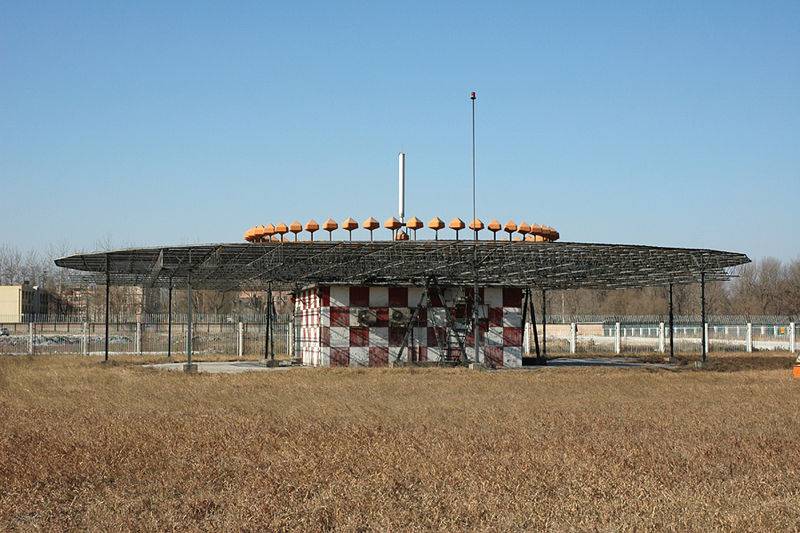
The VOR [very high frequency omnidirectional range] is the international standard for short-range navigation providing the bearing information to the pilot from a reference point. It helps pilots determine their relative direction to or from the station, and would become a secondary means of aiding pilot once the ATM/CNS is in place.

The VOR station was damaged during tropical storm “Ondoy” in September last year and was kept operating through a power supply borrowed from Subic international Airport.

But CAAP personnel are asking why the Agency is giving priority to the purchase of a new navigational aids when refurbishment will do.

Andy Basallote, Chief of Air Navigation Service (ANS), says there are two ways to replace a navigational aid: restoration, which means replacing or renewing an existing one; or replacement, which meant buying an entirely new VOR.

A new VOR would cost from P80 million to P120 million based on UK's Marconi and France' Thales price tag, but Thales Australia has offered P50 million to lease its VOR for 5 years.

CAAP Director-General Ramon Gutierrez said that since their office doesn't have the money to fund the procurement, they would instead borrow P80-million from MIAA to fund the purchase of the new aviation equipment considering the price difference to the brand new unit.

He said since the CAAP has diminutive resources and cannot be able to procure such device, the Manila International Airport Authority (MIAA) will make the financial arrangement while the aviation agency takes care of the services. From its original P120-million funds they requested, the budget was slashed to P80-million by President Benigno Aquino III.

Both MIAA and CAAP are shopping for a new VOR to replace its aging equipment that has been giving airline operators headaches because its power supply frequently bogs down, due to incompatibility problems forcing them to fly to alternate airports in Clark particularly during bad weather.

Basallote said if restoration is resorted to, the cost to the government would be about P45 million to P50 million as offered by Thales, since the “old” Distance Measuring Equipment, a separate but integral part of the DVOR, and the “counterpoise” or the steel bracing supporting the whole structure would be retained. But adding P30 million will give you a brand new equipment. So the choice isn't that difficult.

“Malaki ang matitipid, sa open bidding, but, we are inclined to buy a new one because its life span is approximately 10 to 12 years.”

However, the P80-million is P2-million short of the VOR’s original price in the foreign market. Gutierrez disclosed that he was considering a Korean company that was offering a VOR that is worth P80-million.

“But we could not grab it until we know that it is the same brand that we are currently using,” Gutierrez said.

Currently they are evaluating the offer of a Korean company to install a new navigational aid at concessional rate of 1/10 of 1-percent interest per annum for five years, and a warranty of 10 to 12 years.

Gutierrez says he favors using the same brand of VOR made by Thales now in use at the NAIA because training would not be that expensive anymore considering their previous experience with the equipment. Training in Australia is part of the contract and is included in the cost of the equipment assuming they would win.

Sumitomo wins $100 Million Radar Deal

December 28, 2010

Tokyo - Japan’s Sumitomo Corporation has won phase one of the ¥9-billion ($220 million) contract to upgrade air traffic control systems for the Philippines along with the construction of the Air Traffic Control Center at the NAIA Complex.

Sumitomo Corporation has formed a consortium with Thales Australia Ltd. , the Australian subsidiary of leading French electric company Thales SA, to deliver $100 millions worth of next-generation air traffic control systems for the Philippines' Department of Transportation and Communication (DOTC)'s Communications, Navigation, Surveillance/Air Traffic Management System (CNS/ATM) project.

The company won from among three other bidders that were invited by DOTC for the supply/installation of new communications/navigation and air traffic management systems .

The invited bidders were Kanematsu Corp. and Selex Sistemi Integrati of Italy; Marubeni Corp. and Indra Sistemas, a Japanese-Spanish joint venture; Sojitz Corp. and Raytheon, also of Japan; and Sumitomo Corp. and Thales Systems, another Japanese joint venture, this time with a French group.

The introduction of the next-generation air traffic control systems has been divided into two packages and to be implemented in a phased manner.

Package one costs $100 million that covers for the supply and installation of air traffic management automation system and ATM automation center; communications; navigation signal monitoring system and meteorological system.

Components in Package 1 are Construction of a new air traffic control center building within the Ninoy Aquino International Airport in the Philippines, and delivery of air traffic control systems (including systems for communications, aeronautical information processing, satellite signal monitoring, and weather) at the new air traffic control center and major airports in the Philippines (about 25 sites).

The project is set for completion within 30 months, or by May 2013. Sumitomo Corporation said it will aim to also win the contract for Package 2.

The second part that will cost $120 million is for the supply and installation of automatic dependant surveillance-broadcast (ADS-B) ground station; en-route radar mode; terminal radar; VHF terminal and remote control air-ground communication facility; microwave link and very small aperture terminal or VSAT.

Components in Package 2 includes Installation of radars at major airports in the Philippines (about 10 sites), and delivery of communications equipment to connect the air traffic control center introduced in Package 1 with major local airports.

The International Civil Aviation Organization (ICAO) has recommended a shift from traditional air traffic control systems, dependant on voice and radars, to a new system mainly based on digital data that uses geolocation satellites including GPS satellites.

In the meantime, the Philippines has been faced with the issue of aging air traffic control systems despite being in an extremely important position connecting Japan, China and South Korea with the ASEAN nations.

In the late 1990s, the Philippine Government decided to introduce a next-generation air traffic control system. The Japanese Government also considered this an ODA issue.

In 2002, the Japan International Cooperation Agency (JICA) concluded a contract to provide yen loans amounting to approximately 22.0 billion yen to the DOTC.

The completion of a safe and advanced air traffic control system with the support of the Japanese Government, preparing for the forecast increase in demand for air travel, will have great significance in terms of safety and efficiency not only for the Philippines, but also for nations around the world, including Japan.

Thales is the world's number one distributor of air traffic control systems. In fact, about half the airplanes flying worldwide are controlled by Thales' air traffic control system. With this project, Sumitomo Corporation will actively enter the field of air traffic control systems development, partnering Thales and contributing to airline safety and efficiency across Asia.