Showing posts with label Cebu International. Show all posts

Firefly, Vietnam Flies Mactan


3 December 2025

Vietnam Airlines begins flight to Mactan Cebu International Airport’ from Hanoi with Flight VN643 arriving Mactan early dawn today, December 3, to a water cannon salute, marking the first ever direct connection between Cebu and Vietnam’s capital city. The route will be flown by A321 aircraft thrice a week every Tuesday, Thursday, and Sunday every 22:50 from Hanoi arriving Mactan at 03:30am. Return Flight VN 642 is scheduled every Monday, Wednesday and Friday, flying out of Cebu at 4:45 p.m. and landing in Hanoi at 7:35 p.m.

Meanwhile, Malaysia-based Firefly Airlines, the low-cost subsidiary of Malaysia Airlines, has began direct flights between Cebu and Kuala Lumpur yesterday, connecting Visayas to Malaysia. Firefly will operate five weekly flights. The route will be flown by B738 aircraft.


Mactan Named Best Airport In Its Category

12 September 2025


Mactan-Cebu International Airport (MCIA) was named Best Airport in Asia-Pacific for the 5–15 Million Passengers Per Annum Category for 2024 at the Airports Council International (ACI) World Airport Service Quality (ASQ) Awards held in Guangzhou, China, on Sept. 8–11, 2025.

MCIA general manager and chief executive officer Julius Neri Jr. and Aboitiz InfraCapital Cebu Airport Corp. (Acac) head of Reputation and Customer Experience Ricia Montejo accepted the award on behalf of the airport. 

Neri credited the achievement to the collaboration of MCIA frontliners, concessionaires, airline partners and stakeholders.

MCIA handled 11.3 million passengers in 2024, a 13 percent increase from the previous year. It was also ranked the 7th Most Improved Airport at the 2025 Skytrax Awards.

Aboitiz InfraCapital (AIC), also operates Laguindingan and Bohol-Panglao airports.

United Flies Cebu

Connects LAX

28 October 2024

US Flag carrier United Airlines (UA) flew its inaugural flight from Narita to Cebu and vice versa yesterday, paving the way for transcontinental flight to Los Angeles in the United States.

The airline will use Boeing 737-800 aircraft for the route between the Philippines and Japan and will be flown daily according to Walter Barry Dias, United Airlines Regional Director for Asia Pacific. Connecting flight to Los Angeles will be flown by Boeing 787-900.

Dias said Narita-Cebu Route is the First Fifth Freedom Route out of Narita Airport  after 7 years when it ceased hub operations out of Narita in 2017 and transferred operations at Tokyo-Haneda airport.

UA33 leaves Los Angeles at 11:00am arriving Narita at 3:45. Connection leaves Narita at 5:30pm arriving Mactan at 10:05pm. Return flight UA32 leaves Mactan the following morning at 9:30am arriving Narita at 3:15pm. Connecting flight from Narita departs at 5:45pm arriving Los Angeles at 11:40am.

United said its inaugural departure flight from Cebu carried 166 passengers, for Cebu-Narita and Los Angeles.

MCIA Launches Seamless Transfer Between Domestic and International Flights


24 June 2024

Mactan-Cebu International Airport is reducing the transfer time for passengers with international and domestic connecting flights, according to its airport operator which recently launch its new transfer service—Cebu Connect.

According to Athanasios Titonis, MCIA’s Chief Executive Officer, the faster system for domestic to domestic transfers started Wednesday last week while the domestic to international transfers will be implemented in the coming months.

“This is a testament to our ongoing efforts to improve airport services and enhance passenger satisfaction,” Titonis said. 

“This is part of MCIA’s commitment to meeting global standards in airport operations.” Titonis adds. 

 According to terminal operator Aboitiz InfraCapital GMCAC (AGMCAC),  Passengers with connecting flights will no longer need to pick-up their baggage from the baggage claim but instead head to a designated gate where necessary security clearances will be done, allowing them to seamlessly proceed to their next flight.

“This initiative will reduce transfer times significantly – from 90 minutes to 60 minutes for international connections, and from 60 minutes to 35 minutes for domestic ones – making travel more seamless and enjoyable for our fellow Filipinos and tourists,” said Cosette Canilao, president and Chief executive officer of Aboitiz InfraCapital, at the Cebu Connect launching on Wednesday, June, 19, 2024.

This new initiative is expected to boost tourism in the country by positioning Cebu as an ideal entry point for both domestic and international tourists.

Airline operators lauded AGMCAC’s initiative.

AirAsia chief executive officer Ricky Isla said the new service is “a win not only for the Philippines, but also for Asean.”

“We commend AGMCAC’s initiative for simplifying airport transfers. This delivers a great boost for millions of guests gaining access to a wider network of destinations while making travel to numerous connecting destinations more seamless and convenient. Integrating Cebu Connect into AirAsia Philippines’ offerings will elevate the quality of our services,” Isla said.

Apart from accessible transfers between AirAsia Philippines flights and those of partner airlines, Isla noted that with Cebu Connect, millions of guests will now have access to a wider network of destinations.

“Given the opportunity, we would like to offer new destinations such as Bangkok, Vietnam, Phnom Penh, and additional cities in North Asia. These potential routes will provide more travel options and strengthen Cebu’s position as a key international transfer hub in the region”, he added.

“Clearly, the benefit of this is that this will give passengers the amount of choice that they will have and how seamless it will be for them to connect. This is a great initiative by the airport… We are looking forward to building more connectivity and connections with MCIA,” said Cebu Pacific president Xander Lao.

“About 92 percent of the traffic we carry in Cebu is actually connecting passengers and with this Cebu Connect we expect to be able to increase that further,” said Rabbi Ang, president of PAL Express.

About 10 airlines are operating at MCIA, of which five are local airlines and 15 are foreign airlines. MCIA is connected to 40 destinations as of April.


Mactan to go VFR after ILS destroyed

 24 October 2022

Mactan Cebu International Airport (CEB) announced Monday morning that Instrument Flight Rules (IFR) at the airport's runway 22 is temporarily suspended after Korean Air Airbus A330 destroyed the Instrument Landing System (ILS) localizer at runway. Airport owner Mactan Cebu International Airport Authority (MCIAA) said that it secured permission from the Civil Aviation Authority (CAAP) to resume visual flight rules at the airport around 4:00pm-6:00pm to allow departures of stranded aircraft, and arrival of light passenger planes at the opposite side of the runway. Among the stranded aircraft are Turkish Airlines A350-900 bound for Istanbul via Manila, and Jeju Air bound to Seoul which were allowed to leave. According to latest Notice to Airman (NOTAM) the airport's runway is still closed to civil aviation traffic due to aircraft obstruction at the end of the runway. MCIAA said they will be moving the aircraft later tonight and tomorrow after the Aircraft Accident Inquiry and Investigation Board (AIIB) finishes its investigation to the mishap. CAAP spokesperson Eric Apolonio said Mactan should be open to traffic as early as tomorrow evening at 6:00pm at its latest NOTAM advisory, after the Korean plane is removed from its current location and transferred to at least 50 meters off the runway center-line.


Korean Air Overshoots Mactan Runway

 24 October 2022

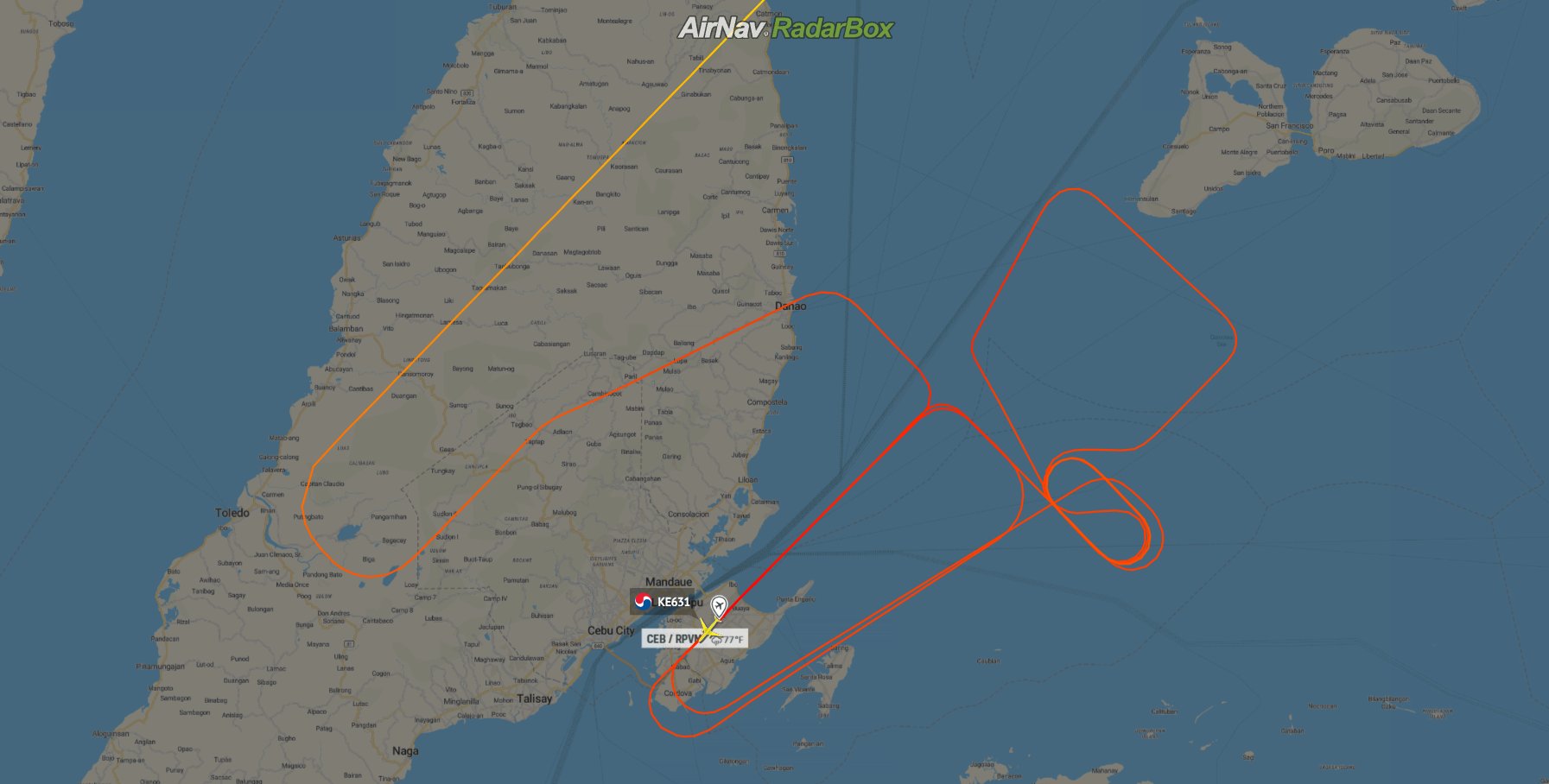
A Korean Air Airbus A330-200 skidded on landing at Mactan International Airport Sunday evening around 11:11pm due to very bad weather. Flight #KE631 (HL7525) from Seoul with 162 passengers and 11 crew, aborted two previous landing attempts due to heavy downpours and poor visibility. No one is reported hurt in the excursion. Aircraft is beyond repair and expected to be written off. Details to follow.


GMR Sells CEB Airport for US$440 Million

GMR Airports Officials, GMR Megawide Cebu Airport Corporation, Aboitiz InfraCapital, Megawide and the Aboitiz Group during the signing ceremony held on Sept. 2.

5 September 2022

GMR Airports International BV (GAIBV) and Megawide Construction Corp (Megawide) has agreed to sell all rights on the 25 years concession agreement awarded to GMR-Megawide Cebu Airport Corp (GMCAC), the developer and operator of the Mactan Cebu International Airport (MCIA) in a deal valued at close to US$440 million to  Cebu-based company Aboitiz InfraCapital Inc. (Aboitiz), the company announced on Friday.

Megawide and GAIBV "agreed to sell down their existing stakes in GMAC to accommodate the entry of Aboitiz InfraCapital" in a Share Subscription and Transfer Agreement, Megawide told the Philippine Stock Exchange (PSE), in transparency disclosure.

The initial deal involves GMCAC's issuance of primary shares and the transfer of secondary shares from Megawide and GAIBV to Aboitiz InfraCapital amounting to P9.5 billion, from date of exchange, resulting in Aboitiz InfraCapital owning 33 and 1/3 percent minus 1 share stake in GMCAC, the disclosure said.

Subsequently, Megawide and GAIBV will issue another note with an aggregate value of P15.5 Billion, maturing on 30 October 2024, representing the remaining 66 and 2/3% plus 1 share of GMCAC's outstanding capital stock, making the company a complete subsidiary of Aboitiz.


Mactan Opens New Taxiway

7 May 2021

New taxiway at the Mactan Cebu International Airport inaugurated on Wednesday, May 5, 2021.


Mactan Cebu Airport Posts 1.1B Pesos Revenue


 15 April 2021

By Carlo Lorenciana

The Mactan-Cebu International Airport (MCIA) posted a revenue of PHP1.11 billion last year as passenger traffic plunged amid the coronavirus disease 2019 (Covid-19) pandemic. 

This was disclosed on Thursday by Megawide Construction Corp., one of the firms managing the country’s second busiest air hub, saying MCIA’s revenue made up 9 percent of the company’s total earnings for 2020. 
 
Megawide said MCIA’s total passenger count reached 2.7 million last year, with the domestic and international segments struggling at 1.9 million and 789,328 passengers, respectively. 
 
Total air traffic was likewise confined to 26,544 movements, split into 20,514 domestic and 6,030 international flights.
 
Meanwhile, the share of commercial revenues to total grew to 44 percent as of end 2020, mostly conducted through cashless purchases and non-contact interaction to prevent virus transmission from less than 30 percent five years ago. 
 
The level inched closer to the targeted 50-percent benchmark noted in major international gateways, Megawide said.
 
Since the reinstatement of local travel in June, 85 new domestic flights were recommissioned by partner airlines to service MCIA’s predominantly domestic routes. 
 
Average passenger throughput also improved to around 2,000 daily in December from 1,100 daily during the resumption of flights.
 
In a statement, Megawide chairman Edgar Saavedra said while travel and tourism in general have yet to show signs of recovery on the back of worldwide vaccine rollout, GMR-Megawide Cebu Airport Corp., the consortium operating the airport, remains optimistic about the country’s own vaccination drive to serve as catalysts for revenge travel, both from the domestic and international fronts.
 
Overall, Megawide described 2020 as a year of recalibration, particularly in the growth opportunities to pursue and the strategic objectives to prioritize.
 
Saavedra said the firm remains focused and committed to its vision of engineering a “First-World Philippines” regardless of the business condition. 
 
“For instance, we completed the Clark International Airport Terminal 2 and successfully hurdled the Swiss challenge for the Carbon Modernization Project in November despite the challenges posed by the pandemic. We believe that our determination and agility ensure that the company's operating businesses continue to grow to create a positive impact on people’s lives and livelihoods, and ultimately, the entire economic ecosystem,” he added. 
 
The infrastructure giant is redeveloping the Carbon Market, the biggest wet market here, in a joint venture agreement with the city government of Cebu. (PNA)

Cebu Airport Found To Be Owned By GMR

 Megawide Acted As Dummy!

17 December 2020

Mactan Cebu Airport Operator GMR Megawide Cebu Airport Corporation (GMCAC) was found by the government of the Philippines to have broken its Constitution and Laws, according to the Justice Department, as the Office of the Ombudsman suspends Mactan  Cebu International Airport Authority (MCIAA) General Manager Steve Dicdican for allowing Foreigners to run Mactan Airport.

The National Bureau of Investigation (NBI) earlier filed before the Department of Justice a case against Mactan  Cebu International Airport Authority (MCIAA) General Manager Steve Dicdican and 15 others, including 11 foreign nationals, for Anti-Dummy Law provisions, risking the cancellation of the consortium license and permit to run Mactan Airport and forfeiture of its security deposits.

GMCAC is a consortium between Megawide Construction Corporation (Megawide), a company incorporated under Philippine laws, and GMR Group, a foreign airport operator based in India.

The  NBI-Anti-Fraud Division (NBI-AFD) claimed that the respondents “connived, colluded, schemed and acted together to violate the 1987 Constitution and the Anti-Dummy Law.”

NBI-AFD Officer-in-Charge (OIC) Director Eric B. Distor said this is not about the Concession Agreement Dicdican claims but concerns about violation of "Anti-Dummy Law".

Distor said MCIAA Officials allowed foreign contractors to take over the management of the airport which they are expressly prohibited to do under Philippine Laws. 

NBI said airports are industry invested with national interest that no foreigners should run it other than Filipinos. That is not the case of Cebu Airport operator. 

Under the Concession Agreement signed by Megawide and MCIAA, the airport operator should not be violating the Constitution or any Philippine Laws, otherwise they lose the right to operate the airport and pay government damages for fraud and misrepresentation.

Aside from Dicdican, named respondents in the complaint were GMR Megawide Cebu Airport Corporation (GMCAC) Filipino officers Manuel Louie Ferrer, Edgar Saavedra, Oliver Tan and JZ Dela Cruz.

The foreign nationals named in the complaint were eight Indian nationals Srivinas Bommidala, Vivek Singhai, Ravi Bhatnagar, Ravishankar Saravu, Sudarshan MD, Kumar Gaurav, Magesh Nambiar and Rajesh Madan.

The other foreigners mentioned in the complaint were Singaporean national P. Sripathy, Ghanaian Andrew Acquaah-Harrison and Irish national Michael Lenane.

Based on the evidence obtained by the Office of the Ombudsman, the MCIA is operated, administered, and managed by non-Filipinos more particularly by an Irish, a Ghanaian and several Indians who have profound control, enjoyment, and control over a Philippine public utility, with the knowledge and approval of the Filipino officers of CMIAA and GMCAC.

“Evidence submitted by the complainant and gathered by the investigators showed that the foreign nationals were actually performing executive and managerial positions, contrary to the provisions of Article XII of the Constitution,” the NBI said.

CEB Opens 1st Airport Covid19 Laboratory in PH

The Reason Most Flight Diversions Went To Cebu
12 July 2020


Mactan-Cebu International Airport becomes the first airport in the country equipped with COVID-19 laboratory as it opened 400-sqm. of space capable of processing 1,500 to 3,000 RT-PCR tests a day.

Manila International Airport and Clark International Airport still relies on off-facility laboratory to do the RT-PCR testing of arriving passengers.

“We immediately embarked on the ambitious project of putting up the fastest built and accredited molecular laboratory with the capability to do mass testing and generate results in the quickest possible time,” MCIAA General Manager and CEO Atty. Steve Dicdican said on Saturday.

According to Mactan-Cebu International Airport Authority (MCIAA), in partnership with the GMR Megawide Cebu Airport Corporation (GMCAC), this exclusive passenger laboratory will have test results as fast as 6 hours after swabbing.

DOTr said a separate molecular laboratory is being set up in Clark and NAIA in compliance with Transport Secretary Arthur Tugade directive for airports to have a molecular laboratory.


CEB Adds Macau From Cebu

27 September 2018


Low cost carrier Cebu Pacific (CEB) will add another international destination from Cebu to Macau starting December 7, 2018. The flight will be flown four times a week on 180-seater Airbus A320 aircraft.

5J364 CEB1850 – 2200MFM 320 x246
5J365 MFM2245 – 0145+1CEB 320 x246

MCIA Commences Runway Overlay Works

5 September 2018

On-going runway overlay works at the the Mactan-Cebu International Airport (MCIA). Cebu airport will be closed from Sept. 1 to 21, from 1:30 a.m. to 6:30 a.m. for overlay and repair works.

Cebu Terminal 2 Opens June 7

1 June 2018

Opens International Flight on July 1

Mactan Cebu International Airport (MCIA) is set to open to the public on June 7 and would start its commercial operations on July 1, as scheduled in their concession agreement.

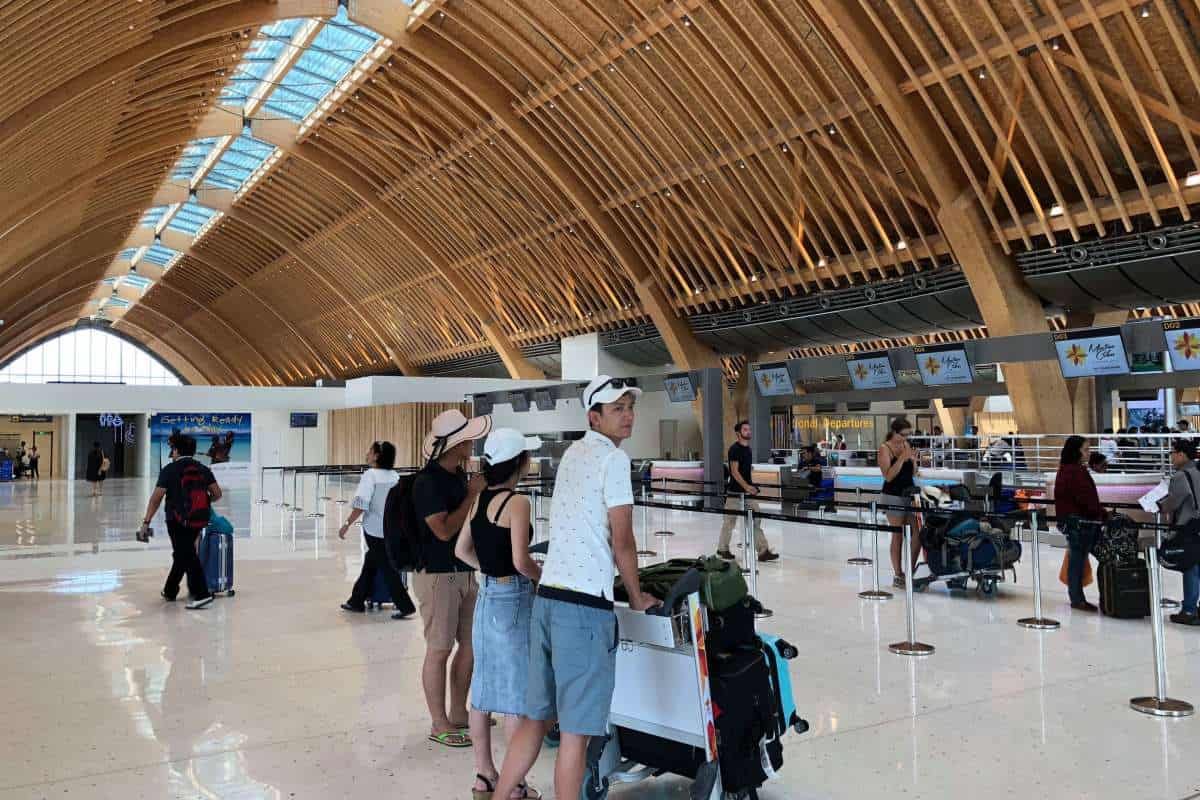
The P17.5-billion Terminal 2 of Mactan Cebu International Airport (MCIA) spans 65,500 square meters and is expected to increase the airport’s passenger capacity to 12.5 million yearly.

The terminal will have an automatic tray return system (ATRS) which would make it easier for passengers to pass through X-ray machines which will automatically return empty trays for passengers to put their bags, ending the hassle to look for one.

Terminal 2 boast seven passenger boarding bridges which can be expanded to 12, 48 check-in counters, which can be expanded to 72, and is expected to increase the airport’s passenger capacity to 12.5 million yearly.

The new Terminal will cater to inbound and outbound international flights. It is equipped with 12 escalators and 15 elevators for seamless access, a car parking facility that can accommodate 550 cars, which can be expanded to 750 cars.

The GMR-Megawide operated Terminal was designed by Hong Kong-based Integrated Design Associates (IDA) together with local designers Budji Layug, Royal Pinda and Kenneth Cobonpue.

Jin Air flight LJ025 from Seoul is expected to be the first user of the airport.

Ceboom!


6 January 2018

Mactan Cebu in Figures

Cebu Airport rises 149% in the past 10 years

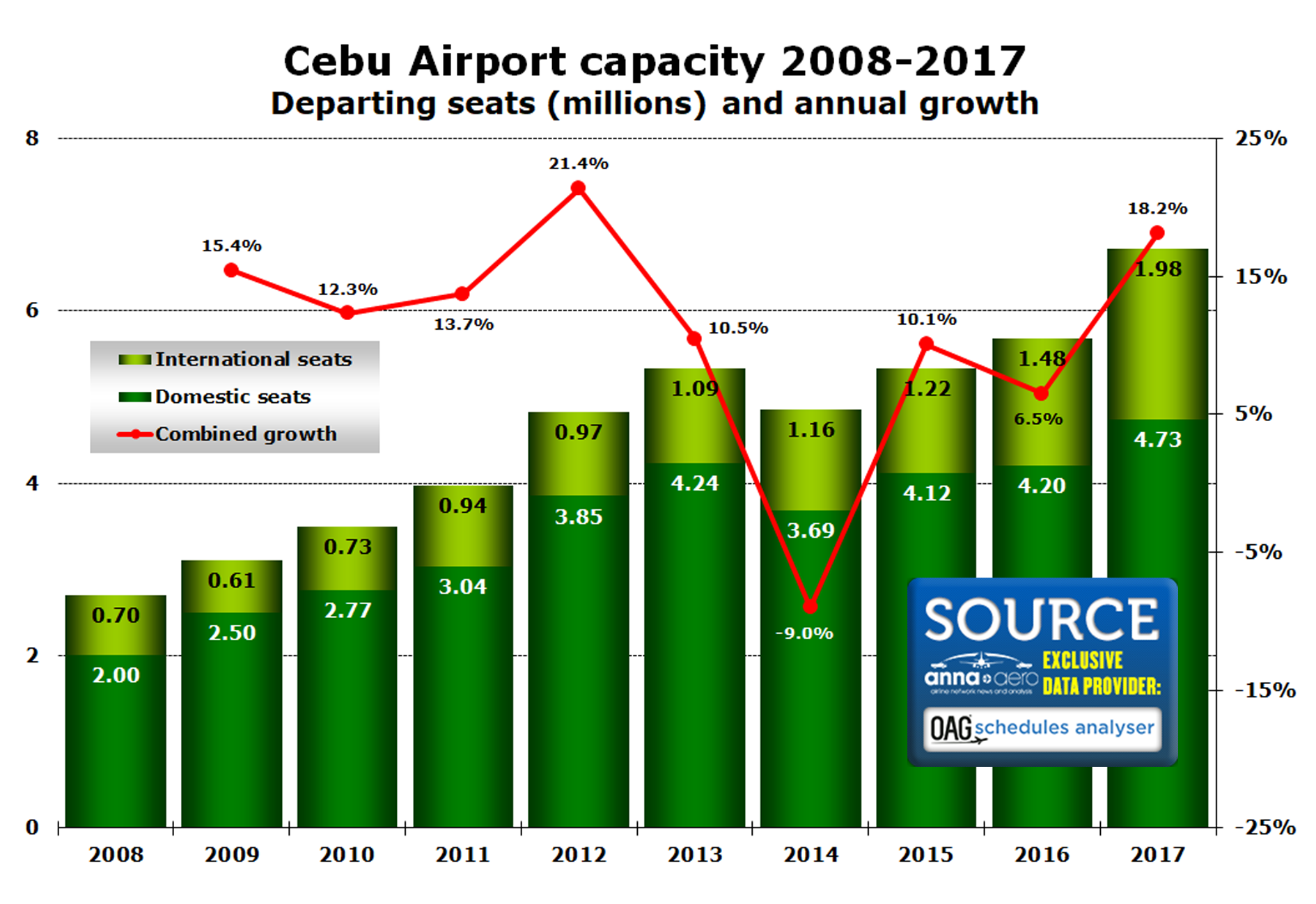
From 2008 to 2017 the number of seats available from Cebu Airport increased by 149%. In 2008, just over 2.69 million departing seats were flown. This had increased to 5.33 million by 2013, with five years of consecutive double-digit growth. Cuts in 2014 have been followed by another three consecutive years of growth, with capacity increasing by more than a third between 2014 and 2017. It should also be noted that the average capacity per departing flight from Cebu increased from 144 to 153 seats from 2008 to 2017. This included an increase in average capacity from 134 to 140 seats on domestic services, and from 188 to 197 seats on international flights.

Domestic and international services have both seen increases in capacity from Cebu over the past 10 years. Domestic routes have historically dominated the schedules. In 2008, flights to domestic destinations accounted for 74% of all departing seats. This increased to a peak of 80% as recently as 2013, but in the past few years international capacity has seen stronger growth, and in 2017 international flights represented 30% of departing seats. International capacity grew from 0.70 to 1.98 million seats from 2008 to 2017, an increase of 185%, while domestic seat numbers rose from two million to 4.73 million, an increase of 137%.


Cebgo Grows 200%

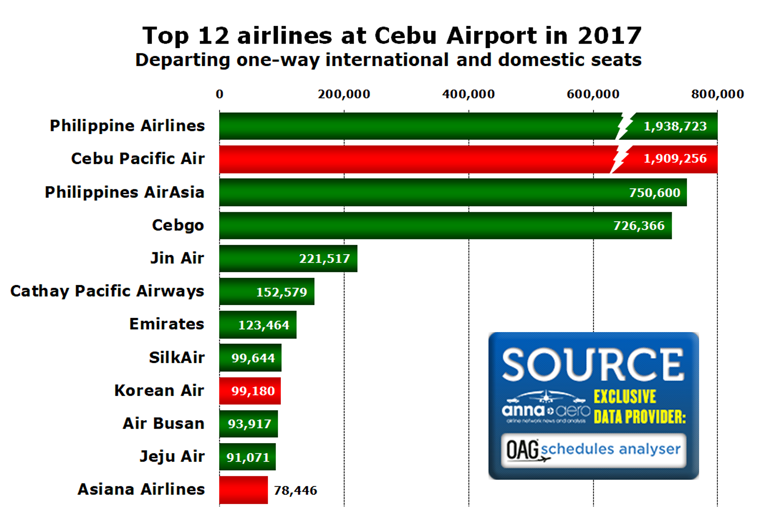
Philippine Airlines is the largest carrier at the airport, accounting for 29% of all departing seats. More than two-thirds of this capacity was operated on domestic services. Cebu Pacific Air was the next largest operator. 

Cebu Pacific and Cebgo have been included as separate carriers, since Cebgo maintains a separate IATA code under which it provides published capacity, despite operating under the Cebu Pacific brand. CH Aviation shows that Cebgo was re-branded from Tigerair Philippines in 2015. If Cebgo’s capacity is considered alongside that of its parent carrier Cebu Pacific, the combined operation would have provided 2.64 million seats from Cebu in 2017, eclipsing Philippine Airlines and accounting for 39% of all departing seats from the airport.

Cebgo experienced the largest increase in departing capacity at Cebu among the top 12 carriers from 2016 to 2017, while parent Cebu Pacific saw the biggest decline. Cebgo’s seats increased by 200% while Cebu Pacific’s dropped off by 15%. This was mainly due to domestic services being transferred from Cebu Pacific to its regional arm. Examples of routes where capacity was transferred from Cebu Pacific to Cebgo include the links from Cebu to Bacolod, Butuan, Cagayan de Oro, Iloilo and Ozamis. If Cebu Pacific’s and Cebgo’s capacity is merged, the combined operation saw a 6.3% increase in seats from 2016 to 2017, with all of the growth coming on domestic services. 

Other top 12 carriers that experienced strong rises in capacity at Cebu from 2016 to 2017 included Jin Air, Philippines AirAsia, Emirates and Jeju Air with respective capacity increases of 99%, 46%, 35% and 32%. Three carriers (highlighted in red) saw reductions in published capacity from Cebu.

Manila Tops Domestic Route

Manila is by far the most popular destination from Cebu, accounting for 44% of the domestic seats available from the airport in 2017 and 31% of all departing seats. OAG data shows that the Cebu–Manila airport pair will be operated by Cebu Pacific, Philippines AirAsia and Philippine Airlines during the week commencing 2 January 2018, with 186 combined flights scheduled between them.

Despite this, capacity on services to Manila actually declined by 6.8% from 2016 to 2017. The top 12 domestic destinations with the most growth from Cebu during this period include Caticlan, Clark, Puerto Princesa and Kalibo, which saw 257%, 93%, 66% and 53% capacity increases respectively. Five of the top-ranked domestic links experienced a decline in capacity from 2016 to 2017 (highlighted in red) with Cagayan de Oro seeing the biggest reduction, with an 18% fall in seat numbers.

South Korea Tops International Route

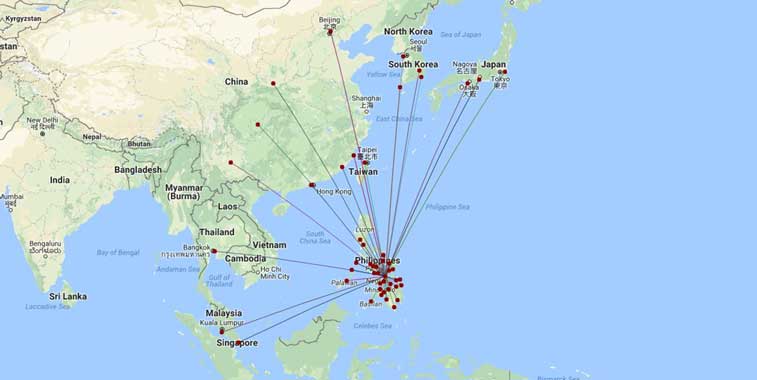
Cebu Airport’s route map from 2 January 2018

South Korea was the most popular international country market from Cebu in 2017, representing 44% of all departing international seats. In all, nine international markets were served from the airport over the course of the year, eight of which are located in the Asia-Pacific region.

Of these, China saw the strongest growth in capacity from 2016 to 2017. New Routes Database indicates that airlines launched nine new services between Cebu and China during 2017, including Philippine Airlines’ links to Chengdu and Beijing, plus Sichaun Airlines stating flights from Chongqing. The top 12 international routes in 2017 all served destinations in the Asia-Pacific region, including three in South Korea, three in Japan and two in China. Chongqing was the only new route to enter the top-ranked international destinations from Cebu in 2017.

Of the existing top 12 services, Daegu experienced the strongest growth last year, since 2017 was its first full year of operation with t’way air. None of the biggest international routes from Cebu experienced significant capacity cuts during 2017, with Osaka Kansai (highlighted in red) witnessing a negligible 0.4% reduction.

The longest sector served from the airport in 2017 was Philippine Airlines’ direct service to Los Angeles, but this was discontinued in May. Dubai is now the longest route flown by Emirates Airlines notwithstanding its triangular service to Clark.


DOTr Unveils Major Airports Projects

Set For Completion Before 2022

27 April 2017
Major Airport Projects


Airport Operations, Management, and Development 
Under Public Private Partnership Scheme
  • 40b - Davao International Airport
      • Construction of parallel taxiway
      • PTB expansion (65,000 to 125,000 sq.m )
      • CTB expansion (13,000 to 27,000 sq.m)
      • VPA expansion
      • Apron expansion
  • 30b - Iloilo International Airport
      • PTB expansion
  • ₱20b - Bacolod International Airport
      • PTB expansion
  • ₱15b - Laguindingan Airport
      • PTB expansion
  • ₱02b - Bohol International Airport


Other DOTC Airport Projects
  • ₱3b - Tacloban Airport
  • ₱2b - General Santos International Airport
  • ₱1b - Dipolog Airport
  • ₱1b - Sangley Airport 
  • 1b - Naga Airport 


The Race To Fill Cebu Hub

26 January 2017

Prime slot allocation at Mactan Cebu International Airport is fast disappearing after Low Cost Carrier Cebu Pacific and PAL Express flooded the airport with new slot request for new flights from the country's second busiest gateway.

The Civil Aeronautics Board (CAB) has noted that the two carriers are scrambling for slots to fly domestic points by fielding smaller planes in exchange for more frequency out of Cebu airport. Slots intended for international operations are not affected at this time.

Cebu Pacific (CEB) has ordered a fleet of 16 new ATR 72-600s, with 78 seats with options for 10 additional aircraft which will be operated by Cebgo, its wholly owned subsidiary while Philippine Airlines (PAL) has ordered a fleet of 5  new Bombardier DH8-400 aircraft with 86 seats and options for 7 additional aircraft which will be operated by PAL Express. It also operates four Q300 planes.

CAB said that a substantial majority of this turboprop orders will be stationed in Cebu for rotations to Visayas and Mindanao while some are heading for destinations in Luzon other than Ninoy Aquino International Airport in Manila. 

The airline regulator cited as an example Cebu Pacific which flies A320 aircraft twice daily to Cagayan de Oro and now intends to operate four times daily on a smaller ATR aircraft. PAL also intends to double frequency to major Visayas and Mindanao hubs with smaller Q400NG planes which is now serviced by existing A320 aircraft.

Cebu Pacific is quick to respond saying the equipment downgrade was due to the exit of its A319 planes out of its fleet and has nothing to do about slot advantages in Mactan. PAL Express on the other hand argued that it is funneling passengers to Mactan so that it can connect passengers to Manila which they are unable to do at  other major airports due to slot concerns at NAIA.

CAB however maintains the position that should CEB and PAL eventually upgrades the aircraft, it will already have rights of first refusal on the unused slots and would most likely keep them away from the competition unless surrendered by the airline which is not going to happen considering its economic value in a congested airport, perhaps taking a cue on their experiences in Manila.

Small airline operators has already opposed such moves by two major airlines as anti-competitive behavior and vows to challenge them holding majority of MCIA slots that would be detrimental to their growth.

Airlines are known to fly non-revenue flights just to keep the slots allotted to them at the fully-booked airport like NAIA.

Mactan Grows 4 International Points in March

18 February 2016


Mactan-Cebu International Airport (MCIA will add four (4) more international destinations in March. Philippine Airlines will start the first long haul flight of the airport from Cebu to Los Angeles and Los Angeles-Cebu flights on March 15 thrice weekly, using an Airbus 340-300, while EVA Air commences daily A321 service between Taipei-Cebu and Cebu-Taipei beginning March 27. Meanwhile, Xiamen Air will start flight services beginning March 28 thrice a week with a Boeing 737-800 between Cebu-Xiamen and Xiamen-Cebu, while Emirates airlines will add Cebu to its network beginning March 30 with flights to Dubai via Clark.

ROKAF at Mactan

11 February 2016

The Republic of Korea Air Force's "Black Eagles" aerobatic team made technical stop on February 8 at Mactan Air Base en route to Singapore for demonstration flights of its T-50 trainer jets. A squadron of similar but more powerful variant was ordered by the Philippine Air Force. 
Image courtesy MCIA