PAL Re-Opens Kangaroo Route


Flight Begins October 2

19 August 2015

Flag carrier Philippine Airlines (PAL) is re-opening the Kangaroo route to London after being suspended for 18 long years, this time offering the best fare and layover time.

The route made famous by Qantas traditionally refers to air routes flown between Australia and the United Kingdom via the Eastern Hemisphere on multiple stop-overs. Nowadays, it is flown westward with one stop-overs.

The airline will now join other airlines as they connect the Kangaroo route, with prices beginning at US$1,100 from London via PR721 to Sydney arriving Manila at 20:05 p.m. with connecting flights PR211 departing 21:15 p.m. with layover time of one hour and ten minutes. The return flight PR214 will leave Sydney at 6:10 a.m arriving Manila at 11:25 a.m, with connecting flight PR720 departing London at 12:45 p.m., also with a short lay over time of 1 hour and 20 minutes.

Connections are available initially every Monday and Thursday. PAL said they intend to double the connections by next year as they are set to receive two new B777-300ER to join their long haul fleet.

Aside from Qantas, and British Airways, PAL was the first airline in Asia to fly the route in July 1952.

In 2015, 20 airlines operated a one-stop service between London and Australia, including: British Airways, Cathay Pacific, Emirates, Etihad, Garuda Indonesia, Korean Air, Malaysia Airlines, Qantas, Thai Airways, and Singapore Airlines.


17 August 2015
10 choppers (8 Bell 412EP's and 2 AW 109E's) officially joins Philippine Air Force (PAF) fleet. PAF

CEB Conquers SYD Seats

But QFA has Better Loads

12 August 2015


Low Cost Carrier Cebu Pacific (CEB) has emerged the largest operating carrier on the Manila – Sydney route by seat capacity according to the latest report published by Australia’s Bureau of Infrastructure, Transport, and Regional Economics (BITRE).

For the May 2015 figures alone, CEB has a seating capacity of 9,592 passengers, as against PAL with 8,464 which is also operating on the same route, according to BITRE. Qantas has 5,346 offered seats.

Meanwhile, Qantas bagged the most number of passengers per offered seats when they carried 4,160 passengers out of the 5,346 seats (77% load factor) while Cebu Pacific carried 5,664 passengers to Sydney and 5,354 to Manila out of the 9,592 seats (59% load factor) for the same month.

NAIA Adopts Full-Body Scanners


11 August 2015


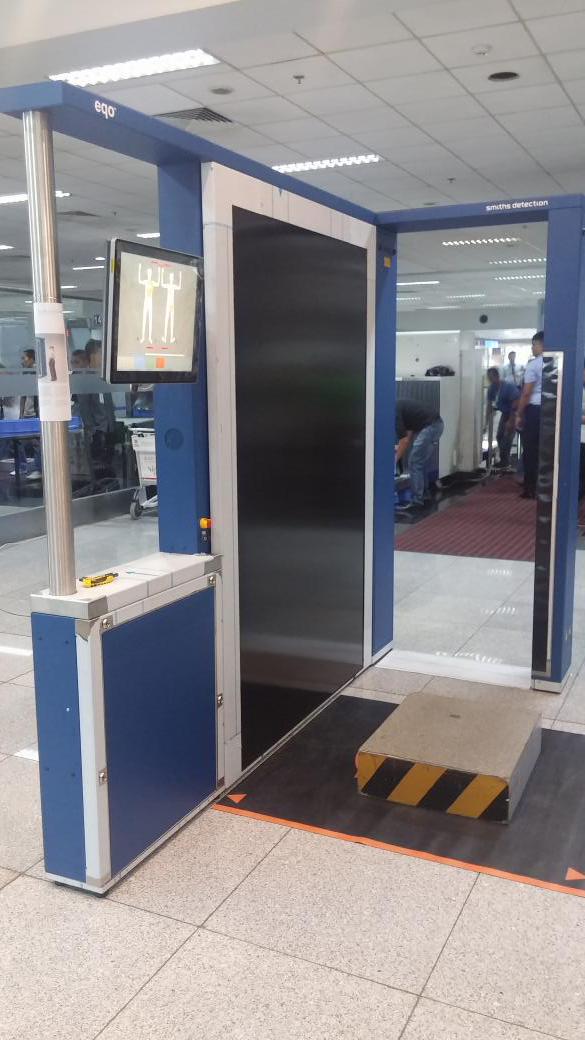
Brand new full body scanners that can detect concealed objects on a person’s body have been installed at all terminals of Ninoy Aquino International Airport for enhanced passenger safety and security.

The new EQO portals employs millimeter wave scanners which makes use of an advanced millimeter-wave technology and low-frequency radiation, making the scanner safe even for pregnant women and those with body implants can detect small ceramics, liquids, metals, narcotics and explosives.

It is manufactured by Smiths Detection and installed by its local distributor Defense and Protection System Philippines Inc. (DPSPI).

During a demonstration tour yesterday, NAIA Terminal 3 Manager Engr. Octavio “Bing” Lina said the new security equipment was procured by Manila International Airport Authority November last year for a price tag of P149,554,720, makes use of low-frequency radiation, making the scanner safe even for pregnant women and those with body implants.

Installation and testing was completed this month. Lina explained that a passenger going through the body scanner will simply have to turn 360 degrees inside the open booth, after which scan results will be shown immediately on the operator’s screen, indicating the location of concealed items.

“Without having to be frisked, passengers will be requested to remove items in question. Privacy is also ensured as the system has a mode that will present only the outline of the body,” says Lina.

The said scanners are now in use at the final security screening checkpoints (FSCP) of each NAIA terminal. There are three units at Terminal 1, five units at Terminal 2, another five units at Terminal 3 and one unit at Terminal 4.

The 14 EQO model portals (full body scanners) will serve as an extra security enhancement augmenting the 26 walk through metal detectors also at the Final Security Check Points of NAIA terminals.


Philippines Approves MC99 Rules Application In The Country

By Marvin Sy

11 August 2015

The Senate has given its concurrence to two treaties on aviation, including one that would provide passengers with greater protection and fairer compensation whenever accidents occur during their flights.

With the concurrence given by the Senate yesterday, the 1999 Montreal Resolution for the Unification of Certain Rules for International Carriage by Air (MC99) and the Protocol Relating to an Amendment to the Convention on International Civil Aviation would now take effect in the country.

MC99 establishes new rules on the liability of airline carriers in cases of accidental death or injury to passengers and the destruction, loss, damage or delay in the carriage of baggage or cargo.


Based on the report submitted by the Senate committee on foreign relations headed by Sen. Miriam Defensor-Santiago, MC99 would provide a new liability system that is expected to minimize costly litigation.

The Convention allows a wider choice of jurisdictions for bringing claims by allowing a damage suit for accidental deaths or injuries to passengers to be brought to the country where the passenger involved resides and where the concerned carrier also operates.

Many of the Philippines’ key trading partners are reportedly already parties to the Convention and when the ASEAN integration finally takes effect, inter-regional flights are expected to increase.

“The Philippines’ ratification of this Convention will prove to be timely and beneficial, resulting in a fairer liability regime that will protect passengers traveling from and to the Philippines,” a committee report read.

The International Air Transport Association (IATA) has been supportive of the universal ratification of MC99, which it says would modernize and unify “all of the different international treaty regimes covering airline liability that have developed haphazardly since 1929.”

Russia Signs ASA with the Philippines

7 August 2015

Approves 21 Weekly Flights

Russia has finally signed the highly classified Air Service Agreement deal with the Philippines granting 21 flights a week between the two countries.

The air services talks were held in Moscow from July 22 to 23.

According to the agreement, Philippine carriers can conduct operations between any point in the country and three destinations in Russia, such as Moscow, St. Petersburg and Vladivostok. 


Russia-based airlines has been offering chartered flights to the Philippines mostly coming from Central Russia, while Philippine Airlines flew to Vladivostok also on charters.

40,000 Russian tourists has visited the country last year according to the Department of Tourism and would welcome more their presence considering that they spend more than any other foreign tourists in the Philippines.

Earlier, PAL secured special permit from the Russian Federation for overflight rights in its famous "Siberian Airspace" that shortens travel time to and from other European countries pending ratification of the agreement. Russia postponed twice the signing of the agreement due to conflicts with some EU countries and Ukraine.

PAL currently flies to London. The special permit does not however cover any other European destination forcing the flag carrier to shelved earlier plans to fly other destinations in the EU such as Frankfurt, and Paris.

The Civil Aeronautics Board (CAB) said the "over-flight" rights that would allow Philippine carriers to take what's known as the trans-Siberian route cut travel time to London and other European cities by at least two hours as compared to routes via India and the Middle East.

Executive Director Carmilo Arcilla of the CAB did not elaborate on the Overflight fees as the other component is confidential and airline-based agreement which is separate from navigational fees mandated by ICAO.
Russia is also not a signatory to the International Air Services Transit Agreement (IASTA).

The agreement, which is an amendment to the 2009 Philippine-Russia Air Services Agreement, was signed by Jose Perpetuo Lotilla, the Philippines’ Transportation and Communication Undersecretary and Sergey Seskutov, Deputy Director, State Policy in Russian Civil Aviation Department


NAIA Opens Runway 13-31 For Take Off and Landing

6 August 2015


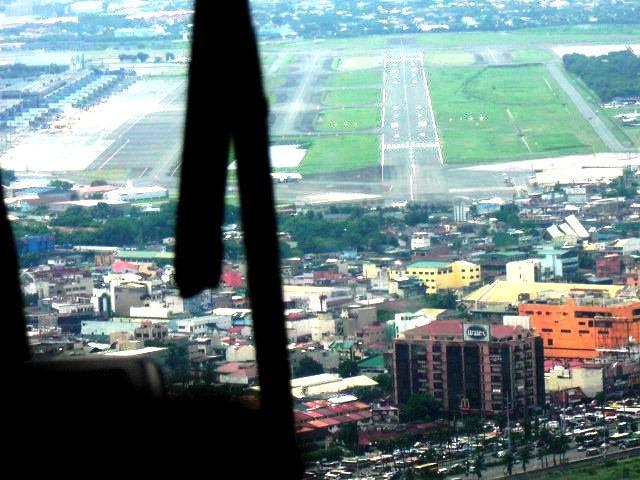
Manila International Airport Authority (MIAA) has opened its secondary 2,367-meter runway 13-31 for take-off and landing, the agency said Thursday.

The opening of the secondary runway for landing is expected to ease aircraft traffic congestion at the 3,737-meter 06/24 main runway, as single aisle jets like Airbus A320 and Boeing B737 type aircraft are now permitted by the Civil Aviation Authority of the Philippines (CAAP) to take off and land at the runway along with smaller aircraft, including business jet and light cargo aircraft.

Runway 13-31 used to be closed for landing, except for light planes and early morning arrivals.

Manila International Airport Authority (MIAA) General Manager Jose Angel Honrado said the new scheme will increase runway utilization rates at NAIA.

"With the reactivation of Runway 31, flight movements can now take place concurrently on both runways. Management is hopeful that this will further ease traffic congestion at NAIA," says Honrado.

CAAP cleared NAIA for jet landing at runway 13 after it removed some jet stands at Terminal 4 that protrude runway 13, installed new signage and information markers among other safety improvements like relocating all turboprop operations of airlines to Terminal 4.

Cebu Pacfic ATR flights will operate at Terminal 4 together with Q300/400 planes of Philippine Airlines. Currently, only small carriers with turboprop fleet operate at the airport.

With the new scheme, runway obstruction at runway 13 is reduced as to allow only turboprop aircraft which has lower height than A320 jet aircraft to park at the terminal.

PAL Flies CEB-LAX

6 August 2015

Flight Starts March 15, 2016

Philippine Airlines has announced today that it will start flying Cebu-Los Angeles by March 15, 2016 as part of the airline's US route expansion.

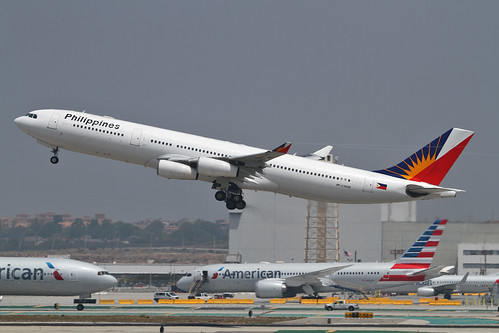
The route will be operated by Airbus A340-300 thrice a week every Tuesday, Thursday and Saturday. Flight schedule is as follows:

PR122 CEB – LAX - Dep: 1825 - Arr: 1755
PR123 LAX – CEB - Dep: 2040 - Arr: 0440+2

The airline said that it will also be expanding Manila-Los Angeles and Manila-San Francisco next year as they receive a pair of brand new B777-300ER planes from Boeing ordered earlier this year.

This new route will be the airline's 38th weekly flight to the United States and its territories, and will be the 34th international flight originating from the Mactan-Cebu International Airport.

Currently, PAL operates international flights to Nagoya, Osaka, Seoul, and Tokyo's Narita airport.