MIAA Opens International Transfer Lounge


12 July 2024

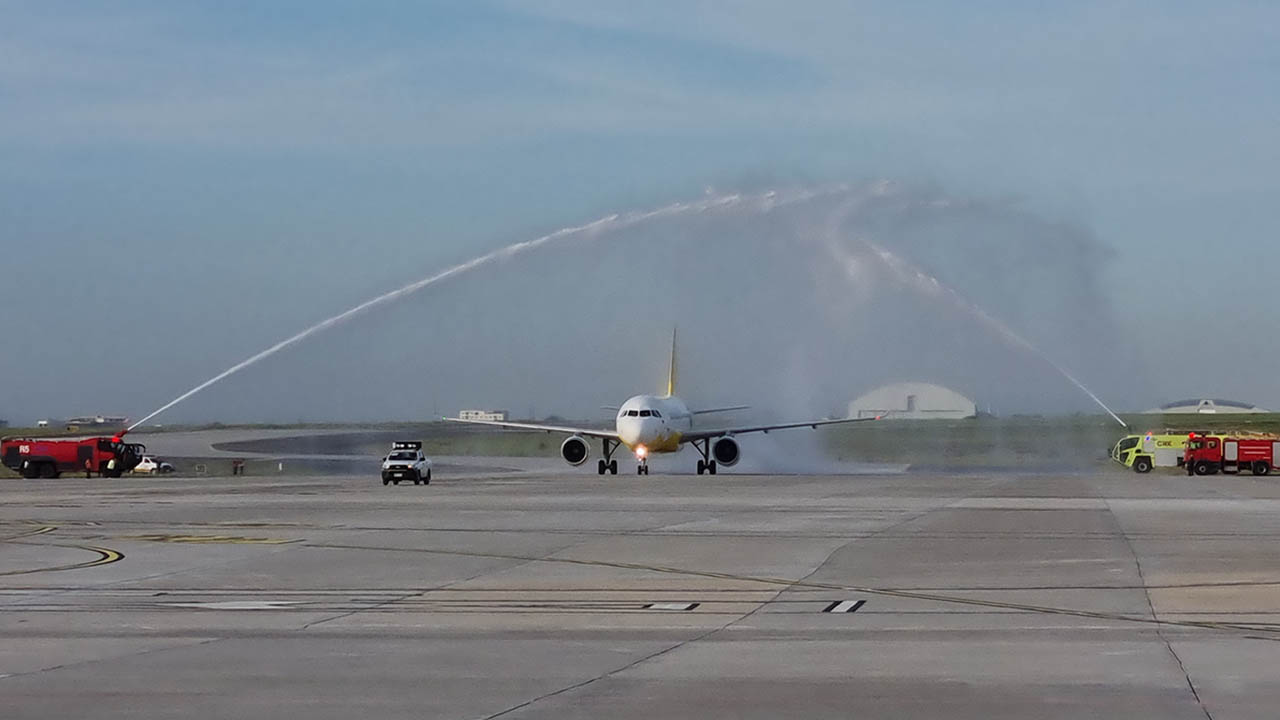
The Manila International Airport Authority (MIAA) in partnership with Philippine Airlines (PAL), has open the new Transit Lounge at the Ninoy Aquino International Airport (NAIA) Terminal 1 for international bound passengers with connecting flights.

The transit lounge is situated at the pre-departure area adjacent to the OFW Lounge and is open 24 hours daily to provide a comfortable and relaxing space for passengers with connecting flights, making travel a more pleasurable experience.

Under the partnership agreement, the lounge will be maintained and operated by the MIAA while PAL will provide the amenities such as comfortable seating, charging stations, shower facilities, and amusement options, as a generous act of support.

"We trust that travelers will find the facility as a welcome respite while enroute to their final destinations," MIAA General Manager Eric Ines said.

Based on Airport data, PAL offers substantial transit passengers to Australia, Vietnam, Thailand, and the United States.

"Our working partnership with the MIAA on this much-needed project has yielded positive results. This transit lounge ensures the comfort and convenience of passengers traveling through the Manila gateway." PAL President and Chief Operating Officer Capt. Stanley K. Ng said Wednesday,


CEB Resumes Clark Flights to 4 Domestic Destinations


9 July 2024

Low cost carrier Cebu Pacific (CEB) is resuming more flights from Clark International Airport to four local destinations it stopped during covid19 pandemic in 2020.

The budget carrier said it will re-introduce flights from Clark to four domestic points  beginning October with the arrival of more Airbus 320 aircraft to join its fleet, bringing CEB's total destinations via Clark to 10 international and domestic points.

Flights to Puerto Princesa will resume on the first week of October, while flights between Clark and General Santos and Clark and Iloilo restart on October 21, and flights from Clark to Davao recommence on October 22. 

Starting October 2, flights to Puerto Princesa will operate from three to seven times weekly.

Flights to General Santos will operate from thrice weekly to daily, and Iloilo from thrice weekly to daily starting October 21.

Additionally, the Clark to Davao route will operate from three to seven times weekly starting October 22.

CEB said it will station 5 Airbus aircraft in Clark to support its hub.

The airline currently offers flights from Clark to Caticlan, and Cebu, along with international connections to Bangkok, Hong Kong, Narita, and Singapore.

"This resumption underscores our commitment to offering greater accessibility to travelers from north and central Luzon and provide every Juan with more opportunities to discover the beauty and diversity of the Philippines, one destination at a time,” said Cebu Pacific president Xander Lao. 

Mr. Lao in a statement Monday, said more domestic destinations from Clark will be added once new Airbus aircraft joins their fleet.  

The airline announced earlier that it signed a memorandum of understanding (MOU) with Airbus for the purchase of up to 152 A321new aircraft for $24 billion or P1.4 trillion based on list prices. It was deemed the largest aircraft order in Philippine aviation history.

PAL To Fly Ormoc

Thrice A Week on Q400s

9 July 2024


Flag carrier Philippine Airlines (PAL) is scheduled to fly to Ormoc beginning in February 2025,  according to Ormoc City government.

In a statement on Monday, Mayor Lucy Torres Gomez said they met on July 4 with Captain Stanley Ng, PAL president and chief operating officer, to discuss plans to launch the new air route.

Torres said she welcomed the plan of Philippine Airlines (PAL) to open the Manila-Ormoc route in support of the goal of having "reliable air transportation" to Ormoc City, and to the western side of Leyte Island, including Southern Leyte and Biliran provinces.

Currently, Manila-bound travelers from Ormoc have to take a more than two-hour trip to Tacloban City to catch a plane ride to the country's capital.

PAL will fly Ormoc three times a week using an 86-seater turboprop Q400 aircraft.

Ng said they are still finalizing the schedule at Manila's Ninoy Aquino International Airport and should be announced soon.

PAL said they are just waiting for CAAP to grant them permit to fly, as they are still awaiting the completion of an air control tower to be operational in December this year, to direct and monitor the movement of civil aircraft.

The airport used to accommodate Cebu-Ormoc-Cebu and Clark-Ormoc-Clark flights but these stopped due to pandemic restrictions in early 2020.


Philippines Expands ASA with South Korea

Adds 10,000 seat entitlements between ICN and MNL

9 July 2024

The Philippines and South Korea have agreed to expand international air services between the two countries on July 4 allowing 10,000 seats more per week.

In a statement Monday, the Department of Transportation (DOTr) said the new memorandum of understanding (MOU) allowed an increase in capacity between Manila Ninoy Aquino International Airport (MNL) and Seoul Incheon International Airport (ICN) to 30,000 weekly seats. Previously, airlines between the two countries could operate up to 20,000 weekly seats on routes from Manila to South Korea.

After the two day consultation, limits on flights from Manila to other points in South Korea was removed. 


“The new agreement further liberalizes the third and fourth [freedoms of the air], without imposing limits on flights from Manila to all other points in South Korea,” the DOTr said.

South Korea is the Philippines’ main source of international visitors, with incoming Korean tourists reaching 1.4 million in 2023. 

According to the Philippine Department of Tourism, there had already been more than 680,000 arrivals from South Korea this year by May 2024, accounting for around one in four foreign tourists arriving to the Philippines.

DOTr said traffic between ICN and MNL has exceeded 25,000 per week, while traffic from South Korea has broken 28,333 passengers per week, and likely surpass the agreed seats before the end of the year.

The updated arrangement further liberalizes third and fourth freedoms, allowing more passenger traffic between the capital cities and increasing overall connectivity. Additionally, flights from points outside Manila to all points in South Korea remaining unrestricted should enhance regional connectivity and benefit local economies in both countries.

The Philippine delegation also proposed an amendment to the two countries’ air transport agreement that would allow the Philippines to designate its airlines based on the airline’s principal place of business and place of incorporation in the Philippines, which refers to AirAsia operations in the Philippines. They also plan to discuss South Korea’s proposal to permit third-country code-sharing arrangements, to accommodate Delta airlines request.

“Though an agreement on the matter was not reached, the two delegations agreed to further discuss the same, along with Korea’s proposal to allow third country code-sharing arrangements, in the next round of consultations,” the DOTr said.

Jeju Air is the largest provider of capacity between South Korea and the Philippines at present, accounting for a 20.4% share of all seats. Korean Air has a 14.9% share, followed by Philippine Airlines on 13.9%. Asiana Airlines (12.5%) and Jin Air (9.7%) complete the top five.

There are 11 nonstop routes currently operating in the market—five of which are from ICN to Cebu, Clark, Kalibo, and Tagbilaran under unrestricted flights, all flown by Jeju Air. While Asiana and Korean air flies Manila and Cebu.

On the other hand MNL is connected to two other points in South Korea through services from Busan and Cheongju which according to the latest bilateral is also unrestricted, being flown by Jin and Jeju Air.

Currently, there are 452,517 available seats between the two nations capital for July 2024, compared with 553,300 at the same time in 2019. More flights are recorded in secondary gateways by both countries.

The latest MOU replaces the previous agreement signed in 2017.


Cebu Pacific Seals $12 Billion Airbus Deal

Biggest Aircraft Order To Date 


Aircraft delivery begins 2028

3 July 2024

Low cost carrier Cebu Pacific (CEB) has signed a Memorandum of Agreement (MOU) with aircraft manufacturer Airbus for 152 A321neo jets valued at a US$ 24 billion (PHP 1.4 trillion) based on list prices.

The agreement includes firm orders for up to 102 A321neos, along with purchase rights for an additional 50 A320neo family aircraft, all powered by Pratt & Whitney GTF engines.

The CEB order is slated to be firmed in October 2024 with delivery schedule starting 2028 to 2035. 

"The order is designed to provide Cebu Pacific with maximum flexibility to adapt fleet growth to market conditions, with the ability to switch between the A321neo and A320neo,” said Cebu Pacific’s Chief Executive Officer Michael Szucs said on Tuesday.

Cebu Pacific Chairman Lance Gokongwei revealed that the European aerospace company offered a better deal than US-based manufacturing firm Boeing. 

Gokongwei said they decided to stay with Airbus and engine company Pratt & Whitney, both of which they have worked with for many years now.

“Our partners at Airbus and Pratt and Whitney have worked very closely with us and are giving us choices which will enable us to support the aviation and tourism industry,” he said.

“Pratt & Whitney is beginning to resolve the issues,” Gokongwei said, referring to maintenance issues on its geared turbo fan engines.

“We're confident the problems will be resolved over time. And they have a very long term contract with us to support these engines.” Gokongwei said.

Mr. Gokongwei also discloses that PW jet engines make up around 50% of the sticker price of A320neo family aircraft. For the nominal $129-million tag for an A321neo, that means around $65 million is for the two jet engines that power it.

Other reasons, Gokongwei cited, are the good feedback from passengers on their current planes, as well as Airbus jets being more fuel-efficient.

“We are already a very happy operator of Airbus. Passengers’ satisfaction with the aircraft is very high and also, I guess the most sustainable and fuel-efficient aircraft there is,” he asserted.

He still thanked Boeing as well as engine companies CFM and GE for participating in the talks after the airline issued an RFP or request for proposal.

The airline hinted that its early delivery schedule swayed Cebu Pacific from considering Airbus against Boeing due to the highly publicized troubles besetting the US plane maker preventing it from expanding capacity. 

“In the end, planes have been strong performers for us on a cost per available seat kilometer, in terms of passenger comfort and sustainability, aside of course from those hiccups with the Pratt & Whitney engines,” Gokongwei said.

The airline operates a fleet of more than 73 aircraft, consisting of  eight Airbus 330s, 37 Airbus 320s, 22 Airbus 321s and 15 ATR turboprop aircraft enabling the widest network coverage in the Philippines.  

Cebu Pacific is also expecting to receive 17 more aircraft from 2024 from its orders made in 2018.

“Our current plane orders end in 2027, I think,” he said, before the new batch of planes arrive between 2028 to 2035. “May outstanding [deliveries] pa kami.” Gokongwei explains.

The airline currently serves 35 domestic and 24 international destinations across Asia, Australia, and the Middle East.

Szucs said the new order will replace all the existing narrow-body fleet when their leases expire in about 8 years after delivery, and the excess shall be an expansion fleet that fly from the new airport in Bulacan, as well as Clark, Cebu, Davao, Bohol, Kalibo, and other gateway points across the country.

“Definitely, with more destinations to fly you, you’ll need more planes,” Gokongwei adds. 

“Hindi na Manila na lang. There are more alternatives.”