CAAP Grounds Seair LET Fleet

On Passenger Safety Concerns

June 30, 2010


The Civil Aviation Authority of the Philippines has directed Southeast Asian Airlines (SEAIR) to ground all of its LET410 flights due to safety concerns of the aircraft.

The LET410 is a twin engine short-range aircraft which has a seating capacity of 14 passengers and are capable of Short Take-Off and Landing (STOL) in about 750 meters with full pay load.

The plane is manufactured by the Czechoslovakian aircraft manufacturer Let Kunovice and first flew in 1969. There were more than 1,100 frames produced and used worldwide. SEAIR's fleet of LET-410 UVPs were manufactured in the late 80's making them more than 20 years old.

SEAIR said flights will be temporarily discontinued beginning on Wednesday, June 30. The affected destinations are El Nido; San Fernando, La Union; Marinduque; Zamboanga; Tawi-Tawi; and Jolo.

"This is to comply with the instruction of the Civil Aviation Authority of the Philippines (CAAP)" the company said in a statement. Also affected by the directive are four other operators which include Sky Pasada, an airline based in Baguio. There are at least 14 LET-410 registered in the country.

"The CAAP directive, which covers all LET410s operating throughout the Philippines, calls for 15 cabin and aircraft systems safety modifications, the most major and costly of which is the installation of two additional exit doors in each aircraft as shown on the illustration on the left under the wing. LET 410 operators were given three weeks to comply," a company statement said.

CAAP however denied giving them 3 weeks notice as they were informed of the deficiency two years ago.

" Its unfair for them to say that they were not informed because they were notified two years in advance" CAAP Official said in response to SEAIR claim.

SEAIR added that they have no choice but to retire the aircraft from passenger service because their Airworthiness Certificate and type ratings has been recalled.

SEAIR operates a fleet of six Let 410-UVP's and four Dornier 328-100's. One of the Dornier 328 plane was previously recalled from service because it was not certified by the manufacturer to carry passengers, while another one was declared unfit for civil aviation.

With the fleet recall, only two planes operate for SEAIR, the remaining Dornier 328 which fly to Caticlan; Batanes; Tablas, Romblon; Clark; and Cebu. SEAIR has daily flights to Caticlan and Batanes, with at least seven flights a day to Caticlan.

In response to the changes, SEAIR announced that "it will be bringing in additional Dornier 328s starting August 2010 to beef up operations in the growing markets of Batanes, Caticlan, and Romblon."

SEAIR said the acquisition of new planes is part of the SEAIR fleet expansion program. Two more 328's will fly in October, bringing the total fleet count to five by the end of the year.

PAL sees growth in Aussie routes

By Lenie lectura

June 28, 2010

BRISBANE, Australia—Philippine Airlines (PAL) expects traffic in its Australian destinations to grow by 10 percent and post as much as $60 million in revenues during its fiscal year that starts in March.

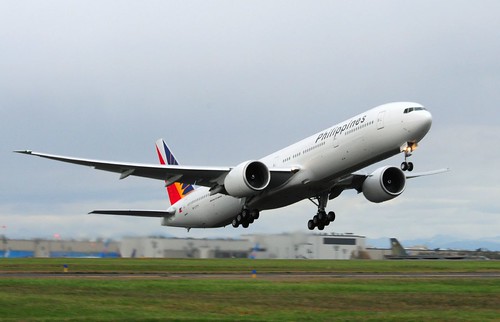
PAL flies five times weekly to Sydney and Melbourne and twice a week to Brisbane. It utilizes the Boeing 777 and Airbus A-330 aircraft.

“Our destinations to Australia are making money. We should be able to make more money,” said PAL country manager Arnul Pan.

PAL’s Australia service represents 4 percent of the airline’s total revenue target, added Pan. “We are looking at increasing our traffic here by 10 percent because of our comeback in Brisbane, our new plane the Boeing 777, and the partnerships we have forged with travel agencies.”

The load factor or the number of seats occupied during a flight for Sydney and Melbourne currently stands at about 80 percent to 85 percent and about 70 percent for its Brisbane route, that reopened in March.

“It depends on the aircraft that we are using. If we deploy Airbus A-330 then our load factor is at 85 percent but for our Boeing 777 the load factor is 65 percent to 70 percent,” added Pan.

The Airbus A-330 can accommodate 300 passengers while the B-777 can seat 376 passengers.

“Of the total passengers, 70 percent are Filipinos,” added Pan.

The PAL official said that for now there are enough frequencies to service Australia. “Our flights are enough. We won’t ask yet for additional flights. We are now observing how the market is starting to build up as airlines have just recovered from the global recession,” said Pan.

The restoration of Brisbane to PAL’s network completes the airline’s comeback in Australia, following the return of Sydney and Melbourne in recent years.

The new Brisbane service marks PAL’s return to the Queensland capital after a 12-year absence and underscores the airline’s commitment to its customers in Australia despite the global economic downturn.

With the addition of Brisbane, PAL will restructure its Australian operations. The current daily, same-plane operation to Sydney and Melbourne, which now share a triangulated routing to and from Manila, will be modified.

PAL first flew to Brisbane on June 5, 1985. In succeeding years, the city formed a key part, along with Sydney and Melbourne, of the airline’s multilegged operation to Australia.

But commercial and operational difficulties spawned by the Asian financial crisis of 1997 forced the flag carrier to shut down its Australian services on June 5, 1998.

PAL will also be looking to tap the huge Filipino migrant community in Queensland, as well as the leisure, business and cargo traffic out of the state. The airline sees an opportunity to provide Australian travelers, via PAL’s convenient connections in Manila, services between Brisbane and destinations in North Asia like Japan, China and Korea. Travelers, said the airline, can also expect to shave hours off current travel time to these points.

Clark Terminal 1 Opens

From Billions to Millions

June 27, 2010

San Fernando – President Gloria Arroyo, in what could be her swan song before she steps down from office, finally inaugurated the controversial and much delayed P308.8 million Phase 1 expansion of The Clark Airport Development Project which consist in the construction of modular passenger terminal at the airport named in honor of her late father, ex-President Diosdado Macapagal.

Terminal 1 has a project price tag of only 130 million pesos in 2007. By 2009, the terminal project cost ballooned 100% more costing the taxpayer 300 million pesos. At the time of completion, it cost the government 8 million more to finish a project riddled with inside dealings.

The new Terminal will have a 2.5 million capacity as it added floor spaces equivalent to 500,000 more passengers annually on top of two million it presently processes every year.

"The new terminal is expected to boost the operations of the airport as well as to attract more foreign and local airlines to relocate" says President Arroyo during the inaugural speech.

President Arroyo has designated DMIA as the next premier international gateway of the country. But major airlines shy away to operate from the airport because of logistics and connectivity problems.

Clark International Airport Corporation (CIAC) President and CEO Victor Jose I. Luciano said they already remedied some of the airport deficiencies that were the concerns of other airlines as Terminal-1 now hosts two passenger boarding bridges; a wider lounges; flight information display system; closed circuit television; public television; background music public address system; x-ray machines; elevators and escalators.

Luciano added that with the bridge facility, airline passengers will now walk door to door without using the stairs to the convenience of the passengers particularly during hot and rainy weather.

Phase 1 of the terminal upgrading project was supposed to have been started in 2005 to be completed in 2008 pursuant to the $1.7 billion US dollars master development plan, but foreign lenders in Japan and Korea refused to fund the project saying that it was overly ambitious with very poor Rate of Returns (ROI).

A clause was later demanded requiring all Low Cost Airlines (LCC) operating out of NAIA to relocate to Clark to make it more viable, but angered LCC airlines threatening to sue CIAC all the way to the Supreme Court should the deal proceed. It was eventually dropped when an American company offered to fund the airport project which turned out to be financially incapable.

Another company from Kuwait offered to develop the airport complex but requires all LCC calling Manila to operate at Clark and demanding at the same time the closing of Subic airport for good. All deals apparently carry a sovereign guarantee in the payment of debts which was declared illegal and unlawful by the Philippine Supreme Court in the PIATCO case.

CIAC formally rejected the offer of Kuwait’s Al- Mal-Pride Consortium to develop DMIA $1.2 billion airport development project at the Clark Civil Aviation Complex.

With no takers, CIAC funded the project in 2009 with a P300 million price tag and was completed on March 31 by its contractor A.G. Araja Construction and Development Corp. Additional 3 months cost the government 4 million pesos more in taxpayers money citing problems with sub-contractors reportedly delaying the project.

In 2008, the original DMIA terminal, which was constructed by the Americans during their stay at the former US Air Force Base, was expanded to increase its passenger capacity from 500,000 to two million yearly. The expansion covered spaces for additional immigration counters, airline offices, concessionaires’ area, and five airline ticketing offices and baggage conveyors among others facilities.

United States Ambassador to the Philippines Harry Thomas Jr. in a meeting with Clark International Airport Corp. (CIAC) and Clark Development Corp. (CDC) officials reminded them last week that expansion and upgrading of the facilities of the Diosdado Macapagal International Airport (DMIA) here should be transparent, efficient and free from any form of graft and corruption to progress from where they are now.

DMIA hosts Tiger Airways of Singapore, Air Asia of Malaysia, Asiana Airlines of South Korea, and locals Cebu Pacific Air, Spirit of Manila Airlines and South East Asian Airlines (Seair). Other airlines calling at Clark are Jin Air of Korea and Pacific Flier of Palau.

Purchase of navigation equipment to push through

But RNAV will Stay

By Rudy Santos

June 24, 2010

MANILA - The purchase of a new Very High Frequency Omni Direction Radio Range (VOR) would push through even if the old busted navigational equipment had already been repaired and a new satellite-based navigational system will be activated in July by the Civil Aviation Authority of the Philippines (CAAP).

Airport general manager Melvin Matibag said he had arranged for the purchase of the new equipment but the actual transaction would be done by the incoming administration to avoid any suspicion of wrongdoing in the bidding.

“Of course, we need a new VOR,” Matibag said, adding that the parts borrowed from the Subic VOR would be returned, while a new set of parts had been ordered from Europe and is about to arrive.

Matibag said that a competitive bidding would be announced by the Manila International Airport Authority (MIAA) for the new navigational aid, estimated to cost between P90 million to P120 million.

Based on a memorandum of agreement (MOA) between the MIAA and the CAAP, the former would pay for the equipment, while the CAAP would operate and maintain it.

As this developed, CAAP director general Alfonso Cusi said he would propose a new arrangement so that the MIAA would buy and maintain the navigational aids at the country’s premier airport so that his office would be able to focus solely on regulation.

Cusi revealed that foreign technicians had been invited by the CAAP to come and bring the new parts for the damaged VOR, and also to assess and make a final recommendation on what to do with it.

Cusi announced in a press conference that come July 4, the CAAP would allow the use of the satellite-based Required Area Navigation (RNAV) system, the next generation navigation procedure that uses Ground Positioning System (GPS), whose signal comes from five satellites orbiting high above the earth.

The satellite is available for civilian use and there is no need for CAAP to buy new equipment.

Cusi said that FedEx, the cargo carrier company, had been using the RNAV for sometime now, following its launching and calibration by the US Federal Aviation Administration (FAA).

The new standard would allow pilots to switch from VOR to RNAV in case any of the other navigational aids at the Ninoy Aquino International Airport (NAIA) fail.

Cusi said the GPS would be readily available for all airlines to use as instrument approach for MIAA runway 06/24.

GPS is a satellite technology that could phase out all other ground radio navigation aid, including the VOR .

Last Tuesday, Cebu Pacific lent their pilot and Airbus 319 to validate the accuracy of the RNAV approach procedure.

Cusi said that the VOR would remain on standby as additional redundancy to the other navigational aids at the NAIA, which include the Instrument Landing System (ILS) and other visual aids now in place.

These landing patterns are published and disseminated by the CAAP for use of all aircraft flying
into the Philippines and all of the 180-some members of the International Civil Aviation Organization.

He said the CAAP is leasing an Aerothai aircraft from Thailand to calibrate the VORs in Manila
, Clark, Subic, Mactan and the new RNAV departure and arrival procedures for the NAIA.

VOR Repair completed

MIAA explains reason for diversions

June 23, 2010


Repair of Manila airport's VOR facility was completed at 4 a.m today. A new NOTAM (Notice to Airmen) was issued at 6 a.m. advising airline operators on the restoration of VOR facility effective 9 a.m. today.

It was operating on test mode after it was fixed at 4 a.m. and finding no problems with the radio signal from incoming Philippine Airlines (PAL) flight from the United States, the test mode was shortened to 9 a.m. which is being circulated as the latest NOTAM.

Meanwhile, Airport Manager Melvin Matibag said that flight diversions to Clark airport yesterday, particularly 7 domestic flights of Cebu Pacific was the result of VIP flight of President Gloria Arroyo which arrived from Tacloban and not because of allegations of Airline Pilot Association of the Philippines (ALPAP) that it had non-functioning VOR.

"We had a busy airport yesterday because of the VIP flight. It was just unfortunate that bad weather compounded the situation prompting the flight diversions to Clark" says Matibag.

According to Matibag, aviation protocol dictates that no aircraft shall be permitted to land or depart within 60 minutes or until after the Presidents flight have left the airport or properly docked at its designated contact gate.

Approved Manila-Singapore flights still unallocated to RP carriers

By Lenie Lectura

June 22, 2010

IT’S been a month since Singapore gave the Philippines additional flight entitlements, but the government has yet to allocate these to Philippine carriers.

Civil Aeronautics Board (CAB) Executive Director Carmelo Arcilla said the CAB was still studying how to distribute fairly the entitlements to Philippine Airlines, Cebu Pacific, Zest Air and Air Philippines.

“The number of entitlements being sought by the carriers exceeds the actual number granted [by Singapore], so we are holding hearings for the allocation,” Arcilla said in an interview.

He said the deliberations will determine which among the carriers would get as many entitlements as they sought in their applications. “We have to determine which carrier is better qualified, and which really needs as many entitlements as it asked for,” Arcilla said.

The amended air services (ASA) agreement with Singapore was sealed last month and produced 2,647 weekly seats for Philippine carriers.

Cebu Pacific, according to vice president for marketing and distribution Candice Iyog, was asking for an additional 2,520 seats for its Manila-Singapore flights to enable it to add a twice-daily flight on top of its 25 weekly flights. “We have used up all our entitlements, while Air Philippines and Zest Air still have rights they have not used,” she said in a text message.

Zest Air, formerly Asian Spirit, has a pending application for two more daily flights to Singapore. “Our existing entitlements allow us to fly to Singapore five times a week. We applied for an additional two more so we can operate daily flights,” said the airline’s vice president for communications Butch Rodriguez.

Zest Air was supposed to start flights to Singapore early in the year but a delay in the delivery of their aircraft aborted the plan. Zest Air will use an Airbus A320 in its Manila-Singapore route. Rodriguez said Zest Air hopes that one of its aircraft delivered next month and another in October. “We intend to launch our Singapore flights by early November. We have 90 days to market the new destination,” Rodriguez said last week.

PAL said it will use its fair share to add more seats to its current four daily flights to Singapore.

The amended ASA between the two countries resulted in more than 13,000 seats a week between Manila and Singapore. For the Clark-Singapore route, a total of 20,000 seats are now available.

“There is really a demand for the Singapore route because the place is not only a tourist destination but also meant for business transactions or activities, and we also have overseas Filipino workers there,” Arcilla said.

The CAB is part of the Philippine air panel which negotiates for traffic rights with other countries. The other panel members include the Department of Transportation and Communications, Department of Foreign Affairs, Department of Tourism, Department of Trade and Industry, and representatives from the airline companies.

Since the start of the year, the Philippine air panel has forged air pacts with Bahrain and Turkey. Up next are China, Indonesia and Hong Kong. “There is no firm schedule yet but tentatively the next air talks will start in August,” Arcilla said.

Zest Airways to receive two A320's

Has July and November as delivery dates

June 22, 2010

Manila - Philippine low cost carrier Zest Airways will take delivery of two new Airbus A320 this year to be powered by International Aero Engine (IAE) V2500.

The ordered aircraft which will be the fourth and the fifth A320 for the airline will join the fleet in July and October respectively. The aircraft was originally scheduled for delivery in November last year but its holding company Asiawide Airways decided to defer its acceptance this year due to funding concerns.

Zest Air currently operates a fleet of six brand new aircraft, with three Airbus 320 and three Xian MA60.

Zest Air vice president for communications Butch Rodriguez said the new aircraft will be used primarily for domestic expansion. The second one will have its international debut in November when it flies to Singapore and Shanghai. Meanwhile, it will start flying from Cebu to Seoul in July 22. It already flies regularly to Seoul from Kalibo.

“Currently we are promoting Cebu to Seoul. Hopefully, we are going to launch our Singapore flights on a winter schedule,” Rodriguez said.

“We already have traffic rights to Shanghai but our launch was delayed because of non-availability of aircraft,” he said.

The carrier recently stopped its Clark-Hong Kong service two months after it was launched in November 2009 because of poor loads.

PALEA to Contest Labor Dept. Ruling

Files reconsideration to decision

June 21, 2010

The Philippine Airlines Employees' Association (PALEA) is not about to give up the fight against its employer Philippine Airlines and now the government as the labor union of the country's flag carrier intends to alleviate its case to the court seeking a reversal of the Department of Labor and Employment (DOLE) ruling that allowed management to outsource some of its present services, resulting to the mass layoff of some 3,000 employees.

Acting Labor Secretary Romeo Lagman upheld the planned PAL spinoff as a valid exercise of management prerogative.

"We are ready to elevate the case up to the Supreme Court. We maintain that contracting out is illegal," Gerry Rivera, PALEA president said Monday.

Rivera said they will first file a motion for reconsideration on or before June 28 as they are required to exhaust all administrative remedies before the court can entertain their case.

"DoLE's decision is not yet final and executory," said Rivera.

PALEA is also planning to file a restraining order in court of the company's decision to retrench should the labor department uphold its ruling.

Philippine Airlines announced the spin-off of its in-flight catering services; airport services, including ground handling, cargo terminal/cargo handling and ramp handling; and call center reservations starting June 1 to implement the next phase of its restructuring program, but the company was prevented by DOLE from implementing its decision pending results of compulsory arbitration.

PAL President Jaime Bautista said restructuring these operations are crucial to the company's survival amid increasing competition particularly from low cost airlines.

Rivera argued that Lagman's June 15 order is faulty on both substantial and procedural grounds.

"It failed to consider the PAL-PALEA collective bargaining agreement's provision, prohibiting the outsourcing of jobs that are being performed by regular employees."

He said that the case has not been submitted for resolution, "and the order came only four working days after PALEA filed a motion for the production of certain documents, such as PAL's latest financial statement and its outsourcing contracts with service providers."