17 January 2018
February 11, 1911 - February 11, 2011. First Red Devil biplane was flown in Manila with James C. Mars as its first pilot.
PAA Expands To Indonesia
Eyes Thailand its next route
17 January 2018+Adrian+Smith.jpg)
Philippine AirAsia (PAA) has launched its first services to Indonesia earlier this year as it expands flight services to Jakarta on January 9. The daily flight will be flown by Airbus A320-200 aircraft.
The carrier is also scheduled to launch its Manila-Bali flights on January 19 on A320 aircraft.Daily flights from Manila to Bali will have a departure time of 6:40 p.m., and an arrival time of 10:25 p.m. Flights back to the Philippines leave Bali at 11:20 p.m.
Meanwhile, flights from Manila to Jakarta will have a departure time of 8:00 a.m, and an arrival time of 11:00 a.m. Flights back to the Philippines leave Jakarta at 11:30 a.m.
Dexter Comendador, CEO, AirAsia Philippines disclosed that AirAsia will also expand to more South-east Asian cities beyond Indonesia and Vietnam as it prepares its flight to Thailand to add to its growing international route network.
“After introducing Manila-Ho Chi Minh City last November and adding two Indonesian services, we plan to launch a new route to Thailand this year and continue expanding to more South-east Asian cities.” he said in a statement.
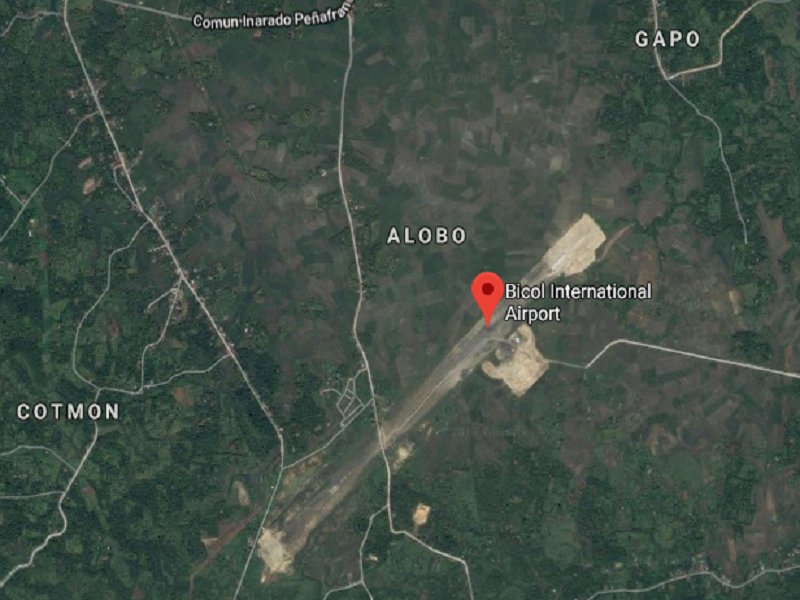
Gulfstream Lands at BIA
Prematurely
11 January 2018PAA,CEB World's Least Punctual Airline
11 January 2017
In its 2017 Annual Punctuality Report, the UK-based aviation analysts OAG highlighted the airlines and airports, both large and small, doing the most to keep your holiday on schedule and two of the Philippine-based carriers top the lists as one of the carriers that flies late most of the time.
Cebu Pacific Air (CEB)ranked seventh-least punctual in the world, with an On Time Performance (OTP) of 57.6 percent.
“On time,” as defined in the study, is a flight that arrives or departs no later than 15 minutes from the scheduled time.
Philippines AirAsia (PAA), meanwhile is ranked ninth, with a 58 percent OTP.
Least Punctual Airline Globally
10. Xiamen Airlines Company - 58.3%
9. Philippines AirAsia Inc. - 58.0%
8. Sunwing Airlines Inc. - 57.9%
7. Cebu Pacific Air - 57.6%
6. SATA International-Azores Airlines S.A. - 57.1%
5. Indonesia AirAsia X - 56.8%
4. LACSA-Lineas Aereas Costarricenses - 54.2%
3. Shenzhen Airlines - 53.5%
2. AVIOR Airlines - 53.1%
1. Air Inuit - 44.6%
Congestion at either origin or destination airports has been blamed by these airlines for its low score, with Manila International Airport (NAIA) operating beyond capacity requiring airlines to expect delays.
Ceboom!
6 January 2018
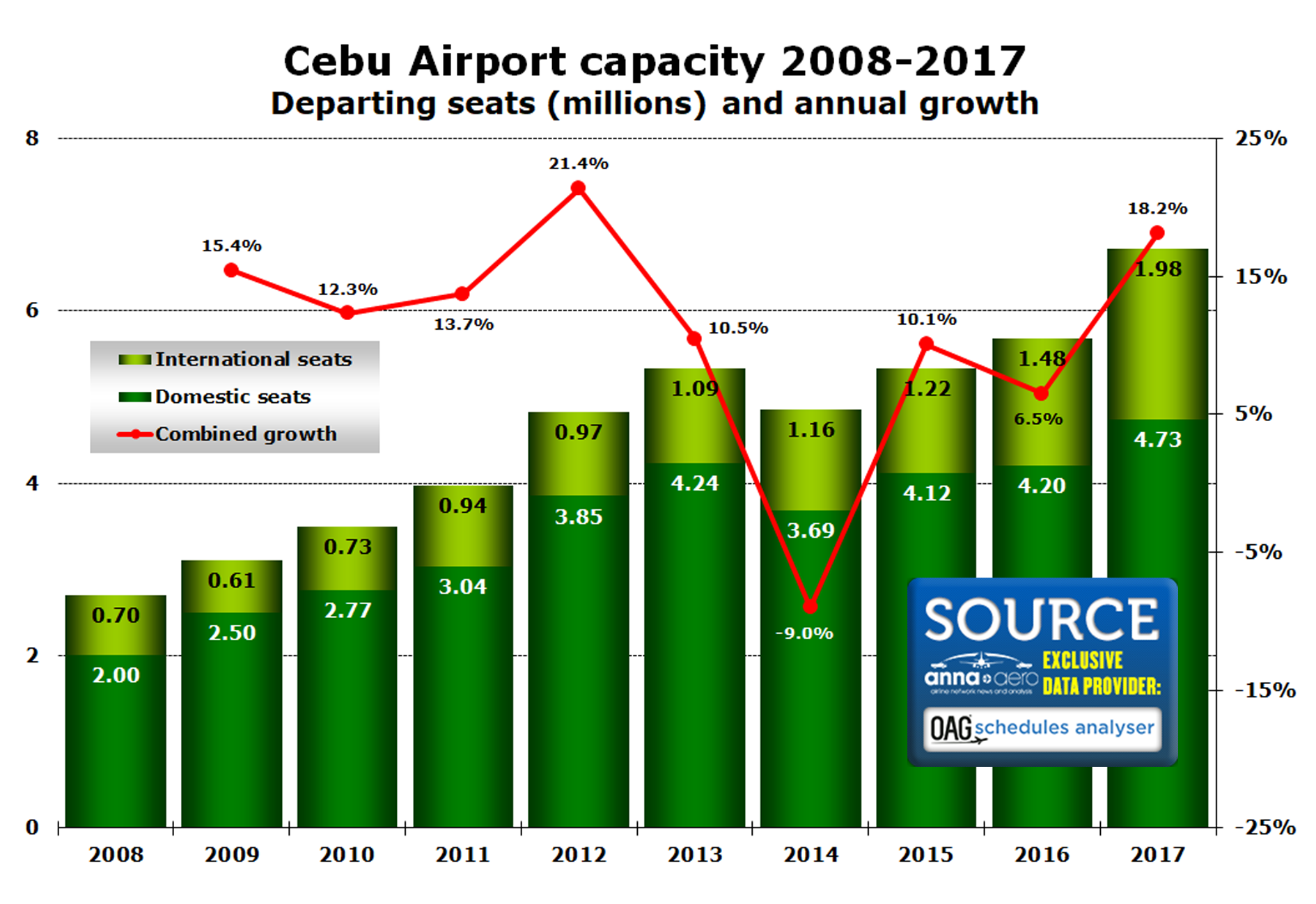
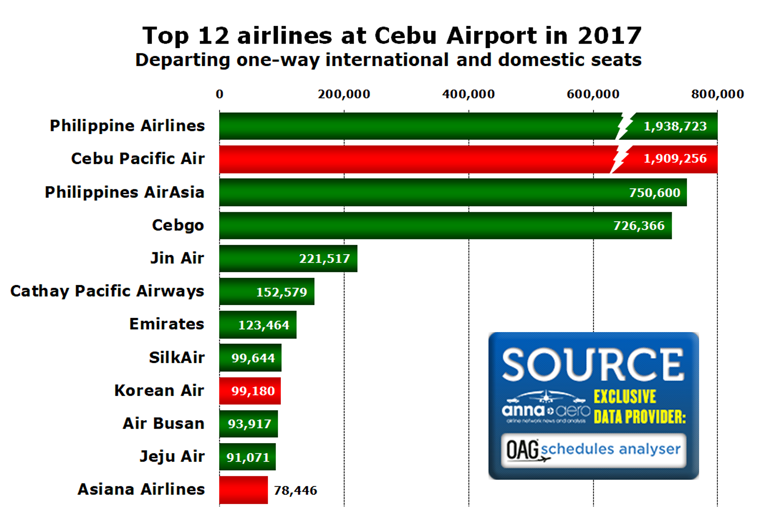
Mactan Cebu in Figures
Cebu Airport rises 149% in the past 10 years
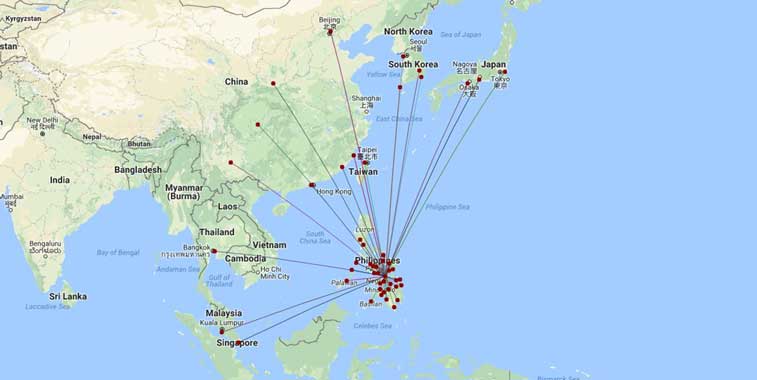
Manila Tops Domestic Route
South Korea Tops International Route
Air Asia Opens First Flight To Davao From Kuala Lumpur
KUL-DVO Inaugural
6 January 2018DOTR Seeks Caticlan Expansion
Operator Wants Gateway Status
3 January 2018

The Department of Transportation (DOTr) is seeking to transform Caticlan Airport to international gateway by proposing to change the design parameters of the airport project awarded in 2008.
The Transport agency has already send the recommendation to the National Economic and Development Authority (NEDA) for approval at the interagency Investment Coordination Committee (ICC).
Changes include expansion of airside and landside components, which has shown to be thorny and controversial issues in the past.
Among the airside issues that hound the project includes leveling the hill at the airport’s eastern side and the extension of the runaway to the sea, and the opposition by some stakeholders on the conversion of the airport from domestic to an international facility because it involves land reclamation to accommodate 500 meters more of the existing runway as originally planned.
As for the landside the project calls for the expansion of passenger terminal building (PTB) from the present 3 million passenger per annum (MPPA) to at least 6 MPPA by 2033.
DOTr proposal could increase Caticlan Airport project cost by as much as 300 percent from the original approved cost of ₱2.5 billion ($58 million) in 2008 to as much as ₱10 billion.
Caticlan International Airport Development Corp. (CIADC) bagged the right to modernize Caticlan airport under a 25-year concession agreement with the government in 2009 after the Neda approved the unsolicited Build-Rehabilitate-Operate-Transfer proposal for the Caticlan Airport Development Project in 2008 after its unsolicited proposal in 2006 was unchallenged by bidders.
San Miguel Corporation (SMC) bought controlling interest (51%) from CIADC in 2010 and established Transaire Development Holdings Corporation (TransAire) as the airport operator until 2034. Full airport administration was handed to TransAire in 2011.
TransAire holds the exclusive rights, obligations and privileges to finance, design, construct, operate and maintain the airport by virtue of a concession agreement with the DOTr and the Civil Aviation Authority of the Philippines (CAAP).
The airport operator however took five years after winning the contract in 2009 to start major construction works after series of obstacles went its way from environmental compliance to uncooperative land owners. They are cleared to construct 1,600 meter of runway as a compromise from local and environmental groups. The original runway design of 2,100 meters was discarded.
Boracay airport as it is fondly known is limited to cater domestic traffic by its Aerodrome Certificate, with international gateway being re-directed to nearby Kalibo International Airport in Kalibo, Aklan.

SMC has been very vocal of expanding the airport’s runway from the former 950 meters to the current 1,600 meters to the now proposed 2,100 meter runway, and if allowed further, to construct up to 2,500 meters runway to accommodate more foreign carriers and larger aircraft.
SMC president Ramon S. Ang said they are building 3 MPPA PTB terminal slated for opening by October this year with expansion potential to 6 MPPA.
“We saw the potential to add more capacity from foreign tourist arrivals and its not possible from the current set-up” Ang said last year.
Ang stated that they propose to build only 2 MPPA terminal and 6 apron bays at first but revised the plan to accommodate growth in the future.The airport now can hold up to 12 apron bays for as big as A321 aircraft up-gradable to contact bridges in the future.
According to San Miguel Corporation, the airport facility is being developed with international operations in mind but is currently being hampered by limitations imposed on its contract.
Ang said the company is prepared to spend as much as ₱15 billion ($300 million) to upgrade the airport further if the restriction is removed.
SMC was originally given seven years or until 2016 to complete both the airside (runway, apron and Taxiway, navaids) and landside (PTB and parking) developments from project award but has since been extended by the government due to regulatory delays.
Caticlan airport handled 1.2 million passengers in 2017.
3 January 2018

The Department of Transportation (DOTr) is seeking to transform Caticlan Airport to international gateway by proposing to change the design parameters of the airport project awarded in 2008.
The Transport agency has already send the recommendation to the National Economic and Development Authority (NEDA) for approval at the interagency Investment Coordination Committee (ICC).
Changes include expansion of airside and landside components, which has shown to be thorny and controversial issues in the past.
Among the airside issues that hound the project includes leveling the hill at the airport’s eastern side and the extension of the runaway to the sea, and the opposition by some stakeholders on the conversion of the airport from domestic to an international facility because it involves land reclamation to accommodate 500 meters more of the existing runway as originally planned.
As for the landside the project calls for the expansion of passenger terminal building (PTB) from the present 3 million passenger per annum (MPPA) to at least 6 MPPA by 2033.
DOTr proposal could increase Caticlan Airport project cost by as much as 300 percent from the original approved cost of ₱2.5 billion ($58 million) in 2008 to as much as ₱10 billion.
Caticlan International Airport Development Corp. (CIADC) bagged the right to modernize Caticlan airport under a 25-year concession agreement with the government in 2009 after the Neda approved the unsolicited Build-Rehabilitate-Operate-Transfer proposal for the Caticlan Airport Development Project in 2008 after its unsolicited proposal in 2006 was unchallenged by bidders.
San Miguel Corporation (SMC) bought controlling interest (51%) from CIADC in 2010 and established Transaire Development Holdings Corporation (TransAire) as the airport operator until 2034. Full airport administration was handed to TransAire in 2011.
TransAire holds the exclusive rights, obligations and privileges to finance, design, construct, operate and maintain the airport by virtue of a concession agreement with the DOTr and the Civil Aviation Authority of the Philippines (CAAP).
The airport operator however took five years after winning the contract in 2009 to start major construction works after series of obstacles went its way from environmental compliance to uncooperative land owners. They are cleared to construct 1,600 meter of runway as a compromise from local and environmental groups. The original runway design of 2,100 meters was discarded.
Boracay airport as it is fondly known is limited to cater domestic traffic by its Aerodrome Certificate, with international gateway being re-directed to nearby Kalibo International Airport in Kalibo, Aklan.

SMC has been very vocal of expanding the airport’s runway from the former 950 meters to the current 1,600 meters to the now proposed 2,100 meter runway, and if allowed further, to construct up to 2,500 meters runway to accommodate more foreign carriers and larger aircraft.
SMC president Ramon S. Ang said they are building 3 MPPA PTB terminal slated for opening by October this year with expansion potential to 6 MPPA.
“We saw the potential to add more capacity from foreign tourist arrivals and its not possible from the current set-up” Ang said last year.
Ang stated that they propose to build only 2 MPPA terminal and 6 apron bays at first but revised the plan to accommodate growth in the future.The airport now can hold up to 12 apron bays for as big as A321 aircraft up-gradable to contact bridges in the future.
According to San Miguel Corporation, the airport facility is being developed with international operations in mind but is currently being hampered by limitations imposed on its contract.
Ang said the company is prepared to spend as much as ₱15 billion ($300 million) to upgrade the airport further if the restriction is removed.
SMC was originally given seven years or until 2016 to complete both the airside (runway, apron and Taxiway, navaids) and landside (PTB and parking) developments from project award but has since been extended by the government due to regulatory delays.
Caticlan airport handled 1.2 million passengers in 2017.
PAL Ends Darwin Stop, Halts flights from Kalibo to Guangzhou
Flies Brisbane Direct beginning March 24
2 January 2018
Flag carrier Philippine Airlines (PAL) has announced that it will fly direct to Brisbane beginning March 24, 2018 as it upgrades its Manila-Brisbane-Manila route to new 168 seater A321NEO aircraft with backseat IFEs and wifi services, as it accelerates efforts to join the prestigious circle of 4-star carriers in 2018.
The route is currently served via Darwin as a stopover which run four times each week. Manila-Darwin-Manila services is planned to be axed from March 24, 2018.
Airline President James J. Bautista said Darwin is "economically unsustainable" for the airline's business model.
Bautista stressed however that they are studying possibility of flying low-cost subsidiary PAL Express to Darwin instead of PAL to take-over the route as it addresses passenger demographic types similar to what was employed in Saipan.
Meanwhile, PAL suspended Kalibo-Guangzhou route starting Jan.1, as part of the restructuring of the flight network in the region. Instead, it will mount an additional Manila-Guangzhou flight every Saturday effective Feb. 1.
“In consideration of the current market conditions, this additional Manila-Guangzhou operation will ensure that efficient air transport services are continuously provided between points in the Philippines and Guangzhou,” PAL said in a statement.
Flag carrier Philippine Airlines (PAL) has announced that it will fly direct to Brisbane beginning March 24, 2018 as it upgrades its Manila-Brisbane-Manila route to new 168 seater A321NEO aircraft with backseat IFEs and wifi services, as it accelerates efforts to join the prestigious circle of 4-star carriers in 2018.
The route is currently served via Darwin as a stopover which run four times each week. Manila-Darwin-Manila services is planned to be axed from March 24, 2018.
Airline President James J. Bautista said Darwin is "economically unsustainable" for the airline's business model.
Bautista stressed however that they are studying possibility of flying low-cost subsidiary PAL Express to Darwin instead of PAL to take-over the route as it addresses passenger demographic types similar to what was employed in Saipan.
Meanwhile, PAL suspended Kalibo-Guangzhou route starting Jan.1, as part of the restructuring of the flight network in the region. Instead, it will mount an additional Manila-Guangzhou flight every Saturday effective Feb. 1.
“In consideration of the current market conditions, this additional Manila-Guangzhou operation will ensure that efficient air transport services are continuously provided between points in the Philippines and Guangzhou,” PAL said in a statement.
Subscribe to:
Posts (Atom)


%2BAjig%2BIbasco.jpg)