SIA Adds Fourth Daily Flight to MNL

Singapore expands Manila and HongKong as it loses a quarter of its passenger traffic

18 June 2009


singapore airlines triple seven on finalSingapore - Singapore Airlines has announced Wednesday that it will add a fourth triple seven daily flight between Singapore and Manila from 10 July.

Huang Cheng Eng, Executive Vice-President of Marketing for Singapore Airlines, said that "The frequency increase on this route underscores the strong and growing economic, business and tourism links between Singapore and the Philippines. It also improves the connectivity of Manila to the rest of the world."

"The scheduling of the four services to depart and arrive at various times during the day between the two cities gives our customers more options to choose a flight which better suits their travel needs."

The increase from three to four daily flights will expand capacity by more than 20%. The increase in capacity was made possible as a result of recent bilateral air services agreements signed between Singapore and the Philippines recently.

To give customers more flight options to suit their travel needs and to reduce transit times for onward departures from Singapore Changi Airport, the airline decided to re-time one of its present Manila services.

SQ916 will depart Singapore at 14:10 and arrive in Manila at 17:45. The return flight SQ921 will depart Manila at 18:50 and arrive in Singapore at 22:20.

While SQ912 will be re-timed to depart Singapore at 12:10 and arrive in Manila at 15:45, while the return flight, SQ919 will leave Manila at 16:50 and arrive in Singapore at 20:20.

Singapore Airlines has been bullish on the Philippine market despite massive 62.8 % drop of passenger traffic from its route network as it continues to be hit by the global financial crisis with the carrier shedding a quarter of its passenger numbers during the past year.

The airline carried 1.2 million passengers in May, compared with almost 1.6 million for the same month last year, according to figures released on Tuesday. In contrast, Manila and Hongkong traffic has been on the rise lately which prompted them to introduce additional flights.

Singapore Airlines will also launch A380 flights on the Singapore-Hong Kong route on July 9, 2009 replacing an existing daily Boeing 777-300ER service. The operation of the 471-seat Singapore Airlines A380 to Hong Kong represents an increase of ten per cent in seat capacity to the City. The Airlines currently operates five daily non-stop flights between Singapore and Hong Kong, along with daily non-stop services between Hong Kong and San Francisco.

Singapore Airlines currently has eight A380s in service, a further 11 on firm order, and options on six more.

PAL A333 Take-Off Incident at Sydney Out


Incident: Philippine Airlines A333 at Sydney on Jul 17th 2008, takeoff without clearance, B737 crossing runway


By Simon Hradecky
Map (Graphics: ATSB)
The Australian Transportation Safety Board (ATSB) released their final report stating, that after the Airbus began the takeoff roll, the tower controller advised they had no takeoff clearance, so that the crew discontinued the takeoff.

The crew had been planning and prepared a departure from runway 34L. While taxiing to the runway, air traffic control inquired whether the crew could accept a departure from runway 25. The crew recalculated the performance and accepted runway 25, however, underestimated the shortened taxi time and the impact on their briefing. While taxiing on taxiway Golf, the crew reported ready for departure and was cleared to line up runway 25 and hold, fly heading 240. The takeoff clearance however was withheld, as a Boeing 737 was cleared to cross the runway at taxiway Bravo. That reason however was not provided to the Airbus crew. The Boeing was on a different radio frequency, so that the Airbus crew was not aware of the Boeing at all.

A Philippine Airlines Airbus A330-300, registration RP-C3333 performing flight RP212 from Sydney,NS to Melbourne,VI (Australia), was cleared to line up departure runway and hold, but the crew commenced takeoff despite another (unspecified) Boeing 737 crossing the runway.

The Australian Transportation Safety Board was investigating the incident and came out with this report. PHOTO by Flickr.


The Airbus crew read back their clearance, however without the "and hold" portion, the tower controller did not challenge the missing hold.

The aircraft lined up runway 25 and commenced the takeoff without having received the takeoff clearance. A tower controller saw the aircraft moving and instructed the crew to hold position, which was queried by the crew. The controller then instructed the crew to cancel the takeoff, to which the crew reacted and aborted the takeoff. The Sydney ground radar showed, that the airplane had reached a maximum speed of 29 knots. The Airbus subsequently vacated the runway and returned to the holding point, where a takeoff clearance was issued. The aircraft departed without further incident.

The Australian Manual of Air Traffic Services (MATS) required, that controllers should issue traffic information as appropriate and should advise crew of the "nature of obstructions if it is not apparent", when aircraft are delayed by the traffic situation.

The ICAO Procedures for Air Navigation Services specified, that a departure instruction may be combined with a takeoff clearance, however did not provide the option to combine a departure instruction with the line up clearance.

The MATS however permitted the combination of a departure instruction with the line up clearance.

The ATSB said, that the combination of the departure instruction with the line up clearance provided an ambiguity to the flight crew, who were not used to hear such a combination. The inclusion of the reason for the delayed takeoff clearance could have reduced the likelihood of a misunderstanding by the crew. The controller did not challenge the missing "and wait" in the readback missing another opportunity to remove any ambiguity. Instead of "stop immediately" the controller issued a "hold position" instruction, which was not understood by the crew so that they questioned what was being said. ATC phraseology should be clear, concise and unambiguous and should reflect international practises and standards where possible, especially with regards to instructions to international aircraft and in safety critical situations.

The flight crew was distracted with departure preparations and provided themselves with little time to brief and comprehend the change to their departure. Had the crew not put themselves under that pressure, they may have been less distracted and may have correctly comprehended the ATC instructions. When the crew was instructed to line up and hold runway 25 combined with the departure instruction to fly heading 240, the crew erroneously took this as a takeoff clearance. The confusion was amplified by the departure instruction, which had only been heard together with a takeoff clearance before.

Air Services Australia, responsible for providing Air Traffic Control, reviewed their procedures to bring them in line with the ICAO standards. The necessary changes to MATS will commence in the August 2009 release. (avherald.com)

5J shops at Paris Air Show


Orders 5 more 320 to Expand Fleets


Cebu Pacific signed a deal for 5 Airbus planes at this year's Paris Air Show

LE BOURGET - Airbus, the European plane manufacturer owned by EADS, edged Boeing into big lead Tuesday as it announced that it will produce 24 A320 jets for the Middle Eastern airline Qatar Airways, 5 A320 jets for Philippine carrier Cebu Pacific, and 1 A320 prestige from a private Asian customer in a deal worth more than $2 billion.

The European planemaker also won a deal for 16 single-aisle A321 jets worth $1.4 billion at list prices from Vitnam Airlines on Tuesday as it expands its regional and domestic route networks.

The orders was well below the $25 billion raked in the first day of the last big show, at Farnborough, England last year.

John Leahy, Airbus Chief Operating Officer, said the company has more orders in the pipeline, in an interview at the Paris Air Show on the second day of the show at Le Bourget outside the French capital.

"Of course, the figure could be less, but I'm keeping this target of 300," Leahy said.

US aviation giant meanwhile did not announce any orders on the first day but Boeing Company executives said the industry's prospects were robust, yet the Chicago-based rival has reported no new orders so far.

"At this point it appears to us that the economic conditions have bottomed," said Scott Carson, President and Chief Executive of Boeing's commercial aircraft division. "If they have bottomed and a recovery comes next year, I think we have a shot at getting through."

The commercial aviation industry has been hit hard by the global downturn, with its airline customers expected to sustain $9bn of losses this year, according to industry body International Air Transport Association (IATA).

Qatar Airways Chief Executive Akbar Al Baker said the A320s represent new orders, while the remaining four are A321 models announced at the Farnborough Air Show last year.

Mr Al Baker said the aircraft would be delivered from November this year and used to expand its regional, Eastern European and Southwest Asian services.

He added Qatar Airways was "determined to grow" with the world's best aircraft at the heart of a modern and fuel-efficient fleet.

Cebu Pacific has made a firm order for five single-aisle A320s worth a total of $385 million at list prices. Delivery of the new order is scheduled from October 2010 to November 2013. The airline is considering an option for 5 more jets but the decision to acquire is not yet taken. It is also shopping on leases for 4 wide-body aircraft from GECAS an aircraft lessor at the show.

The airline had earlier signed a $100-million OnPoint solution agreement with GE Aviation’s services business. The 12-year service contract includes general maintenance and repairs, parts procurement, technology upgrades, engine leasing, and overhaul of the CFM56-5B engines. CFM56-5B engines are the product of CFM International, a 50/50 joint company between General Electric Company and Snecma (SAFRAN Group).

OnPoint solutions are customized service agreements tailored to the operational and financial needs of each customer for any size fleet. These agreements are designed to help lower the customers' cost of ownership and maximize the use of their assets. Backed by GE's global support network, OnPoint services may include overhaul, on wing support, new and used-serviceable parts, component repair, technology upgrades, engine leasing, integrated systems support and diagnostics and integrated systems.

Cebu Pacific President and CEO Lance Gokongwei said the additional orders are needed because of the airline’s expanding domestic and international operations.

"This expansion will more than double passenger capacity and enable us to provide our trademark low fares for new domestic and international destinations. We expect to increase our passenger numbers from nine million this year to 15 million in 2013," the CEO said.
"The global economic downturn notwithstanding, we are experiencing a surge in the number of passengers flying Cebu Pacific mainly because of our low fares. We expect this growth to continue, hence our decision to further expand our fleet," he said.

Vietnam Airlines total order is worth around $1.9 billion when it firmed two more A350-900s worth $480 million. It placed a firm order for 10 A350 XWBs in December 2007 .

Tuesday's deal increases the total number of orders placed by Vietnam Airlines for A321 to 41, of which 14 have already been delivered.

"Vietnam will remain one of the key growth markets in Asia in coming years," Airbus Chief Executive Tom Enders told the news conference.

This week's Paris Air Show is celebrating its 100th anniversary and was opened to the industry on Monday for business and will open to the public on Friday.

International air passenger traffic drops

By Darwin G. Amojelar


INTERNATIONAL passenger traffic in the Philippines fell in the first three months of the year due to the global economic crisis, the Civil Aeronautics Board (CAB) said Monday.

Data from CAB showed that international passenger traffic went down by 4.2 percent to 2.97 million in the first quarter from 3.1 million in the same period last year.

Of the total, incoming passengers were down by 6.7 percent to 1.4 million, while outgoing passengers slipped to 1.58 million from 1.65 million.

Porvenir Porciuncula, CAB deputy executive director, said the decline in passenger traffic “is [due to] the global economic slowdown.”

He said passenger traffic would slow down further in the second quarter due to the A(H1N1) scare.

Of the 43 carriers with authority to fly in and out of the country, only 32 airlines operated during the period. The CAB said Air Nauru, Aeroflot, Air France, Vietnam Airlines, Canadian Airlines and British Airways ceased flying to the Philippines in 2001 followed by Swissair, Egyptair, Air France and P.T. Bouraq in 2004.

Philippine Airlines (PAL) flew 880,642 international passengers, down by 3.6 percent from 910,508 passengers last year. The flag-carrier’s incoming traffic stood at 411,572, while outgoing passengers reached 469,070.

Cebu Pacific carried 352,226 international passengers, or 4.7 percent higher than the 336,246 in the same period last year. Of the total, incoming passengers numbered 165,552 while outgoing passengers stood at 186,674.

Asian Spirit had no passengers during the period, while Southeast Asian Airlines flew 225.

Foreign airlines like Cathay Pacific carried 355,547 passengers; Northwest Airlines, 125,598; Singapore Airlines, 128,133; Korean Air, 57,784; Emirates Air, 99,376; Japan Airlines, 105,842; Thai Airways, 72,039; China Airlines, 67,403; Gulf Air, 68,971; and Asiana Airlines, 129,538.

Lufthansa and Dragon Air also had no passengers during the first quarter.

The regulator said domestic air traffic grew 21 percent to 3.4 million passengers from 2.8 million in the same three-month period last year.

The industry’s load factor—the number of seats occupied during a flight—climbed to 77 percent in the first three months from 75.6 percent in the same period in 2008.

The total number of seats during the period reached 4.29 million, up from 3.4 million in the same period previously.

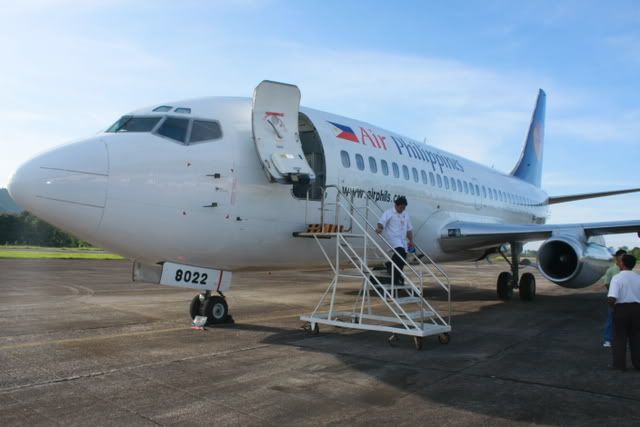
Air Philippines arrives Surigao four months late

June 16, 2009

Air Philippines finally fly Surigao this summer!
Summer of the western world that is...

Manila- Low Cost Carrier Air Philippines arrived late in Surigao but still on time for the summer period in the western world as it will start daily service instead of 4 times a week schedule originally slated in March this July 1st.

The airline founded in 1995, will substitute PAL Express Q400 service and operates on code share agreement with Philippine Airlines.

A Boeing 727-200 jet aircraft, which seat 118 passengers in a monoclass layout, will be deployed on the route. AirPhil will start daily jet service between Manila and Surigao starting July 1, 2009. Flights from Manila will depart 8:45 am, arriving Surigao at 10:15 am. The return flight leaves Surigao airport at 10:45 am and lands in Manila 12:15 pm. It operates at the new Terminal 3.

Air Philippines President & CEO Capt. Edilberto R. Medina said that it concluded a probing flight to Surigao City on 16 February and while they intend to launch flight there as originally scheduled some unforseen technical circumatances were going there way which prompted them to delay the service. The culprit seems to be the airport's preparedness to handle a jet flight and training of some CAAP personnel to emergency situation.

Surigao will becomes Air Philippines’ 9th domestic destination in the airline’s expanding route network based at hubs in Manila and Cebu. The airline has recently suspended its commercial operations to three major Mindanao cities in July last year and reduced much of its frequency for its main Visayas-Mindanao service due to massive losses and intense competition with Cebu Pacific.

The airline took off its last flight to Ozamiz City last June 14, 2009 to give way to its sister company, Philippine Airlines. In a press release, AirPhil. decided to leave Ozamiz after observing the city's rapid economic expansion that requires bigger aircraft to accommodate the growing volume of air travelers and cargo.


Airline industry sources however said that the entry of Cebu Pacific's direct Manila service paved the way for its eventual exit based on its experience at the Dumaguete Airport.

The source said the airline’ cannot anymore justify fuel bill as the cause but have to contend with heavy competitions from both Cebu Pacific and Zest Airways which are introducing newer and better aircraft at the same charging fare at a lower cost, and passenger awareness to choose to ride newer and better planes.

Air Philippines fare was considerably higher than Cebu Pacific and Philippine Airlines flight from Dipolog which prompted other passengers to ride from Dipolog airport instead while others contend themselves of booking early for the Cebu stops.

The airline has been hit particularly hard by high petroleum prices in 2008 because its jet fleet consists mostly of 20-year-old Boeing 737-200s, whose engines are substantially less fuel-efficient than their modern counterparts. To operate profitably, they have to maintain load consistency and pricing strategy which they can do at will while being alone in a particular market.

With impending profitability warning, the airline surrendered Ozamiz to its much bigger sister while enjoying happily at Surigao Airport. The Airbus 319 which Cebu Pacific had is not certified to fly safely at the current Surigao airport until after runway extensions and safety areas has been met.

Air Philippines fly only profitable routes in Puerto Princesa, Iloilo, Cebu, Davao, Naga, and this time Surigao while it buys time for a better market conditions but that condition is slowly being eaten by Zest Airways . It has 7 active Boeing 737-200 advance and 1 Boeing 737-300 aircraft on its fleet. Presently, it operates only 4 aircraft and grounded 4 others. Air Philippines has announced a plan to completely ground its old 737s by 2010 but deferred its implementation due to massive losses in 2008. The airline is expected to receive two A320 this year and a solid black financial performance.

PAL rethinks Boeing purchase

CAAP in Limbo

By Recto L. Mercene

FLAG carrier Philippine Airlines (PAL) is reported to be shelving its planned purchase of about six units of the long-range Boeing 777-300ER because the Philippines remains in Category 2 status since its downgrading by the Federal Aviation Administration (FAA) in the last quarter of 2007.

The Faa will not allow any Philippine air carrier to mount new destinations in the United States unless Category 1 status has been reaquired through sweeping reforms in the local aviation industry.

Although the former Air Transportation Office has been abolished and replaced by the Civil Aviation Authority of the Philippines (Caap), its director general, Ruben F. Ciron, is finding that getting back to Category 1 is a long and difficult process.

Ciron, who took over the Caap in June 2008, has discovered that the reported “autonomy” granted by the Caap for him to put in place sweeping reforms is not easily enforceable.

For one, the Caap remains under the Department of Transportation and Communications (DOTC), which means reforms must have the approval of Secretary Leandro Mendoza.

Pressing more technical men into service means going through the requirements imposed by the Civil Service Commission (CSC), and having his funds scrutinized by the Budget Department.

The Caap has trouble recruiting highly technical men because of the low salary structure. But when the Caap submitted a salary scale that appears to overtake the levels of those from the DOTC, the latter’s executives balked, demanding to know what technical know-how these men have that they don’t.

When Ciron suspended an assistant for committing eight counts of alleged illegal transactions, the executive refused to submit himself to an accounting before his peers and brought the case before the Pasay City Regional Trial Court (RTC).

The Pasay RTC junked the case, although the Caap said that may not be the end of it.

Caap in limbo; PAL cautious

These difficulties are preventing the Caap from focusing on its main objectives of addressing the problems that the FAA wants solved before the authority is allowed to regain its Category 1 status.

So long as the Caap remains in limbo, PAL has to reconsider its expansion plans, according to sources in the aviation industry.

On December 6, 2006, PAL signed an agreement with Boeing for two Boeing 777-300ER aircraft, with a purchase agreement for two more aircraft. A separate agreement to lease two additional 777-300ERs from General Electric Capital Aviation Services was signed as well.

Delivery of the four 777-300ERs will commence in 2009. In May 2007, PAL exercised its rights to purchase an additional two 777-300ERs for delivery in 2011.

However, Jaime Bautista, PAL president, is reported to be wary about ending up with airplanes that have no routes to fly, as they are not prepared to enter Europe at this stage when American doors are closed for them to expand.

The effect of the downgrading is that PAL and other Philippine air carriers would not be able to apply for new routes in the United States until the Category 1 rank is reinstalled.

Bautista said that having two new planes is manageable, as they can find routes easily for them, but the third one will be more difficult at this stage of their finances.

The airline intends to fly the triple seven to Canada, Japan and Australia for the time being and will transfer the A340 to Los Angeles by November.

Same caution everywhere

An aviation source said that most international airlines in the world are either

deferring or canceling (then buying a cheaper aircraft type) their orders because of the global financial crisis.

The Boeing 777 is a long-range, wide-body twin-engine airliner, now considered the world’s largest twinjet and commonly referred to as the “Triple Seven.”

The aircraft can carry between 283 and 368 passengers in a three-class configuration and has a range from 5,235 to 9, 380 nautical miles. It is designed to bridge the capacity difference between the B767 and the B747.

Airline relocation to Terminal 3 Down to two


Two more airlines to relocate to Terminal 3

Cathay Pacific
The airline is the biggest foreign operating carrier in the Philippines with more than 1.2 million passengers carried in 2008. The airline flies 6 to 7 international flights to Manila and Hongkong daily and utilizing wide bodied aircraft from Boeing 747 and 777 to Airbus 330.


Singapore Airlines.
The biggest Southeast Asian Airline operator has carried close to 600 Thousand passengers in 2008. It operates three daily triple seven service from Singapore.
Korean Airlines, Asiana and Thai Airways are expected to join Terminal 3 before the end of the year at the earliest.
Elaine R. Alanguilan
TWO more airlines are expected to relocate their operations to the Ninoy Aquino International Airport Terminal 3 within the year, joining the three carriers already operating at the facility.

Alfonso Cusi, general manager of the Manila International Airport Authority, declined to name the two airlines, but said their system requirements matched that of Terminal 3. The terminal can accommodate 13 million passengers.

Cebu Pacific operates its domestic and international flights from Terminal 3, along with Air Philippines and PAL Express which run domestic flights from the facility.

Terminal 3 has processed 8 million passengers in its first year of operations, leaving capacity of 5 million more passengers.

Cusi said there could even be room for at least one more airline, but only two were accommodated this year to avoid choking the system.

Relocating at least two international carriers to Terminal 3 would ease the load of Terminal 1, which currently hosts some 30 international carriers.

He said that about 50 to 60 percent of the new passenger terminal was operational, excluding the parking and mall areas.

“The other airlines will transfer to Terminal 3 as soon as the baggage handling system, check-in system and flight information details system are online,” said Cusi.

He said the baggage system was still manually operated while the flight information details system was still a stand-alone system.

Meanwhile, Cusi said passenger traffic was growing despite the global economic crisis and the influenza A(H1N1) scare.

Seair offers lowest fares to Boracay

SOUTHEAST Asian Airlines (Seair), the country’s premiere leisure airline, is offering the lowest fares to Boracay this season.

From June 15 until October 15, travelers can fly to one of the world’s top tourist destinations for as low as P350 all-in, the airline said in a statement.

This promo can be availed of exclusively online. Passengers need only log on to www.flyseair.com between June 15 and June 30, to avail of this exciting promo.

Boracay has one of the best tropical beaches in the world. The three-kilometer stretch of powdery white sand and crystal clear water never fails to delight many travelers to this island paradise. Apart from the spectacular beachfront, Boracay is host to a multitude and diverse selection of bars, restaurants, and hotels that cater to all kinds of tourists.

The Boracay experience is further enhanced with Seair offering special service advantages to its Caticlan-bound passengers.

Travelers will enjoy compli-mentary transfers from the Caticlan airport to Boracay beach and vice versa, the shortest queues and airport check-in procedures, fastest baggage claims, and exclusive boarding pass privileges in partner establishments in Boracay and Manila.

Seair offers the fastest flights to Boracay at just 35 minutes.

Meanwhile, Seair recently opened its new Manila-El Nido route. Passengers can now fly directly to the famed diving destination every Sunday and Wednesday.

Seair also flies five times weekly to Basco, Batanes during from June to August. Due to its proximity to Taiwan, Batanes has four seasons: fall is from September to November, winter from December to February, spring from March to May and summer from June to August.

SEAIR is the nation’s second-oldest airline and has flown almost three million passengers to local destinations including Boracay, Batanes, Puerto Princesa, Tablas (Romblon), Clark, Zamboanga, Jolo and Tawi-tawi.

SEAIR also offers flights from Boracay and Puerto Princesa to Kota Kinabalu, Malaysia. Seair will soon fly to Masbate, Bicol.