EU aviation body invited to inspect RP facilities

Written by Recto Mercene
21 March 2010

THE Civil Aviation Authority has invited the European Community’s Air Safety Committee (EC-ASC) to come to the Philippines and look how CAAP has complied with EC’s safety concerns.

The invitation was extended by CAAP Director General Alfonso Cusi during a one-day presentation last Thursday in Brussels, Belgium, before the 27-member body led by Daniel Calleja, the European Union’s director general for transportation and energy.

Cusi headed that mission composed of Caap technical personnel and Philippine Airlines (PAL) executives to the EC.

The mission returned on Saturday to report the outcome of its appearance before the EC.

“Twice in the past we asked you not to come because we are not ready. Now we ask you to come because we are ready,” Cusi told EC aviation officials.

He added that he hopes to demonstrate the Philippines’ commitment to improve air-safety oversight by inviting Calleja’s group to conduct its own safety inspection of the Philippine aviation system.

The EC-ASC is concerned about the safety of Philippine aviation because many Europeans visit the country as tourists or businessmen.

It would take two weeks before that body officially communicates with the CAAP to make known its response to Cusi’s presentation.

The EC makes a quarterly review of countries that it deems to have “significant safety concerns.”

Cusi said the EC-ASC had recognized what the Philippines had done to address its concerns, such as the hiring of technical people, adhering to the minimum “qualification standards” for employees and other related issues.

However, he added that the Europeans also commented that what the country’s aviation body did in the past weeks “are not enough to reverse all the problems we had during the past years.”

To fully comply and meet EC’s demands with satisfaction, Cusi said the EC want assurance that all of the country’s “aviation practices, processes, and our aircraft are safe for the public. It’s more on business processes.”

Cusi added that the 27-member body is satisfied with the presentation made by PAL on what it had been doing to make sure that its operations are up to world standards.

“PAL had shown that the CAAP had complied with the Europeans’ audit and that there are also audit conducted by a third party. They are very satisfied with that.”

Capt. Beda Badiola, PAL senior vice president, said the EC was satisfied with PAL’s presentation.

“We showed them that the inspection process or the re-certification process of the CAAP was a robust thing,” he said, adding that PAL accompanied the CAAP mission to Europe to boost its claim that the audit was conducted properly in accordance with the international standard.

“And we were able to show them that PAL is committed to the safe operations of aircraft and the safe transport of passengers,” Badiola said.

He added that since the “proof of the pudding is the eating,” PAL also invited the EC to come to the Philippines and look into its operations.

“We went there based on their letter of invitation as a matter to exercise our right of self-defense, according to them, so that’s the framework of our going to Brussels,” Badiola added.

He said PAL does not fly to Europe at the moment, but the EC-ASC has not prevented its nationals from coming to the Philippines.

Cusi said his next move is to go to Canada on the last week of the month to convince the International Civil Aviation Organization (Icao) to return the Philippines to Category 1 status.

The Philippines had been downgraded from Category 1 to Category 2 by the US Federal Aviation Admnistration in November 2007 after the then Air Transportation Office (ATO) received unfavorable review under its International Aviation Safety Assessment.

Despite the passage of a new law that created Caap and replaced the former ATO in 2007, the Icao still raised a Significant Safety Concern on the Philippines last year.

This led to the invitation by the EC-ASC to a conference in Brussels last week.-- Businessmirror

PAL expects Seoul to approve flights from Cebu

By Emilia Narni J. David
March 21, 2010

Manila - FLAG CARRIER Philippine Airlines (PAL) is optimistic Seoul will approve its planned chartered flights to South Korea from Cebu.

PAL President Jaime J. Bautista told reporters the airline was expecting a favorable decision from the Korean government. "We are expecting a favorable decision for our planned charter flights from Cebu to Korea. The [Philippine] government has already explained the strides the country has [achieved] in civil aviation to the Korean government," said Mr. Bautista.

The Korean Civil Aviation Board had denied PAL’s application to expand flight operations in Korea because the Philippines is classified by the International Civil Aviation Organization (ICAO) as a "significant safety concern."

The Philippines has also been demoted by the United States Federal Aviation Authority as a Category 2 country, limiting the activities of Philippine carriers in the United States.

PAL already flies to Korea via Manila.

Mr. Bautista also said the airline is expecting the delivery of two more Boeing 777 aircraft in 2013. The Boeing 777 will be used for long-haul flights.

PAL is expecting a net loss for the fiscal year ending March 31, 2010. The airline will end the year having served more than nine million passengers. PAL had a 10% growth in domestic passengers for 2009-2010 but suffered a decline in overseas passengers.

"We’re hoping that there will be recovery next [fiscal] year. We are seeing good signs. Cargo is improving and hopefully passenger profit will also improve. For international passengers, we will be happy with a 5% increase and for domestic, we are expecting modest growth," Mr. Bautista earlier said.

The airline reported a net loss of $40.2 million in the nine months of its fiscal year ending December 2009, an improvement from the $330.2 million the previous year. It carried 7.02 million passengers during the period, up by 7.3% from 6.54 million previously.

Revenue rose by 15% to $1.08 billion but expenses reached $1.1 billion. -- Businessworld

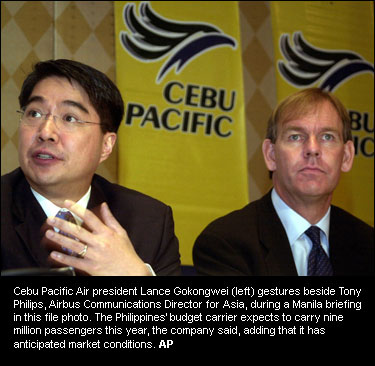
5J to List on May 4

As Regulators approve Cebu Pacific's $265M IPO

March 20, 2010

CORPORATE REGULATORS have approved the initial public offering of Gokongwei-led Cebu Air, Inc., allowing the budget airline to secure almost P12 billion in cash from the equities market.

In an en banc decision yesterday, the Securities and Exchange Commission (SEC) allowed Cebu Air, operator of Cebu Pacific, to list 235.562 million shares on the stock market on May 4. The budget airline will have the stock symbol “CEBU.”

The SEC approved the “offer of [Cebu Air] shares, consisting of up to 125.253 new shares to be issued and offered by the company, and up to 110.309 million existing shares offered by the selling shareholder, and up to 35.334 optional or over allotment shares.”

Cebu Air can offer as much as 164.894 million shares internationally while 47.112 million and 23.556 million shares will be sold to Philippine Stock Exchange brokers and investors, respectively, at a maximum price of P95.00 each.

ATR KimEng Capital Partners, Inc. was tapped as the domestic lead underwriter while the Hong Kong branch of Deutsche Bank AG and J.P. Morgan Securities, Ltd. will be the international underwriters.

Net proceeds from the primary offering were estimated at P11.561 billion.

Last week, Cebu Air said it would use the bulk of funds to be raised from the IPO to buy up to 20 more aircraft within five years.

“It’s going to be for capital expenditures for purchasing airplanes. We have a purchase order from Airbus for 15 Airbus A320 in the period of 2010 to 2015 and an option to buy five more,” said Bach Johann M.

Sebastian, senior vice-president for corporate planning of listed JG Summit Holdings, Inc., in an interview early last week.

Mr. Sebastian said going public was only one option, and that the company could also borrow from export credit agencies. Cebu Pacific can also tap the lease market, he said.

Documents showed the carrier needed to make P9 billion in advanced payments to increase its fleet to 49 by 2014.

The company originally planned to go public in 2008 but postponed the listing due to difficult market conditions.

Cebu Air turned around last year by posting a net income of P3.184 billion, from a net loss of P3.259 billion in 2008. Operating income almost doubled to P3.164 billion from P1.727 billion in 2008.

Shares in parent firm JG Summit Holdings rose to P8.50 apiece yesterday from P8.30 per share on Wednesday. -- Neil Jerome C. Morales, Businessworld

American held in Cebu Airport


for trying to break plane window

By Chito O. Aragon
Philippine Daily Inquirer

March 20, 2010

CEBU CITY —Airport authorities in Cebu detained an 80-year-old American who created a commotion while on board a Philippine Airlines flight bound for [Mactan from Manila] early Friday.

Rex Hampton struck and slightly damaged a window of the airplane that frightened his fellow passengers. When they arrived at the Mactan International Airport before 6 a.m., Hampton was immediately arrested by the airport police, according to Supt. Joselito Salido, chief of the Police Center for Aviation Security at the airport.

Hampton, a native of Portland, Oregon, was behaving normally when he boarded the plane but was reported to have taken “valium,” an anti-depressant medication before he boarded the Cebu-bound flight, said PAL spokesman Simon Canton Jr.

Salido said the management of PAL called them up to ask for assistance about an unruly passenger on a flight from Manila to Cebu at about 5 a.m

Hampton was with his wife, Jovelyn Campilanan, 42, of barangay Malubog, Toledo City, on the Air[b]us 330. The couple came from the United States via Tokyo, Japan, and was bound for Cebu via Manila since there is no direct Tokyo-Cebu flight.

Canton told reporters that Hampton, who sat by the window struck the window using a metal cane. The cane was immediately taken by a flight attendant, with the help of his wife and by some passengers but soon after, Hampton took his bag containing medicines and some documents and threw it against the window, causing some damage to the window.

Canton said the aircraft’s window has three layers of glass and only the first layer was damaged by Hampton.

Canton said the incident happened 30 minutes after the flight left Manila.

Hampton was turned over to the Lapulapu City Police Office Friday afternoon. The airport police filed charges of damage to property and malicious mischief against Hampton at the Lapulapu City prosecutor’s office at past 3 p.m., Salido said.

Canton meanwhile said that the aircraft went back to its normal flights and left Cebu for Manila on schedule at 6:30 a.m. Friday.

PAF to add 18 Trainers

Four new SF-260 to arrive in July

March 19, 2010

Manila - After two years delay, Italian aircraft manufacturer Alenia Aermacchi S.p.A, a Finmeccanica subsidiary, is finally set to deliver $13.1-million worth of defense contract for the supply of 18 brand new SF-260 training planes for the Philippine Air Force.

Complete delivery is scheduled by year end with four units to be delivered in July, a statement from Alenia's local partner said.

Teresa Parian, chief operating officer of Clark-based Aerotech Industries Philippines Inc. (AIPI), Aermacchi's local partner, said the Department of National Defense had agreed to reconstitute the project in 2009 after price escalation problems plagued the contract due to foreign exchange fluctuations resulting to deferral of award.

The contract of Italian aircraft manufacturer Alenia Aermacchi S.p.A was approved in 2008, but the firm began assembling SF-260 planes only late last year due to due to foreign exchange losses.

"We're fast-tracking the assembly of these aircraft to meet the needs of the military," Parian said.

It is not known however if the provisions for training of pilots and technicians, technical assistance and the supply of ground support equipment and spare parts are included in the revised deal as AIPI refused to comment on it.

The Philippines air forces have been using SF-260 trainers since 1973 when the government placed an order for 48 SF.260's divided between 32 SF.260M's and 16 SF.260W's. They were replaced in 1991 by 18 SF-260TP turboprops.

The latest order calls for delivery of the standard SF-260F version powered by 260-hp, six-cylinder Textron Lycoming AEIO-540 D4A5 engines.

“The P622.5 million budget was made several years ago when the peso was worth 42 to the dollar,” Defense Secretary Norberto Gonzales said.

He recently inspected a set of trainer jets being assembled in Clark that were still 40 percent complete.

“The problem all boils down to the value of our currency. The Italians agreed on a contract denominated in dollars and our budget is pegged in pesos. Fortunately, Congress allowed us to proceed with the multi-year obligation for this procurement which will all be delivered this year.” Gonzales said.

He also confirmed that the Aermacchi contract requires the firm to provide the military with a complete training support package, which includes pilots, technical and maintenance training and spare-parts guarantees. Each aircraft costs government $700,000.

There are about 900 units sold around the world and operated by 27 military customers of different countries. Among the operators are Air Forces of Indonesia, Singapore, and Thailand.

Cusi overhauls CAAP

Start works convincing EU against blacklist

March 18, 2010

Brussels - Its a whole new day for the Philippines beleaguered Civil Aviation Authority as its new head appointed 23 technical people—check pilots, cabin crew, accident investigators, aircraft inspectors, and other related positions in a bid to restore the country's image back to world aviation standards.

The man who made possible the tasked required to be done is former Manila International Airport Administrator and now CAAP Director General Alfonso Cusi who worked out the problem his predecessor couldn't and wouldn't do for a million reason.

Cusi, torn between serving his constituent, by planning to run for a congressional seat in the 2nd district of Oriental Mindoro, and serving the greater interest that require of him on his country, opted to served the Filipino at large, by accepting the bigger challenge to run the aviation body he inherited in serious disarray and major image problem.

His first mission is to address the Significant Safety Concerns (SSC) arising from the conduct of safety oversight audits by Geneva based International Civil Aviation Organization (ICAO) under Universal Safety Oversight Audit Programme (USOAP). Second, to regain the country's Category 1 rating labeled by the Federal Aviation Authority of the United States under the International Aviation Safety Assessments (IASA) Program, also based on USOAP findings. And Third, is to make sure that European Union will not blacklist our airlines as a consequence of such deficiencies.

The objective of USOAP is to promote global aviation safety through auditing Contracting States, on a regular basis, to determine States’ capability for safety oversight by assessing the effective implementation of the critical elements of a safety oversight system and the status of States’ implementation of safety-relevant ICAO Standards and Recommended Practices (SARPs), associated procedures, guidance material and safety- related practices.

The conduct of safety oversight audits consist of three phases; Pre-audit, Audit and Post Audit. For the Philippines, the State duty is supposed to ensure that it's national aviation industry meets or exceeds the safety levels established by the SARPs at the pre-audit stage which it failed to correct in a six year cycle.

An on-site audit was later done in October of 2009 where deficiencies were noted and validated by ICAO inspectors and brought to the attention of the government for corrective action. The Philippines has 12 months to resolve the deficiencies before the EU considers blacklisting the Philippines. FAA already downgraded the country to category 2 status since December 2007.

“My first day in office at the CAAP was spent looking at the ‘serious safety concern’ that the Icao had raised last October which I will present at the European Union in Brussels this week,” said Cusi who took his first day of office in March 22.

“I am now confident that the country would no longer be blacklisted by that aviation body.” he adds.

New personnel were hired by Cusi to man the Flight Standard Inspectorate Service to address one of the ICAO findings concerning flight-safety requirements which was also a big concern to the European Union that might affect the operations of local airlines to Europe if the safety concerns are not adequately address.

“If we are blacklisted, that means we are disconnecting ourselves from air routes in EU member countries,” says Cusi.

Director Cusi left for Brussels in Belgium Tuesday where he is scheduled to brief Daniel Calleja, Air Transport Director of the European Union, as to what had been achieved by the agency in compliance with their safety concerns, particularly lack of highly trained technical personnel.

He is also scheduled to brief representatives of the US Federal Aviation Authority later this month and request the Geneva based aviation regulators for the lifting of the significant safety concern during the ICAO Aviation Safety Conference which will be held on March 29-31 in Montreal, Canada.

Because of lack of effective implementation by ICAO to monitor SARP compliance, the US IASA Program was established in August 1992 to address the risk that some States were not implementing the required safety standards. Following the assessment, IASA assigns a rating (Category 1 – in compliance; Category 2 – not in compliance;) to the assessed State regarding its level of compliance with the SARPs.

The Philippines was listed twice in Category 2, once in 1995 during the first round of assessment and 12 years later in 2007 when it becomes clear to the US that the Philippine government reneged its promise of compliance agreed 10 years ago.

The Federal Aviation Administration assessed CAAP's predecessor in July 2007 and found serious concerns about the agency's inability to conduct consistent, and effective safety oversight.

Meanwhile, In 1996, EU launched the Safety Assessment of Foreign Aircraft (SAFA) Program to assess compliance with ICAO Standards by ramp inspections of aircraft landing in any of its members. By 2001, EU member States were obliged to "ensure that third-country aircraft suspected of non-compliance with international safety standards landing at any of its airports open to international air traffic [should] be subject to ramp inspections".

On December 14 2005, the European Parliament and the Council of the European Union promulgated Regulation (EC) No. 2111/2005 and established a Community list of air carriers subject to an operating ban within the Community for non-compliance with international safety standards. As of 24 July 2008, 156 airlines were subject to an operational ban within the European Union Airspace.

While the US IASA and EU SAFA findings are sometimes political in nature, the ICAO audit is not and is obligatory which must be complied by the Philippines. Unanimous assessments speaks clearly of the need to addressed the safety concerns.

Both programs however generate an adverse impact against a State economy or any of its airlines, resulting in economic losses for the State's transportation, commerce and tourism. Nevertheless, these programs have encouraged compliance with the Annexes of the Chicago Convention by exposing SARPs deficiencies.

Eduardo Batac, director of the CAAP’s Flight Standard and Inspectorate Service, said that although the Philippines has no direct route to Europe at the moment, there are many European nationals who come to the Philippines as tourists or businessmen who avail of the country’s air transport system and the EU is concerned about their safety.

Batac said if the EU decides to blacklist the Philippines, Philippine Airlines may be refused landing and overflight rights in EU countries.

According to Batac, one of the concerns brought up by the US Federal Aviation Administration, the ICAO and the EU’s Universal Safety Oversight Audit Program is the “inability of the Philippines to recruit and retain qualified technical personnel.”

“In the past some highly trained technical personnel were recruited but left for greener pastures,” he said.

As its first step of redeeming the world aviation standard, the Philippine delegation is set to convince the European Regulators that despite some regulatory issues, its local airlines flying international flights are up to standards with the rest of the world.

“Our delegation will prove that the Philippine aviation system meets safety standards and that the blacklisting is not necessary,” Alfonso Cusi said.

Cusi's delegation includes Director Batac; Efren Rocamora, CAAP commercial air transport chief; Carl de Guzman of the airworthiness department; Batac’s technical assistant, Nestor Pasano; and Cusi’s executive assistant, Teresa Mendoza.

Philippine Airlines is sending senior vice president Beda Badiola, vice president for operations Johnny Andrews, and flight safety head John Steinberg.

Cebu Pacific has sent vice president for flight operations Victor Custodio and chief operations adviser Mark Breen.

Philippine Airlines fleet is maintained by Lufthansa Technik Philippines, a world renowned MRO provider, while its LCC counterpart Cebu Pacific is maintained by Singapore based SIA Engineering. Both boast new aircraft on its fleets.

PAL expects losses in FY 2010


Written by Lenie Lectura

Wednesday, 17 March 2010

FLAG carrier Philippine Airlines (PAL) expects another round of net loss for its fiscal year ending March 2010 brought about by the global economic slowdown that continues to depress passenger traffic.

But for the next fiscal year, PAL is looking at improved revenues and passenger traffic, particularly in its overseas routes. The company expects the airliner may break even by end-March next year if the aviation industry’s standard is upgraded to Category 1 from Category 2.

“If the government will be successful in upgrading the category we will almost break even as we will be able to fly to the US using the Boeing 777,” said PAL president Jaime Bautista told reporters on Monday.

The January 2008 decision by the US Federal Aviation Administration (FAA) to downgrade the standard of Philippine aviation prevents PAL from increasing its flights to the US or from switching the type of aircraft being used in the route. The next inspection by the FAA may take place within the year or in 2011.

If the restriction will finally be lifted, PAL said it will expand its presence in the US market by opening new services to San Diego, New York and Chicago. PAL may also mount additional flights to San Francisco if demand is strong.

“Even if the upgrade happens toward the last half of the year we will be happy. We’re hoping that we will recover next year. We are seeing good signs,” added Bautista.

As a result of the category downgrade, PAL has asked aircraft manufacturer Boeing to delay the delivery of four B777 aircraft. “We have made arrangements with the aircraft manufacturer. Originally, we [were supposed to] take delivery of two more [aircraft] this year and [another] two in 2011 but because of the decline in traffic and the Category 2 downgrade, we were able to negotiate with Boeing to defer delivery to 2012 and 2013,” said the PAL executive.

PAL, in its fiscal year ending March 2009, recorded a net loss of $301 million from a net profit of $30.6 million in the fiscal year ending March 2008.

With only two more weeks before the end of PAL’s fiscal year, Bautista said PAL will likely be in the red again. “Last year, we lost so much. We are one of the airlines which were affected by the crisis so we are expecting another loss, definitely smaller than last year,” said Bautista.

From April 2009 to March 2010, Bautista said PAL will report over 9 million passengers, revenues of about $1.5 billion and a slightly lower net loss compared with the year-ago figure.

In the same period, PAL sees a 5-percent decline in the number of recorded passengers who traveled outside the country and a 10-percent increase in domestic passenger traffic.

“PAL, this year, we will be carrying more than 9 million passengers. We will be happy if there will be a 5-percent drop in international passenger traffic, although in domestic we’re expecting a modest growth as [what] we experienced this fiscal year. We have a growth in domestic passenger traffic of more than 10 percent and a minor decline of 5 percent for overseas,” said Bautista.

PAL also wants to resume flights to India. “We wanted to fly from Manila to Bangkok and [then] to India—either Mumbai or Delhi. But we were not permitted to pick up from Bangkok by the Thai government,” said Bautista.

At present, the flag carrier is appealing to the Philippine government to help negotiate landing rights for PAL so it could service the Manila-Bangkok-Bombay route, said Bautista.

“The problem is the landing rights. We are talking to the government to negotiate for landing rights,” said Bautista.

GMA scraps $100-million Clark airport deal with Kuwait firm


By Ding Cervantes

March 16, 2010

CLARK FREEPORT, Pampanga , Philippines – President Arroyo has directed the scrapping of the Kuwaiti Al Mal Consortium in the list of possible contractors for a $100 million passenger terminal at the Diosdado Macapagal International Airport here amid controversies.

Reliable sources from Malacañang and the Clark International Airport Corp. said the President relayed her directive to former Malacañang public affairs secretary Edgardo Pamintuan during her visit to her hometown in Lubao on Saturday.

“Cut it (any negotiation with Al Mal),” an angry President was quoted to have said. Mrs. Arroyo was reported to have been angered by reports linking her to Al Mal’s interest in the terminal project. Al Mal is a subsidiary of the Kuwaiti firm M.A. Kharafi and Sons.

Pamintuan said in a text message that the President was supposed to meet about this with CIAC president Victor Jose Luciano, CIAC executive vice president Nestor Mangio, and CIAC executive vice president Alex Cauguiran at the Haribon aviation complex of the Philippine Air Force before flying to the Visayas yesterday morning.

“Let’s make it (President’s directive) after she has met with them,” he said.

Reached by phone, Mangio, who has been pushing for Al Mal as contractor for the project apparently retained hopes that the Kuwaiti firm, with its local partner Al Mal-Pride, would still get the project amid a seven-day deadline imposed on Friday, for it to agree to CIAC’s terms of agreement on the project.

“The President went to the Middle East last year to look into the capability of Al Mal to undertake the airport project. We were impressed by the airport project it built in Egpyt,” he said.

A CIAC source said yesterday that a statement was supposed to be released after a meeting of its board late in the afternoon to officially announce the termination of negotiations with Al Mal-Pride as the President had directed.

Terminate negotiations

“We are terminating the negotiations with the Al Mal-Pride consortium due to the non-acceptability of their proposed terms and conditions for a possible joint venture agreement with CIAC for the development of various components of DMIA complex,” the statement said.

The statement said that “out of respect for the other party and until they have officially received our written communication, we will have to refrain from discussing those grounds for the rejection of their proposal.”

But it also said “we categorically deny any attempt to railroad the award of the project to Al Mal-Pride consortium. Records will bear out that Al Mal’s unsolicited proposal to develop the DMIA was first submitted all the way back to April 2008.”

“CIAC had been very careful and judicious in negotiating the terms of our agreement. But while we needed to develop DMIA through the entry of much needed foreign investments, we also needed to protect public interest and make sure we will not violate the law. It was a difficult balancing act,” the statement further said.

CIAC executive vice president Cauguiran said that Al Mal had been pushing for onerous provisions in its version of TOR, including the prohibition of any operation of a premiere airport within a 150-kilometer radius of the DMIA.


Clark International Airport Corp. (CIAC) chairman Nestor Mangio said he is “open to resignation” after President Arroyo ordered the junking of the Kuwaiti firm Al Mal as contractor for the $100-million Terminal 2 of the Diosdado Macapagal International Airport (DMIA) here.

This, as Max Sangil, director of the Bases Conversion Development Authority (BCDA), urged Mangio to “resign out of delicadeza” after the CIAC board again rejected Al Mal last Monday as contractor for the project, as directed by the President.

“I am open to resigning and I will think about this,” Mangio said, adding though, “Personally, I am quite convinced that Al Mal is the best contractor for the development of the DMIA.”

“We have been looking for a contractor for the past two years and all, except Al Mal, failed in financial capability,” he said, pointing out that M.A. Kharafi and Sons, Al Mal’s mother company, has been listed by Fortune Magazine as among the world’s richest.

CIAC executive vice president Alex Cauguiran said that while the plan was to bid out only the construction of Terminal 2, Al Mal also wanted to take over the existing Terminal 1 and have control over 1,500 hectares of the 2,500-hectare civil aviation complex in this freeport.

Cauguiran added that Al Mal demanded that no premiere airport be operated within a 150-kilometer radius of the DMIA for 45 years, extendable for another 25 years.

“This would deprive other provinces the same chance to host a premiere airport that we fought for before the DMIA was developed,” he said.

Al Mal’s proposal was first junked in December 2008 but was later revived after the CIAC failed in its initial bidding for the project.

Apart from Al Mal, which Mangio has allegedly pushed, other proposals for the Terminal 2 project have come from a Malaysian consortium with partners from the United States and the Middle East, and a South Korean consortium with local partners.

Because of Mangio’s alleged insistence to consider Al Mal for the DMIA’s development, Sangil said the construction of Terminal 2 has been delayed. “The timetable was disrupted,” he said.

Mangio, however, said Sangil has been blaming him for his removal as a member of the CIAC board last December.

“But I had no control over rules and regulations. There is a prescription against one person being a member of both the boards of CIAC and BCDA. Later I found out the President had signed the appointment of Raffy Angeles as his replacement in the CIAC board,” Mangio said.

He alleged that Sangil worked for his appointment to the BCDA board since the directorship is not co-terminus with the term of President Arroyo.