Banned

MIAA Closes Airport to General Aviation, 
Opens Sangley to Commercial Traffic

1 August 2013

The Civil Aviation Authority of the Philippines (CAAP) has issued an order limiting flights of general aviation traffic from using Ninoy Aquino International Airport beginning July 31.

In its stead is the Sangley Airport in Cavite which begins its first commercial traffic since its inception as a military airport by the Americans in 1945.

The restriction was issued by Transport Secretary Joseph Emilio Abaya on June 28 under Department Order No. 2013-08.

In a statement by  CAAP Deputy Director General John Andrews during a press briefing this afternoon, the flight restriction covers corporate jet and air taxi landings and take-offs at NAIA to only two cycles per hour, which is equivalent to two take offs and landing from 11 PM to 11 AM only.

General Aviation flights used to have seven to eight cycles per hour, according to Andrews. 

With the opening of Sangley Airport,  all the general aviation flights will eventually be transferred in Cavite, as well as small propeller and turboprop flights soon, making NAIA a jet-only airport as it prepares to accommodate the arrival of 12 widebody jets of both PAL and CEB this year. 

In a separate statement, Angel Honrado, Manila International Airport Authority General Manager, said the new policy will raise NAIA's rated capacity to 42 landings and take-offs per hour from the present 40 with the reduction of Genav traffic.

“We will be able to minimize delays and cancellations,” Honrado said.

Honrado added that NAIA was able to handle as high as 52 events (landing and take offs) per hour in the past but because of high delay incidence they were able to reduce congestion to as low as 36 events in past two years.

NAIA registered an average of 550 aircraft movements daily with 450 planes using runway 06-24, while  runway 13-31 handles 100 planes on average per day.

General Aviation planes causes delay in congested airport because they occupy a lot time on approach and landing due to their speed limitation as compared to the faster jet which can vacate the runway through the rapid exits in less than 60 seconds as compared to the props which takes almost 120 to 180 seconds from final approach to landing.

MASWings Apply Permit to Fly South

 PPS, CEB, ZAM, DVO Finally!

31 July 2013

Malaysia Airlines subsidiary MASwings has finally applied with the Civil Aeronautics Board (CAB) for “Foreign Air Carrier’s Permit (FACP) to operate international scheduled air transportation services” in the Philippines. 

MASwings intends to fly to Puerto Princesa in the Philippines from Kota Kinabalu, says its Chief Commercial Officer, Shauqi Ahmad after deferring its application couple of times in the past due to adverse market conditions. 


Flight is expected to begin at the end of the year after securing regulatory approvals.

Ahmad said it will be the airlines first destination in the Philippines and the route will be flown using ATR 72-500 planes.
The airline intends to open additional destinations in Zamboanga, Davao and Cebu from Kota Kinabalu and Sandakan after launching flight to Puerto Princesa.


Parent Malaysia Airlines recently confirmed an order for 20 ATR 72-600s and 16 options valued at $840 million which will go to its Firefly and MASWings subsidiaries beginning in mid 2013.


MASwings currently operates a fleet of 10 ATR 72-500 similar to those being used by Cebu Pacific. It expects to receive 16 of the newer generation ATR 72-600 for flights between BIMP- EAGA Region.

Cebu Pacific Orders Two More A330

27 July 2013

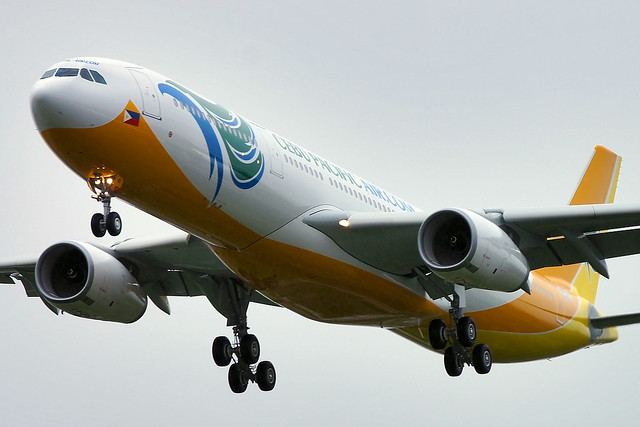
Cebu Pacific sealed operating lease agreements for two additional Airbus A330-300 from US-based Intrepid Aviation for 2014 to 2015 delivery as it targets more destinations in Asia Pacific and the Middle East, a statement on Wednesday revealed.
The airline is doing rotation daily of its first A330 to Singapore and Seoul. The second A330 is scheduled to fly Dubai and the third on order is scheduled to fly Melbourne with the fourth one also slated for middle east run.

Why FEDEX Can't Fly


FEDEX must be Filipino Owned


By Edu Punay


22 July 2013

The Court of Appeals (CA) has effectively stopped the operations in the country of international forwarding firm Federal Express (FedEx).

FEDEX has to comply the 40% Ownership to fly the Philippines
The fourth division of the appellate court last week voided the permit granted in 2011 by the Civil Aeronautics Board (CAB) to Federal Express Pacific Inc.

The CA ruled with finality that FedEx’s operations in the country violate the constitutional ban on foreign ownership of firms delivering public utility services.

In a two-page resolution released last week, the CA denied the motion for reconsideration filed by FedEx.

Instead, it affirmed its decision last Jan. 23 which held that FedEx is a foreign corporation and could not engage in public utility services such as international airfreight forwarding.

The court reiterated that FedEx’s operations are detrimental to the interest of local competitors and of the Philippine economy as a whole.


“We hereby declare respondent Federal Express Pacific, Inc., a ‘foreign corporation,’ disqualified in our country from operating as an ‘international airfreight forwarder’ which is clearly a public utility,” read the ruling penned by Associate Justice Danton Bueser.

Associate Justices Amelita Tolentino and Ramon Garcia concurred in this decision.

With the new ruling, the May 2, 2011 resolution of the Civil Aeronautics Board (CAB) granting Federal Express Pacific Inc. a regular permit to operate international airfreight forwarding has been “null, void and of no further force and effect.”

As basis, the CA cited Article XII Section 11 of the Constitution, which provides that “operation of a public utility shall be granted to Filipino citizens or to corporations or associations organized under the laws of the Philippines.”

The CA was ruling on petitions filed by Merit Freight International Inc. and Ace Logistics Inc., questioning CAB’s decision to grant FedEx a regular permit to operate international airfreight forwarding.

In questioning CAB’s decision, Merit argued that international airfreight forwarding is a public utility reserved for qualified Filipino individuals and corporations as embodied in the 1987 Constitution.

Ace, for its part, said CAB erred in granting permit to operate to Federal Express Pacific Inc. despite the fact that it is a 100 percent foreign-owned and foreign-based corporation.

In granting the petitions, the CA also cited a previous resolution by the CAB dated June 1, 1990, directing Royal Cargo Corp., a company whose president then was a foreigner, to relinquish its top position to a Filipino national in accordance with Article XII Section 11 of the 1987 Constitution.

Royal Cargo questioned CAB’s resolution before the Court of Appeals, which ruled that the petitioner is covered by restrictions embodied in the 1987 Constitution.

The court also rejected Federal Express’ argument in its appeal that Merit has no legal standing to question its application for a regular permit and no personal stake in the outcome of the case.

The CA ruled that Merit, as a citizen, has the requisite locus standi – or the right to bring an action to be heard in court – to question the matter.

Toronto Stays

21 July 2013

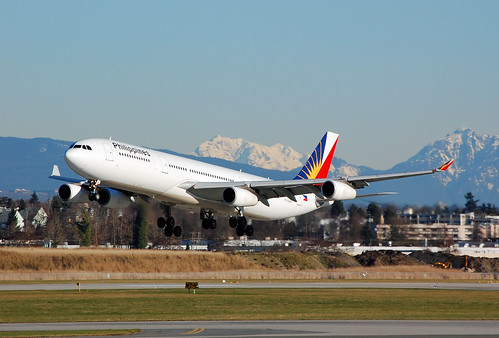
Philippine Airlines has re-considered yesterday its decision to axe Toronto from September 18, 2013 by announcing that it will continue to fly eastern Canada three times a week.

The airline said it has secured approval to lease two more A340-300 to support this route and its growing long haul network.

Earlier, PAL said it terminated the service because it wont have the aircraft to service Toronto.

LTP Upgrades A380 Hangar for MRO


20 July 2013
  
Lufthansa Technik Philippines will spend US$20 million
this year to expand its MRO) operation in Manila
Lufthansa Tecknik Philippines (LTP) announced a $20 million expansion of its A380 hangar to accommodate aircraft overhaul from the present cabin modifications.

At the sidelines of the company's stockholders meeting, MacroAsia president Joseph T. Chua said the expansion is necessary to address the needs of its clients, particularly Qantas.

LTP is a joint venture between MacroAsia and Germany's Lufthansa Technik AG, providing line and base maintenance as well as MRO services to at least 50 customers from around the world in its facilities at the Ninoy Aquino International Airport, Clark , Cebu and Davao.

Among LTP's long time base customers are Qantas Airways, Cathay Pacific, Virgin Atlantic, Lufthansa Airlines, Austrian Airways, Swiss Airlines and Philippine Airlines. 

Line customers include among others Qatar Airways, Hawaiian Airlines, Japan Airlines, ANA, China Eastern, Air China, Cebu Pacific, Air Niugini, Eva Air, Etihad, China Airlines and Korean Air

EU Ambassador Argues Why Flying Direct Matters

19 July 2013

By Guy Ledoux 
Ambassador of the European Union to the Philippines

"The lifting of the EU air ban for Philippines Airlines
on 10 July opening the door for direct flights to Europe
is significant in today’s world where time is precious."
One month ago, I took the plane for Brussels to attend the EU-Philippines Senior Official meeting. As I was in the check line, I learned that the computer system of the airline I was using had broken down and the checking was done by hand. 

We were back in the old age where the airline attendant was writing your name and seat number by hand on your boarding pass. Inevitably the boarding time was delayed by 2 hours. 

When I was finally comfortably seated in the plane a very strong storm hit the airport and we had to wait another two hours for the weather to improve so that we could take off. 

Of course with that sort of delay, I missed my connecting flight and instead of arriving at 7 a.m. in Brussels I arrived at 6 p.m. I must emphasise that the delay was not related to the airport nor to the local staff. These sorts of situations happen. I was however upset that I could not enjoy the short break I had planned which included the visit of the newly renovated Rijks museum of Amsterdam.

In our modern world, travellers, whether for business or leisure, expect airlines to be on time. When it is for business, a late arrival might result in an important meeting with a customer missed. When it is for leisure, time is also precious and one prefers to spend a few hours more on the beach than in a cramped airplane parked on the tarmac.

The lifting of the EU air ban for Philippines Airlines on 10 July opening the door for direct flights to Europe is significant in today’s world where time is precious. The re-introduction of direct flights will bring the travel time between Manila and Paris or Manila and London from around 17:00 h to 12:00 h. Businessmen and tourists will appreciate the absence of connecting flights with all the related inconvenience such as transit time, transit formalities and risk of losing luggage.

The Philippine government considers tourism one of its key growth industries that should contribute to providing much needed jobs. The beauty of Philippine beaches and diving opportunities undoubtedly represent a key comparative advantage for the Philippines. In 2012, European tourist arrivals in the Philippines were up 10%, with 349,000 visitors, despite the absence of direct flights. Direct connections will provide a strong additional incentive for European tourists to visit the Philippines.

The lifting of the air ban, starting with the national flag carrier, demonstrates that the Philippine government is following a steady path of reforms. Having identified tourism as a growth industry it concentrates its efforts on progressively eliminating all bottlenecks affecting the sector. By renewing its fleet with an order of 67 new planes from Airbus, Philippine Airlines will offer its customers attractive direct flights from Europe and local investors are building new hotel facilities showing that the private sector is following suit. These combined efforts will definitely validate the department of tourism’s slogan: Its more fun in the Philippines. (Published on the Philippine Star on July 19, 2013)


Too Ambitious!

CAPA labels PR flight to EU too risky

19 July 2013

After 15 year hiatus, Philippine Airlines (PAL) will be back in Europe with ever increasing and tense competition to the region amidst recession in the EU area. Can PAL survives the competition?

The Centre for Asia Pacific Aviation (CAPA) thinks otherwise and labelled the airlines desire to fly to Europe as "overly ambitious".

In its analysis, it found that its better for PAL to focus its attention "on the better performing Asia-Pacific market" which CAPA said is generally a more profitable option, considering the present economic environment.

"A large online network could help and quickly build PAL’s brand in the European market, where the carrier is relatively unknown. But operating several 12 to 13-hour routes in a market that is highly price sensitive and has limited premium demand is very risky", it said. 

CAPA added that "Such long-range flights are expensive to operate and PAL could struggle to achieve the yields necessary to make the routes viable, particularly as it will need to price competitively against more economical one-stop products".

Philippine Airlines (PAL) Chief Operating Officer and President Ramon Ang has different perception in mind saying that they have studied the European market more than once for so long that they are certain to be competitive in the Europe-Asia market. Its market study also found that daily flights to major European destinations gets better results than having to fly on odd-even days.

Ang said that PAL's ticket prices will be "very competitive" with other airlines, which offer economy seats from Manila to London at $1,200 or about P52,000.

PAL is targeting close to 1 million migrant workers in Europe as well as leisure travellers heading to the Philippines. But CAPA maintains that Gulf carriers are in better position to carry European tourist to the country given their much larger European networks.