Sleepless in NAIA 1? Not anymore


19 June 2014

Rudy Santos

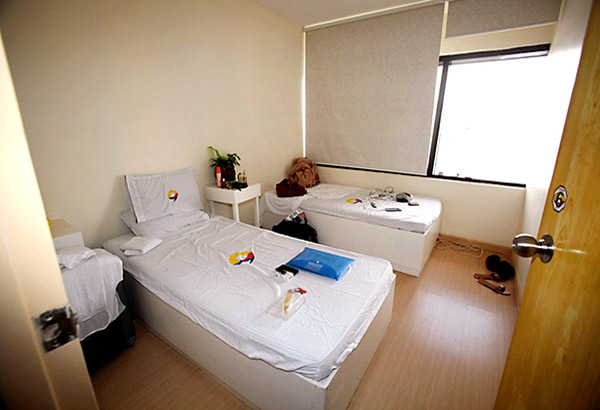
Passengers waiting for connecting flights at the Ninoy Aquino International Airport (NAIA) Terminal 1 can actually avail themselves of facilities where they can rest in comfort.

NAIA-1, tagged as the world’s worst airport last year by travel website sleepinginairports.com, in fact has clean and comfortable sleeping accommodations for passengers.

Twelve air-conditioned “day rooms” can be rented for P840 ($19) each for 24 hours. The rooms are located on the fourth floor of Terminal 1 right beside the Sampaguita lounge, which is being refurbished as part of improvements being done at NAIA.

Each room, measuring 3x3 meters, has a private toilet and shower.

A similar facility was set up in 1983 at the arrival area near the immigration section, but it was closed on March 23, 2012.

The new sleeping facilities opened on Sept. 5 last year but are little known.

Portia Ortiz, airport operations assistant, said most of the occupants of the rooms are foreigners with connecting flights as well as “excluded” passengers or those with immigration problems.

The day rooms have a strict no smoking policy, according to Ortiz.

Travel website Sleeping In Airports, in its Best and Worst Airports for 2013, tagged NAIA as the world’s most notorious airport.

NAIA 1 was first named as the world’s worst airport in 2011 and the worst in Asia in 2012.

The website’s list of best and worst airports in the world is based on the votes of travelers who were asked to consider comfort, convenience, cleanliness and customer service.

Some of the factors for the “worst airport” tag are crowded terminals, long delays, difficult transfers, lack of 24-hour food, dirty floors, bathrooms and food courts; unfriendly staff and airport scams, among others.


PH, Macau increases Flights

18 June 2014

The Philippines and Macau have signed a new Air Service Agreement increasing the current entitlement of 4,500 seats for additional 2,520 weekly seats to the current allocation.

The new agreement increases the entitlement to 7,020 weekly seats.

The existing air service agreement with Macau was signed in 1997, with the last negotiation for increased passenger traffic held in June 2013, when both countries agreed to increase seat entitlement to 4,500 seats a week from 3,500.

CEB Abandons Melbourne, Flies Sydney Instead

Opens Kuwait

17 June 2014


Cebu Pacific has changed its mind and has abandon Tullamarine Airport in Melbourne to fly direct to Syndey in Australia Beginning 9 September 2014.

In a press conference Monday,  Cebu Pacific president Lance Gokongwei said they will also introduce Kuwait in the Middle East starting 2 September and open up Saudi Arabia early next year.

Meanwhile, Cebu Pacific Vice president for long-haul operations Alex Reyes said the airline would fly 3 times a week to Kuwait, starting September 2, and 4 times a week to Sydney, starting September 9 using Airbus A330-300 for the new routes.

Canada Doubles Air Rights

Agrees 14 flights per week, Clears New York!

28 May 2014


Canada has agreed to double the number of flights to the Philippines from the present seven agreed in May 2008 to 14 flights a week today.

Fifth freedom rights to the United States was also increased from four to five times per week upon the request of Philippine Airlines (PAL) which intend to introduce flight to New York via Vancouver in British Columbia, or Toronto in Ontario abolishing seat restrictions in exchange for code share rights. PAL used to fly four of this rights to Las Vegas Nevada before terminating the route in December 2012 due to poor loads.

Air Canada does not fly to the Philippines, but the new Air Services Agreement allow the airlines of both countries to enter into third-country code-sharing. A third country code-sharing happens when airlines like Air Canada for example put their Airline code for PAL flights to New York in the United States which also agree to jointly market the route. Fifth Freedom traffic is usually restricted to 50% of the aircraft capacity calculated in annual basis.

The same agreement calls for the same fifth freedom rights to Canadian carriers from Manila to Australia.

Canada’s Ambassador to the Philippines Christopher Thornley said that PAL is proposing 14 flights a week to Vancouver with onward connections to New York and Toronto.

The air talks were held in Manila from 26 May to 27 May, agreement and confidential memorandum of which were signed today May 28.  The air services talks with Canada was originally set for June 27 to 28 meeting but was reset earlier by Canadian transport officials.

SMC and Sangley Airport Project Consolidates

24 May 2014
This blog break this story long before it became official. You can read the still classified story here

By Miguel R. Camus
Philippine Daily Inquirer

The Department of Transportation and Communications will consider a San Miguel Corporation proposal to build a $10-billion international airport in a former US naval base in Sangley Point, Cavite as part of a “dream” infrastructure plan, Transportation Secretary Joseph Abaya said.

Abaya said in a recent interview that the Sangley airport project, which would require about 2,000 hectares of reclaimed land and support four runways, was ready to be presented to the board of the National Economic Development Authority, chaired by President Aquino.

The Sangley airport proposal was prepared by the Japan International Cooperation Agency, which included the massive alternative air gateway as part of a Metro Manila transportation “dream plan” aimed at easing congestion in the capital district through various mass transportation solutions.

“The dream plan is about to go to the Neda board,” Abaya said. “Jica needs Neda approval on their dream plan before they conduct the FS [feasibility studies].”

The Sangley airport proposal and that of San Miguel Corp. are aimed at providing alternative sites to Manila’s Ninoy Aquino International Airport, which has been suffering from congestion issues partly due to limitations from its single primary runway.

Abaya said the proposed airport in Sangley was similar in size to the 1,600 hectares San Miguel would need to reclaim for its airport project near the CyberBay Corp. reclamation project in Manila Bay.

Abaya said JICA’s airport project was estimated to cost “in the same ballpark” as the $10-billion airport proposal of San Miguel, which partly owns flag carrier Philippine Airlines.

While acknowledging that a new airport serving Metro Manila would not be completed by the time Mr. Aquino steps down in mid-2016, Abaya said the government was keen on laying the groundwork like starting land acquisition and reclamation activities within the next two years.

“We are hoping to start that and show we are committed to the project,” Abaya said. He said the government would likely enlist the private sector’s support for an airport project of this scale via an open bidding process.

San Miguel president Ramon S. Ang earlier said that an open bidding was acceptable should the government choose San Miguel’s proposal.

Ang also said he was keen on partnering with other local conglomerates like Ayala Corp., Henry Sy’s SM Investments and the Gokongwei Group’s JG Summit Holdings.

Government Sticks To Sangley Project

23 May 2014

The Department of Transportation and Communications (DOTC) said Thursday that studies for the establishment of International Airport in Mega Manila replacing Sangley airport in Cavite will continue despite offers from San Miguel Corporation (SMC) to build a $10 billion international airport in CyberBay Corp.’s disputed waterfront reclamation project in Manila Bay.

DOTC Secretary Joseph Emilio Abaya said that government also has its own plans of putting up a new international airport in Sangley by 2027 capable of  supporting 4 runway adjacent to where SMC wants to build their airport.

SMC Airport still has to be approved by Philippine aviation regulators, design of which this early appears to cross wind direction as against flying with the wind, an essential element of building airport runways.   

The new airport plan is part of the transport roadmap that seeks to address growing passenger volume in the country. 

The Civil Aviation Authority of the Philippines (CAAP) is constructing a parallel runway next month to address congestion at the Ninoy Aquino International Airport (NAIA) while waiting for the new airport to be completed in 2027.

CAAP Deputy Director General John Andrews said the parallel runway will be completed in 2 years at the cost of 2 billion pesos.

Parallel runways boost airport capacity from less than 40 events an hour to between 60 and 70 per hour, resulting to massive decongestion to about 80 percent of NAIA's air traffic which will allow the airport to grow more capacity in excess of 40 million. 

Andrew said the new parallel runway is only intended for domestic flights and can accommodate aircraft as big as Airbus 321's and Boeing 737-900's comprising majority of all commercial flights in Manila.

The Japan International Cooperation Agency projects passengers from the greater capital region to hit 106.7 million by 2040 from 31.88 million in 2012.

PH Signs ASA With Burma

22 May 2014

The Philippines has signed a new air services agreement with Myanmar on Tuesday allowing designated airlines of the Philippines and Myanmar a total of 3,780 seats a week or equivalent to three flights a day between Manila and three international airports in Myanmar.
Both countries also agreed on unlimited traffic rights between all points in the Philippines, except Manila, and between all points in Myanmar.

Air Services Agreement with Myanmar was originally signed in 1979 but no airline flew this route.

PPS Builds New Terminal

Kumho-GS wins bid

21 May 2014

Department of Transportation and Communications (DOTC) has unveiled on Tuesday the new US$82.9 million terminal building with capacity for 2 million passengers in Puerto Princesa Airport, scheduled to open in March 2017. 

Construction of this projcet was funded through the Korean Export Import Bank (KEXIM) loan amounting to $71.6 million while the rest is funded by the Government of the Philippines (GOP). The loan is payable in 40 years, inclusive of a 10-and-a-half-year grace period, at an interest rate of 0.1 percent a year. 

Bidding for the project was limited to South Korean companies in accordance with the Guidelines set for Procurement of Korea’s Economic Development Cooperation Fund (EDCF), and was awarded to Kumho Industrial Co. Ltd.-GS Engineering and Construction joint venture (Kumho-GS), which is set to start work on a new passenger and cargo building, apron, taxiways and navigation facilities by the end of this year.

In 2013, Puerto Princesa Airport registered 1.34 million travelers against the 350,000 passenger capacity terminal building.