Showing posts with label Baguio Airport. Show all posts

PAL Ends Baguio Flight

Citing Poor Sales

30 May 2024

Flag Carrier Philippine Airlines (PAL) is ending its flight from Cebu to Baguio effective July 1, 2024 due to poor passenger traffic.

“Passengers of the cancelled flight Cebu-Baguio-Cebu will be provided the necessary assistance and refund,” the flag carrier said.

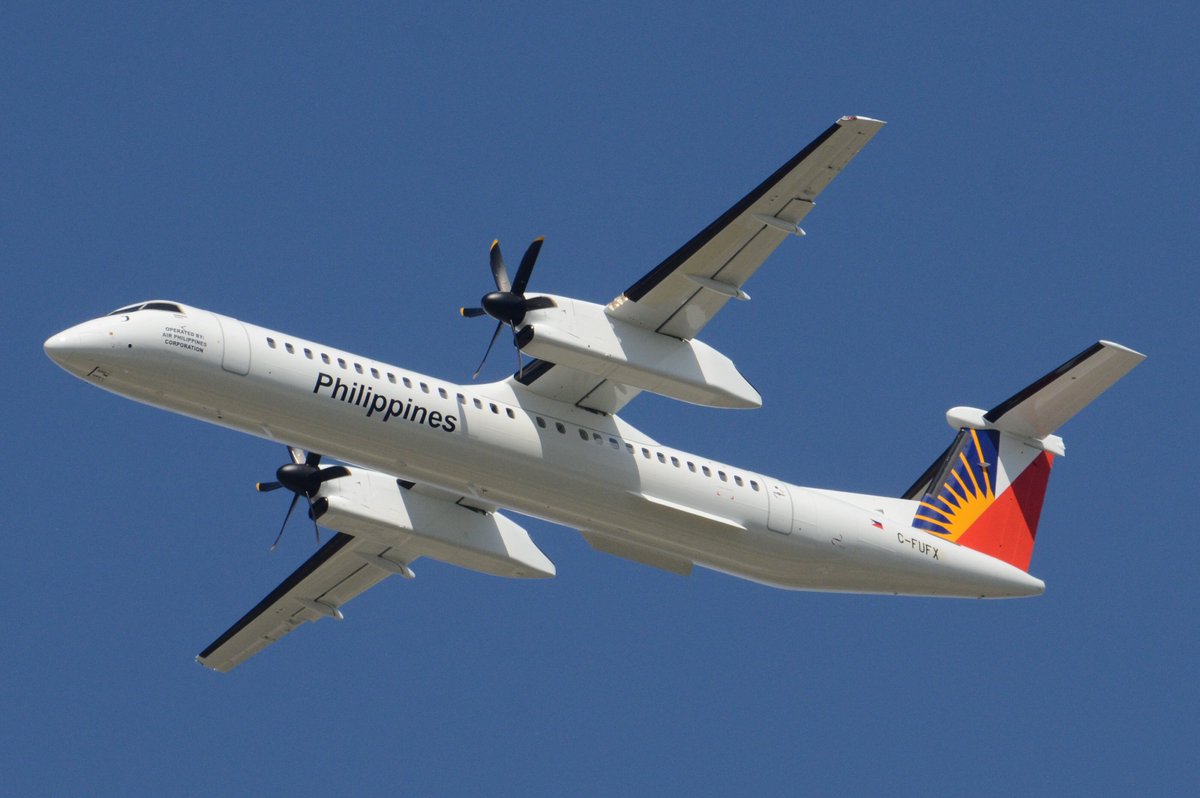
PAL launched its four times a week Cebu-Baguio flights in December 2022 using the De Havilland Canada Dash 8 Series 400 NG aircraft, but poor passenger loads prompted the airline to terminate the route as flights become economically not viable.

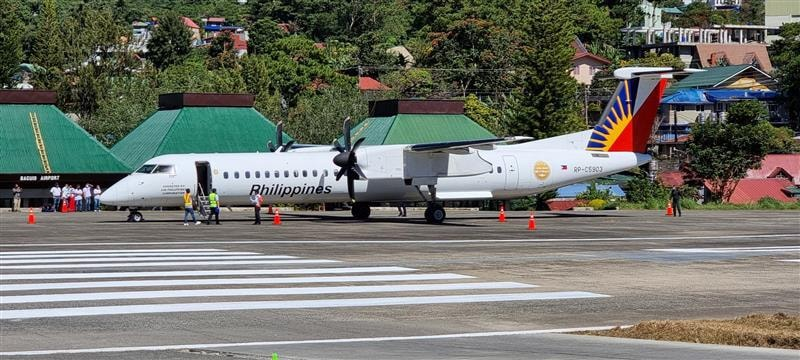
PAL Arrives Loakan

 From One Salute To Another

17 December 2022


PAL Flies Loakan-Cebu

Flight Commences From December Onward


6 October 2022

Flag carrier Philippine Airlines (PAL) will fly Cebu-Baguio-Cebu four times a week effective second week of December 2022 according the airline executive. 

The flight will depart at 9:20am from Cebu arriving 11:20am in Baguio.  Return flight is scheduled at 1:20pm arriving Mactan Cebu at 4:20pm.

PAL President and Chief Operations Officer Stanley Ng  said that safety audit of Loakan Airport is currently being conducted for the operations of 86 seater Bombardier Q400 turbojets.

"Will have the date fixed when the safety audit is approve," say Ng.

Ng said the audit is needed since the Q400 they are flying is the biggest passenger plane to land at the airport which used to cater before the 50 seater Fokker 50s which the airline used to operate at the airport 25 years ago.

"F-50 was the biggest passenger plane that operate at this airport before and we are flying now even bigger turpoprop plane." he said, referring to the DHC8-400NG plane.  

A second thrice a week flight to Davao is also on the agenda of the flag carrier.

The airline said they will post updates as to the commencement of the flight soon.


DOTr To Open Baguio For Commercial Traffic Next Year


 30 August 2022

The Department of Transportation (DOTR) is earmarking 68 million for rehabilitation of Loakan airport terminal as it prepares itself to accommodate commercial traffic next year.

Director General Capt. Manuel Antonio Lara Tamayo of the Civil Aviation Authority of the Philippines (CAAP) disclosed over the weekend that Baguio airport is in bad shape and too small to accommodate passenger traffic on the biggest turboprop airline intends to operate.

"The biggest plane it used to received was the Fokker 50 which is a 50 seater plane. Nowadays, airlines used a 80-90 seater plane," says Tamayo.

PAL earlier manifested intent to fly Manila-Loakan 5 times a week should airport reopens to the public using Q400 aircraft.

The Director General said the current passenger terminal cannot handle that number of people.

"And that is not the end of the problem for Loakan. We still have to contend with other airport facilities, such as navigation, drainage, runway safe areas, and the weather which could be problem for airlines," Tamayo adds.

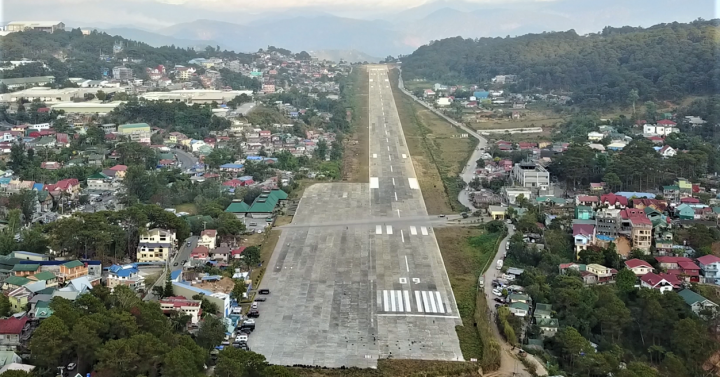
CAAP is looking to extend the length of the runway by at least 100 meters from the present 1,683 meters, and clear natural and man made obstructions along the airside.

"Its a safety concern. It would not be a problem if a small plane is used. But airline operators got bigger planes now." says the CAAP head.

At least 35 natural obstructions were listed by the air regulator as plane hazard that needs to be removed within the airport premises. CAAP also needs to install new drainage and repair clogged drains costing another 20 million, caused by typhoon in 2018.

Baguio Mayor Benjamin Magalong earlier discussed with Transport Secretary Jaime J. Bautista on residents encroachment to airport premises affecting commercial airport operations, and the City executive has promised to remove and demolish building structures obstructing the airport to restart commercial operations.

“There are at least 300 houses located within the buffer zone. We need to deal with the illegal structures within the airport reservation now if we want to open the airport,” Magalong said.

According to the City of Baguio, more than a hundred individuals have been given notices to vacate by the city government since 2020 that they are within the buffer zone, and more than half of them have left already paving the City to demolish structures. The rest of the houses are still there.

Magalong said, houses and other structures obstructing its buffer zone will need to be removed and human activities such as walking or crossing on the runway will no longer be allowed. 

The City mayor also said they may have to re-align the access road to widen the clear area.

CAAP safety regulation requires a commercial airport runway to have a clear area of 150-meter width which Loakan fails due to terrain issues.

Usually the airport regulator issues special operating conditions reducing the clear area to 80 meters for the airport, taking into account natural obstructions on both sides as the buffer zone, but this safe zone was already invaded by residents.

"We have to remove this obstruction before we allow airlines to operate,"  says Tamayo.

Loakan Airport is built by the Americans in 1934 and has served domestic flights until 1998 when PAL abandoned turboprop operations which used to operate at the airport regularly. 

Small airline operators Seair and Asian Spirit managed to operate at the airport in the past after 1999 but was eventually plagued by airport closures due to weather conditions until commercial services terminated in 2012 due to low traffic conditions. 

It eventually was closed for commercial traffic in 2014 after it failed to pass aviation security audit due to safety concerns amidst continuing encroachment to its runway safety area (RSA). 

Currently, the airport only services chartered and military flights on demand.
 

Baguio Airport Requires ILS To Open 365 Days In A Year

15 February 2019

Needs ₱500 million To Be Operational

Baguio's Loakan airport is the first destination Philippine Airlines flew on March 15, 1941, yet seventy eight years later was the farthest to being served by the airline that makes hub less than 100 kilometers away. From its opening in 1934 some eighty five years ago, the problem was the same then as it is now.

The problem was its location atop a mountain that limits its runway to a mere 1,600 meters. While long enough to being not a problem to turboprop and commuter planes, its altitude at 1,296 meters above mean sea level limits the potential of the airport to serve bigger aircraft like the Airbus A320's or the Boeing 737's for the sole reason that they need a longer runway at high altitude. Its operation at the airport is just not possible.

And while turboprop and commuter planes on the likes of Philippine Airlines Q400's and Cebu Pacific's ATR72-600 can land in Loakan, these airlines will then need to contend the terrain as visibility goes to zero in less than a minute while the aircraft is on final approach on some days.

The most important for airline operations though is making a fixed schedule for arrival and departure which is not feasible in this airport at this time. It is actually the main reason why airline such as Asian Spirit, the last operator to serve commercially at this airport left due to weather considerations resulting to numerous flight cancellations which when added up does not bid well for business. At this altitude, cloud ceiling is always the problem.

Still, If that safety issue does not trouble you, the runway is also nestled at the top of the plateau with a steep cliff at both ends that simple miscalculations to approach or engine trouble on take off roll can mean the runway or the cliff. Technologies can however solve some of the airport's problem.

The Civil Aviation Authority of the Philippines (CAAP) disclosed that as much as ₱500 million is needed to upgrade the navigational and lighting facilities of Loakan airport to meet international standards.

The airport already suffers from separation problems with the runway and its taxiway to its apron that even the passenger terminal building  will need to be dismantled and move all the way to Loakan road. A new road also needs to be open But the Department of Transport (DOTr) has not made progress to its development after the Baguio City government failed to relocate the informal and formal settlers that were required to move to safer grounds to make airport operations safer. A re-design of its perimeter was also made after typhoon induced flood water damaged building structures adjacent to the runway due to drainage design flaw, which would cost another ₱200 million to construct. A budget proposal for this project is scheduled to be included in the 2020 General Appropriations Act for implementation next year.

Meanwhile, the airport remains open to general aviation and military traffic, as well as some chartered flights.