5 October 2018
February 11, 1911 - February 11, 2011. First Red Devil biplane was flown in Manila with James C. Mars as its first pilot.
Showing posts with label Philippine airports. Show all posts
Poor Visibility Causes Mindanao Airport Shutdown
22 October 2015
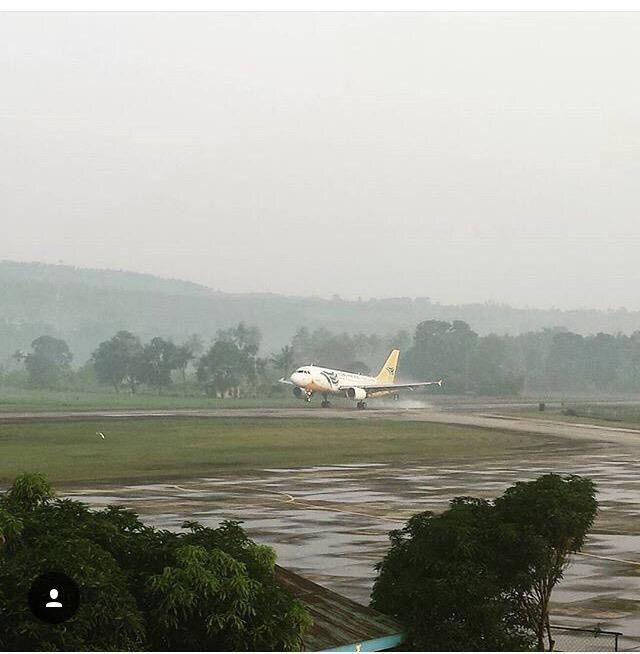
Airports of Pagadian and Cotabato were closed some days last week after both airports suffered poor visibility problems arising from bad weather brought by Typhoon Lando and haze results from forest fires which were blown northwards by the tropical storm, the Civil Aviation Authority (CAAP) reported Thursday.
Philippine Airlines and Cebu Pacific flights between Manila to Cotabato and Pagadian Cities have been disrupted numerous times since October 17, even if Mindanao was far from the typhoon epicenter and path.
CAAP spokesman said that airport in these cities doesn't have Instrument Landing System which can guide the aircraft to the airport in cases of poor to zero visibility unlike other airports in Mindanao like Zamboanga, Cagayan, General Santos, Davao and Butuan.
![]() |
| Haze still limits visibility to Pagadian Airport at 5 miles causing flight cancellation .Image courtesy, Stephen Rene Soriano |
Philippine Airlines and Cebu Pacific flights between Manila to Cotabato and Pagadian Cities have been disrupted numerous times since October 17, even if Mindanao was far from the typhoon epicenter and path.
CAAP spokesman said that airport in these cities doesn't have Instrument Landing System which can guide the aircraft to the airport in cases of poor to zero visibility unlike other airports in Mindanao like Zamboanga, Cagayan, General Santos, Davao and Butuan.
PAL Plane Stalls At TAG Runway
5 October 2015
NEDA Approves 3.5B Pesos Naga Airport Project
6 September 2015
National Economic and Development Authority (NEDA) Board has approved Friday the P3.5-billion runway re-orientation project of Naga City Airport in Camarines Sur to address capacity expansion, approach, air safety and navigation issues.
Naga airport is currently using a single directional approach with only one way for take-off and landing due to terrain issues (Mt. Isarog obstruction) at the other end of the approach. The runway reorientation is to enable dual-approach landing and takeoff with new international standard airside and landside facilities to meet the airport category rating and for it to address growing tourism demand.
The existing runway configuration (04-22) North-Northeast will be re-oriented 90 degrees clockwise to South-Southeast orientation to be constructed in San Jose Pili, Camarines Sur.
The Department of Transportation and Communications (DOTC) is expected to build the two-kilometer (2km) runway to accommodate Airbus narrow bodied planes. Construction is slated to start in 2017 after detailed engineering design is done. It will be funded under the General Appropriations Act (GAA) to be introduce in 2016.
The airport project is slated for completion in 2019.
Meanwhile, P20 billion has also been earmarked by DOTC for airport expansion and modernization projects for Laoag International Airport, completion of Bicol International Airport and Tacloban International Airport, Siargao Airport expansion, Caticlan International Airport, Kalibo International Airport, Busuanga Airport and the San Vicente Airport.
DOTC Completes Legaspi Airport Terminal Renovation
24 August 2015
DOTC Awards Tacloban Airport Terminal Repair
27 March 2014
The Department of Transportation and Communications (DOTC) has awarded contract to B.M. Marketing to undertake the P42.5 million repair works of Daniel Z. Romualdez Airport terminal building in Tacloban City pending construction of its new P251.6 million terminal building.
B.M. Marketing in consortium with FIAT Construction Services is the contractor of the airport's new apron and taxiway.
The rehabilitation project is slated for completion one year after typhoon Yolanda destroyed the terminal building in November 8, 2013.
The construction of the new terminal building is expected to begin later this year and is slated for completion in December of 2016.
CEB Overshoots Butuan Runway
15 February 2014
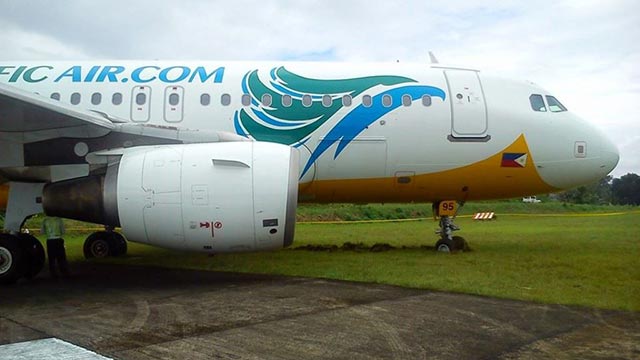
Butuan airport was closed by the Civil Aviation Authority of the Philippines (CAAP) Saturday morning following the skid of Cebu Pacific Airbus 319 plane (RPC3195) of its runway as it was preparing for takeoff at 10:00am. No injuries was reported.
Cebu Pacific flight 5J 220 carried 105 passengers and crew and was bound for Cebu. CAAP immediately dispatched a team headed by Anthony de Arca to determine the cause of the
accident.
At least seven flights to and from Butuan airport were cancelled as
the runway was ordered to be closed until 4pm Sunday afternoon, the
CAAP said.
Kalibo Survives, Busuanga Limping
12 November 2013
![]() |
| Busuanga Airport survives the wind of typhoon Yolanda but suffers major damage to passenger terminal structure |
The Civil Aviation Authority of the Philippines (CAAP) open on Sunday 10 domestic airports that was shutdown by typhoon Yolanda’s wrath Friday. Today Kalibo re-opens while Busuanga airport will open Tuesday after completion of emergency repair works.
Kalibo airport return to normal operations this afternoon with airlines resuming flights to Aklan leaving only three domestic airports - Tacloban, Roxas, and Busuanga - still closed for business due to major terminal damage but military and humanitarian flights are allowed to land.
CAAP Director General William K. Hotchkiss lll flew in Busuanga Sunday morning to bring emergency communication equipment to replace the ones damaged by typhoon winds and hasten the immediate normalization of airport operations.
Kalibo airport return to normal operations this afternoon with airlines resuming flights to Aklan leaving only three domestic airports - Tacloban, Roxas, and Busuanga - still closed for business due to major terminal damage but military and humanitarian flights are allowed to land.
CAAP Director General William K. Hotchkiss lll flew in Busuanga Sunday morning to bring emergency communication equipment to replace the ones damaged by typhoon winds and hasten the immediate normalization of airport operations.
There are close to 400 foreign tourists that is stranded in Coron, Palawan and may have to stay there longer until one of the C-130s make a scheduled flight tomorrow.
Tacloban Airport Blown to Pieces
9 November 2013
From this
To this
From this
To this
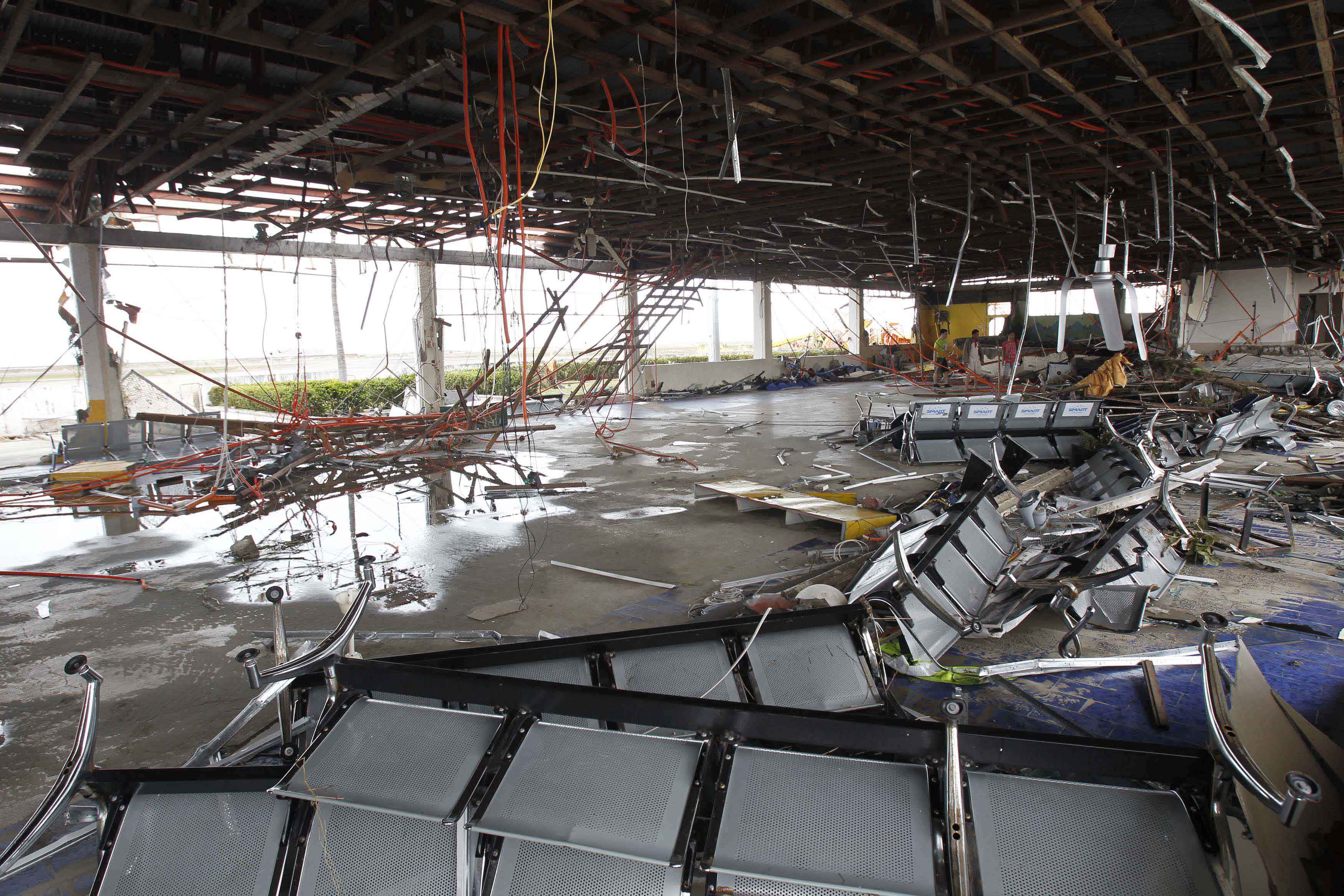
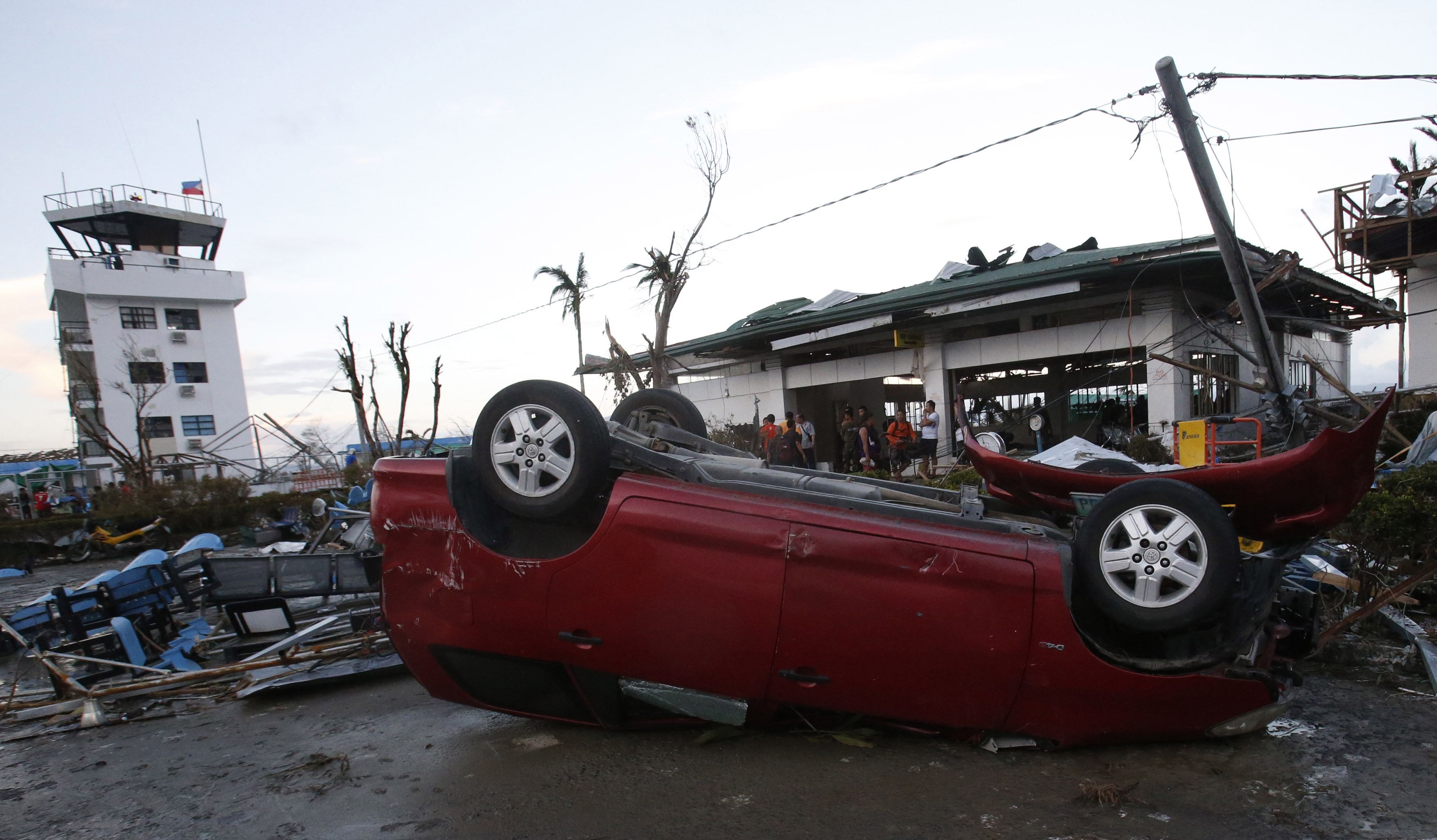
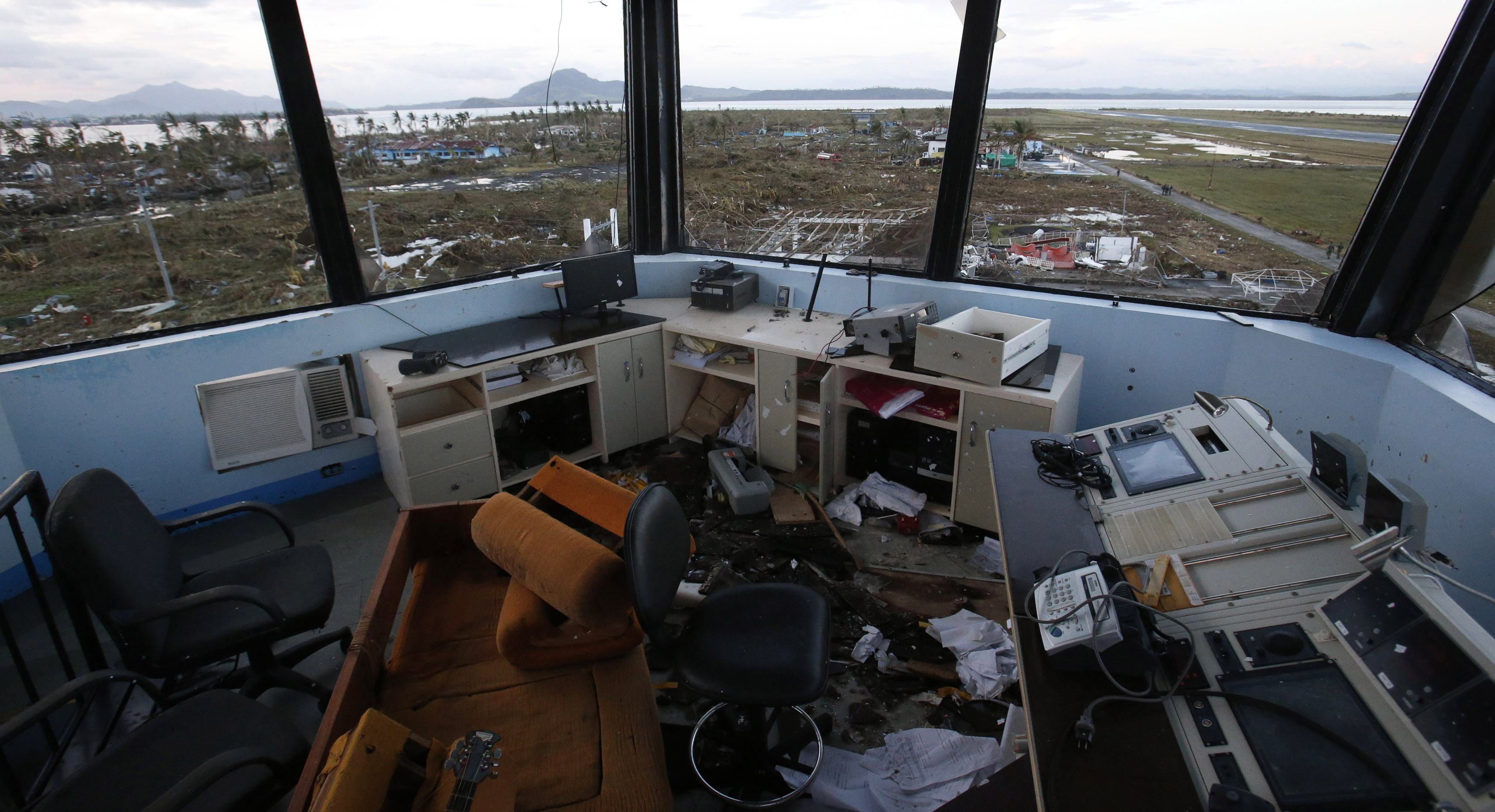
Tacloban Airport suffered the wrath of typhoon Yolanda (international name HAIYAN) Friday as more than 120 people have been reported killed by the category 5 storm with wind speed at more than 335 km per hour near the centre.
Aviation officials disclose that an airplane can fly at 185 kilometers per hour wind while a 200 km wind can damage concrete structures and obliterate wooden-based structures to pieces which happen to Tacloban terminal which faces the Pacific ocean.
No happy landing for Aquino at Catarman airport
A highway runs through it
April 28, 2013
By Michael Lim Ubac
April 28, 2013By Michael Lim Ubac
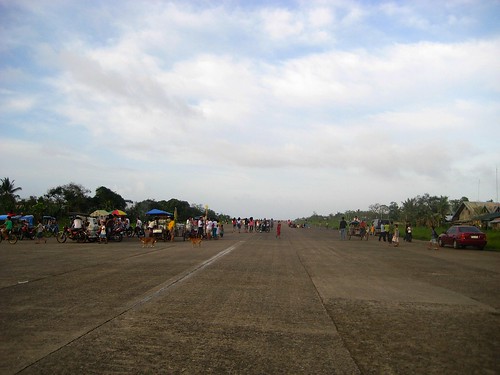
CATARMAN, Northern Samar—President Benigno Aquino III discovered on Friday that it’s no fun to land on this town’s short and accident-prone runway, especially on board a Philippine Air Force C-130 Hercules cargo plane.
Mr. Aquino had a rough landing on Friday morning in this sleepy town, site of the first leg of his three-town swing through Northern Samar and Southern Leyte provinces intended to ensure a 12-0 win for his handpicked senatorial candidates.
Only a day after returning from Brunei, the President was already back on the campaign trail, but his eagerness to resume campaigning for Team PNoy was met with one minor air turbulence: the Marcos-era Fokker F28 presidential plane conked out during a scheduled trip from Dumaguete City to Cebu for a campaign rally last week.
So he had to fly in a C-130, which is built for maneuvering on Catarman’s perilous 1280-meter runway.
He last boarded this Air Force workhorse when he brought back the remains of the late Interior Secretary Jesse Robredo from Masbate City to Naga City in August 2012.
‘Rocks are coming out’
“When I disembarked (from the plane), many wondered why I kept on staring at the pavement. I told them, ‘look, the pavement is almost gone and the rocks are coming out. A tarmac should be on level ground,’” said Mr. Aquino, recounting his initial impression of the airport during a rally at the Freedom Park here.
He recalled that the airport was actually “intersecting a highway,” meaning it is also used for other purposes (people and vehicles cross the runway since houses serve as the airport’s de facto perimeter fence).
Some airlines had already ceased plying the Manila-Catarman route as the number of passengers using the airport had dwindled through the years because of safety concerns.
State of disrepair
“Of course, a runway should be flat. There may come a time when tourists would start flocking to this place and they would find it incredulous that the runway is littered with humps. That’s the end of our tourism program,” said Mr. Aquino.
The President learned from local officials that the runway has been in a state of disrepair for the last 40 years.
The President was also greeted with the unseemly sight of a dilapidated terminal in dire need of a fresh coat of paint and major renovations.
Security was also evidently lax.
Right then, the President decided to provide allocation for the rehabilitation of the terminal and the upgrading of the runway.
The transportation department has already bid out the P7.6-million Catarman Airport Development project, which consists of an asphalt overlay of 128 meters of the runway and the construction of 264-meter perimeter fence.
Time to buy new plane
Brig. Gen. Ramon Mateo Dizon, Presidential Security Group chief, agreed that although the C-130 was a safer alternative for landing and takeoff in shorter runways, he deemed it wise for the leader of Asia’s so-called “rising star” to rely on the services of a new plane.
“What we’re saying is it’s time to buy a new plane. As to what kind of plane, it’s up to the experts (at the Air Force),” said Dizon.
“I don’t want to preempt the Air Force. Their procurement process is not finished yet,” Dizon added.
At the Freedom Park, Mr. Aquino announced before a sea of yellow-clad Liberal Party supporters that the National Economic Development Authority (Neda), which he chairs, had already approved the Samar Pacific Coastal Road project that will connect Northern Samar and Eastern Samar.
‘Abortion road’
The Neda also assured funding for the 220-kilometer Samar road rehabilitation project that is presently under construction, including the so-called “abortion road” in Eastern Samar, an unpaved highway filled with large potholes.
Mr. Aquino had a rough landing on Friday morning in this sleepy town, site of the first leg of his three-town swing through Northern Samar and Southern Leyte provinces intended to ensure a 12-0 win for his handpicked senatorial candidates.
Only a day after returning from Brunei, the President was already back on the campaign trail, but his eagerness to resume campaigning for Team PNoy was met with one minor air turbulence: the Marcos-era Fokker F28 presidential plane conked out during a scheduled trip from Dumaguete City to Cebu for a campaign rally last week.
So he had to fly in a C-130, which is built for maneuvering on Catarman’s perilous 1280-meter runway.
He last boarded this Air Force workhorse when he brought back the remains of the late Interior Secretary Jesse Robredo from Masbate City to Naga City in August 2012.
‘Rocks are coming out’
“When I disembarked (from the plane), many wondered why I kept on staring at the pavement. I told them, ‘look, the pavement is almost gone and the rocks are coming out. A tarmac should be on level ground,’” said Mr. Aquino, recounting his initial impression of the airport during a rally at the Freedom Park here.
He recalled that the airport was actually “intersecting a highway,” meaning it is also used for other purposes (people and vehicles cross the runway since houses serve as the airport’s de facto perimeter fence).
Some airlines had already ceased plying the Manila-Catarman route as the number of passengers using the airport had dwindled through the years because of safety concerns.
State of disrepair
“Of course, a runway should be flat. There may come a time when tourists would start flocking to this place and they would find it incredulous that the runway is littered with humps. That’s the end of our tourism program,” said Mr. Aquino.
The President learned from local officials that the runway has been in a state of disrepair for the last 40 years.
The President was also greeted with the unseemly sight of a dilapidated terminal in dire need of a fresh coat of paint and major renovations.
Security was also evidently lax.
Right then, the President decided to provide allocation for the rehabilitation of the terminal and the upgrading of the runway.
The transportation department has already bid out the P7.6-million Catarman Airport Development project, which consists of an asphalt overlay of 128 meters of the runway and the construction of 264-meter perimeter fence.
Time to buy new plane
Brig. Gen. Ramon Mateo Dizon, Presidential Security Group chief, agreed that although the C-130 was a safer alternative for landing and takeoff in shorter runways, he deemed it wise for the leader of Asia’s so-called “rising star” to rely on the services of a new plane.
“What we’re saying is it’s time to buy a new plane. As to what kind of plane, it’s up to the experts (at the Air Force),” said Dizon.
“I don’t want to preempt the Air Force. Their procurement process is not finished yet,” Dizon added.
At the Freedom Park, Mr. Aquino announced before a sea of yellow-clad Liberal Party supporters that the National Economic Development Authority (Neda), which he chairs, had already approved the Samar Pacific Coastal Road project that will connect Northern Samar and Eastern Samar.
‘Abortion road’
The Neda also assured funding for the 220-kilometer Samar road rehabilitation project that is presently under construction, including the so-called “abortion road” in Eastern Samar, an unpaved highway filled with large potholes.
DOTC Upgrades 8 Domestic Airport for Night Flights
| Airports in Butuan, Cotabato, Dumaguete, Tuguegarao, Dipolog, Roxas, Ozamis, and Busuanga prepares for night flight operations. |
By Lawrence Agcaoili April 20, 2013
The Aquino administration is set to upgrade the
night landing operations in eight airports across the country by
bidding out P434.5 million worth of contracts for the supply of
communications equipment as well as meteorological instruments and power
supply system.
In an invitation to bid, the Department of Transportation and
Communications (DOTC) and the Civil Aviation Authority of the
Philippines (CAAP) urged interested parties to participate in the open
and transparent bidding for the upgrading of night landing operations in
various airports.
The DOTC and CAAP said the country’s air transportation is becoming
one of the major means of transportation for passengers and cargoes as
indicated in the increased frequency of flights from the different
airports.
“This situation shows positive growth in the country’s economy;
however congestion of arriving and departing aircraft in Manila’s
premier airport is a dilemma of the air transport sector and needs to be
addressed by the DOTC and CAAP,” the agencies stated in the invitation
to bid.
To solve the congestion at the Ninoy Aquino International Airport
(NAIA), the DOTC and CAAP agreed to upgrade the night landing operations
of eight airports in accordance with International Civil Aviation
Organization (ICAO) standards & recommended practices (SARPs) of the
United Nations.
The agencies intend to bid out contracts for the installation or
upgrade of airfield lighting system as well as upgrade of communication
and meteorological systems at the airports in Butuan, Cotabato,
Dumaguete, Tuguegarao, Dipolog, Roxas, Ozamis, and Busuanga.
The government is spending P159.6 million to upgrade the tower
communications equipment in the eight airports through the acquisition
of 14 VHF transmitter systems, 14 VHF receiver systems, seven VHF
transceiver systems, seven voice communication switch systems, seven air
traffic control console, four air traffic light gun, and eight voice
logging systems.
A pre-bid conference would be held on May 6 while the schedule of the opening of bids is on June 5.
The agencies are also bidding out a P16 million contract for the
supply, delivery, installation, training of meteorological instruments
for the airports in Dipolog, Roxas, Ozamis, and Busuanga. The opening of
bids is scheduled on June 6.
Likewise, the DOTC and CAAP are also inviting interested bidders to
bid for a P258.9 million contract to upgrade the power supply systems at
the airports in Busuanga, Cotabato, Dipolog, Ozamis, and Roxas. The
opening of bids is scheduled on June 7.
The Philippines through the CAAP passed the audit conducted by ICAO
of the United Nations from Feb. 18 to Feb. 22 resulting in the lifting
of the remaining significant security concerns.
Multi-Airport System For Manila Set
Policy Directions readied
March 1, 2013
March 1, 2013
Manila will soon join the elite cities of the world that would have the distinction of having a Multi-Airport when the Department of Transportation and Communications (DOTC) makes recommendation to Malacanang for adoption of Multi-Airport System (MAS) for Manila to address the congestion at the Ninoy Aquino International Airport (NAIA).
A Multi-Airport System is defined as a set of two or more significant airports that serve commercial traffic within a metropolitan region.
Transportation Secretary Joseph Emilio Abaya said it would be better if there are two international airports for Manila as international gateways. But the choice would be between maintaining two major airports—Clark and NAIA—supporting each other, or vacating Manila in favor of Clark, or establishing a brand-new airport (e.i. PAL Airport) inside Metro Manila or in a nearby province that will replace the existing NAIA complex in Pasay City.
A Multi-Airport System is defined as a set of two or more significant airports that serve commercial traffic within a metropolitan region.
Transportation Secretary Joseph Emilio Abaya said it would be better if there are two international airports for Manila as international gateways. But the choice would be between maintaining two major airports—Clark and NAIA—supporting each other, or vacating Manila in favor of Clark, or establishing a brand-new airport (e.i. PAL Airport) inside Metro Manila or in a nearby province that will replace the existing NAIA complex in Pasay City.
To be labelled for MAS are Manila-NAIA, Manila-CLARK, and Manila- PAL should the government approved its construction, as primary airports supplemented by secondary airport, Manila-SANGLEY as general aviation airport. Two primary airport is likewise considered for Metropolitan Manila, while Sangley and Clark could be relegated to secondary gateway.
“They will be operating similar to London, New York, and Tokyo airports,” says Abaya.
New York operates a multi-airport system that is composed of four airports (i.e. three primary airports; New York/Kennedy, New York/Newark, New York/LaGuardia and one secondary airport; New York/Islip on Long Island).
“There were several options on the table and it would be up to the President to take his pick. At the very least, we will be recommending to the President to adopt a twin airport system for Manila,” Abaya added.
He refused to comment on the propose San Miguel International Airport, saying the fate of PAL airport and Clark International Airport are to be announce by the President soon.
The former project does not cost the government while the latter needs massive capital expenditures to develop as gateway as it is already the country’s fastest growing airport with eight budget airlines operating, and handled 1.3 million passengers last year.
“They will be operating similar to London, New York, and Tokyo airports,” says Abaya.
New York operates a multi-airport system that is composed of four airports (i.e. three primary airports; New York/Kennedy, New York/Newark, New York/LaGuardia and one secondary airport; New York/Islip on Long Island).
“There were several options on the table and it would be up to the President to take his pick. At the very least, we will be recommending to the President to adopt a twin airport system for Manila,” Abaya added.
He refused to comment on the propose San Miguel International Airport, saying the fate of PAL airport and Clark International Airport are to be announce by the President soon.
The former project does not cost the government while the latter needs massive capital expenditures to develop as gateway as it is already the country’s fastest growing airport with eight budget airlines operating, and handled 1.3 million passengers last year.
Plane’s nose wheel gets stuck at Cotabato Airport Again
By Eric B. Apolonio
Manila Standard
October 8, 2012
A Cebu Pacific (CEB) Airbus 320 flight from Cotabato to Manila was cancelled before the weekend when the plane’s nose wheel got stuck while the aircraft was making a 360 degree turn on the runway prior to takeoff, officials said on Sunday.
CEB Vice President for Marketing and Distribution Candice Iyog said the flight was called off and the Cotabato Awang Airport, which serves Maguindanao province and neigboring areas, was immediatley closed down.
Iyog said the passengers were accommodated in the next flight, and she appealed for public understanding because the incident “was beyond our control.”
Manila Standard
October 8, 2012
A Cebu Pacific (CEB) Airbus 320 flight from Cotabato to Manila was cancelled before the weekend when the plane’s nose wheel got stuck while the aircraft was making a 360 degree turn on the runway prior to takeoff, officials said on Sunday.
CEB Vice President for Marketing and Distribution Candice Iyog said the flight was called off and the Cotabato Awang Airport, which serves Maguindanao province and neigboring areas, was immediatley closed down.
Iyog said the passengers were accommodated in the next flight, and she appealed for public understanding because the incident “was beyond our control.”
Security Equipments at major PH Airports for Bid
April 28, 2012
![]() |
| Final Security Check Point (FSCP) at NAIA's Terminal 2 showing Xray machine and the walk-through metal detectors |
The Department of Transport and Communication (DOTC) announced Thursday the bulk bidding for the 500-million airport x-ray screening and security equipment
contract next month.
“These
x-rays will be installed in places where there are no screening or where
even if there is equipment, but because of the volume of passengers,
they need additional equipment,”
said Transportation Secretary Manuel Roxas.
Roxas aims to improve airport security at selected aerodomes across the country with commercial flights by installing,
upgrading and layering of security screening of passengers.
“We will make them all to have
two layers of screening just like what we have in NAIA ” says Roxas.
DOTC disclosed that there are 45 airports in the Philippines with scheduled commercial flights with 21 having adequate airport screening. The government intends to procure screening equipment to be installed in 31
airports.
Items
for procurement include 21 sets of initial security checkpoint (ISCP)
screening equipment and 25 sets of final security checkpoint (FSCP)
screening equipment.
The
airports to be installed with the 21 ISCPs are Puerto Princesa, Kalibo,
Tagbilaran, Davao, Laoag, Iloilo, Tacloban, Cotabato, Dipolog, Cagayan
de Oro, Marinduque, Busuanga, Masbate, Calbayog, Catarman, Jolo, Basco,
Sanga-sanga, Siargao, Cauayan and Ozamis.
The
25 FSCPs are Puerto Princesa, Kalibo, Tagbilaran, Davao, two in Laoag,
General Santos, Zamboanga, San Jose, Roxas, Tacloban, Pagadian, Dipolog,
Cagayan de Oro, Marinduque, Busuanga, Masbate, Calbayog, Catarman,
Jolo, Basco, Sanga-sanga, Siargao, Cauayan and Ozamiz.
The procurement also includes nine units of x-ray inspection systems for cargo screening to be installed in Puerto Princesa, Kalibo, General
Santos, Zamboanga, Iloilo, Roxas, Cotabato, Cagayan de Oro and Clark.
Transport Department will also buy 46 units of walk-through metal detectors, 92 units
of hand-held metal detectors, 59 sets of CCTV (closed-circuit
television) IP (Internet protocol) surveillance system, 55 units of UPS
system, 55 sets of AVR system and 55 sets of ergonomic chair for the
x-ray operator.
The airport security project is set for completion before the end of the year.
Daraga Airport Rises
October 15, 2011
By Genivi Factao
Albay Gov. Joey Salceda announced development of
the Southern Luzon International Airport (New Legaspi Airport) in Daraga,
Albay is in full swing and is finding investors for the redevelopment of the old Legazpi airport when the new airport opens in 2014.
"We are just waiting for the bidding of the terminal of Daraga
airport. The needed investment for the project is about P3.4 billion.
The Legazpi airport is up for redevelopment; we will make it an
integrated development like Singapore’s Sentosa," Salceda said at the
sidelines of the Orgullo Kan Bikol held at Megatrade Hall of SM Megamall held recently.
Salceda said the Bicol region, particularly the twin airports of Naga and Legaspi has been growing in double digits as it slowly become one of the top tourist destination in the country.
International tourists to Albay in the first quarter numbered
54,000, up 51 percent from last year. This year, the province expects
foreign tourists to hit 150,000.
The Department of Transportation and Communications (DOTC) is
studying a proposal to bundle the privatization of the old Legazpi
airport with the SLIA terminal construction.
Salceda said the airport is on the priority list of
private-public partnership projects. The private sector is being enticed
to develop the old Legazpi airport into something like Sentosa that can
be linked to Ligñon Hill development.
Earlier, DOTC Secretary Mar Roxas said the terminal component of the project will be funded by ODA loans and funds coming from the GAA.
APECO Eyes Separate Funding For Aurora Airport
By Butch Fernandez
October 13, 2011
Administrators of the
Aurora Pacific Economic Zone and Freeport Authority (Apeco) are eyeing
separate funding sources to facilitate early completion of its air and
seaport projects to attract more local and foreign investors to the
region.
Roberto
Mathay, Apeco president and chief executive officer, confirmed ongoing
efforts by the national government to tap the Korean Export-Import Bank
to provide $55-million funding for the seaport project under the
official development assistance (ODA) program.
Mathay said
additional funding of P92 million is being allocated by the Philippine
government in the annual national expenditure program to complete a
proposed 1.5-kilometer airport runway, under the Civil Aeronautics
Authority.
This
developed as Sen. Frank Drilon, finance committee chairman, announced
after a public hearing on Wednesday that Apeco’s proposed 2012 budget,
amounting to P332.5 million, is deemed submitted for approval, despite
opposition from restive residents affected by the projects.
“We
are going to try to track more locators to Apeco pa rin. Our mandate is
to bring varied business interests in marine-culture business, as well
as ecotourism to the zone so we can transform it to something the people
from Casiguran can be proud of,” Mathay said. “We are [also] looking at
agroindustrial or mariculture, or other businesses which are more
fitting to the area. We would like to focus on small to medium
enterprises, both from the Philippines and from abroad.”
Mathay
disclosed they have, likewise, requested funding from Congress, as part
of their capital outlay for this year, to have “a standard factory
building where we can have smaller companies establish their operations
in the zone.”
He
reported that the mariculture business at the zone include raising
bangus and tilapia and processing these to fillet or fish ball which are
then sold in the local market and nearby provinces, such as in Isabela
and Quirino. “Eventually, we may also export them,” he added.
“There
are other prospects. One company we are signing up plans to put up sea
cages. We are trying to finalize the details [for their operation] by November,” Mathay said.
Far and Away 2
Flying the Philippines Remotest Airport

July 24, 2011
By Joseph Holandes Ubalde
(This article was originally written in 2008, during the author’s visit to Pag-asa.
It has remained unpublished until now. The photos are also from that visit.)
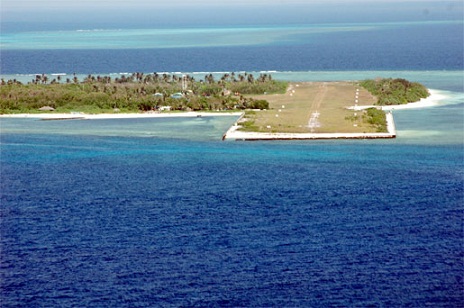
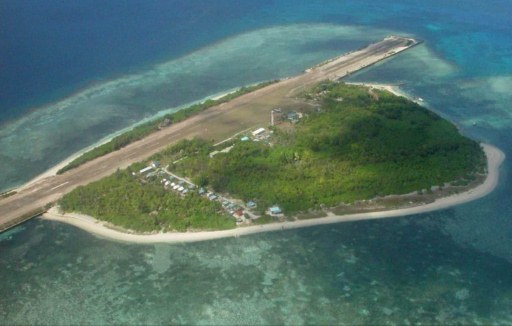
PAGASA ISLAND, Palawan - After 45 minutes of staring at nothing but turquoise waters, Pag-asa Island finally appeared in my plane window like a sandy green gem, tiny waves lapping at its shore.
My excitement was replaced by sudden fear as the C-130 plane made a bumpy landing on the island’s lone airstrip.
When the doors opened, the balmy wind was first to welcome us. But instead of locals with garlands of flowers greeting us, a pack of soldiers in camouflage approached the plane.
To the rest of the world, this idyllic paradise, the second largest island in the disputed Spratly chain in the westernmost part of the Philippines, is perhaps the most secure and heavily guarded area in the country. But to the soldiers deployed there for six months, it seems more like the loneliest.
The only cellphone site on the island makes communication with the outside world a choppy four-hour frustration.
Only C-130 planes are allowed to fly over the Spratlys once a month for reconnaissance missions. And to prevent any sand blown by the sea breeze from clogging engines, a plane can only stay for a brief two hours.
After that, Pag-asa truly becomes an island.
I was among the lucky few civilians who managed to visit the island with 60 soldiers who were on a military school field trip last March 2008. My good friend, “Jodi” dragged me along with her to visit "Abe", her boyfriend, who happens to be one of the soldiers on Pag-Asa.
Lucky me indeed for visits to Pag-Asa are few and far in between. To get to the island we had to endure the hot and nauseating two-hour C-130 flight from Villamor Airbase in Pasay City to Puerto Princesa in Palawan before transiting to the Spratly chain for another 45 minutes.
As soon as Jodi and Abe were reunited, I went off to discover the island on my own. It would take only 30 minutes to tour the entire 37.2-hectare island by foot. I started my two-hour stay there strolling the shore barefoot.
I had quickly undressed to my shorts, anticipating a quick dip. But no one else dared initiate it. Perhaps the soldiers were too busy taking pictures of each other. And I couldn’t blame them, since their first trip to the Spratlys could very well be their last.
A soldier there remarked that Pag-Asa is like Boracay before the tourist invasion of the late 80s—which allegedly caused the once turquoise water to turn mossy green— but with the added security of Camp Crame.
But as soon as we landed, it became clear that Pag-Asa is no Bora.
There are no umbrellas hoisted on the sand, no reclining white chairs for sunbathers, no hammocks swaying gently between the coconut trees. All one sees are ill-colored concrete boxes that soldiers call their camp.
Pag-Asa’s beach is also far from having Boracay’s talcum-like sand as broken corals bleaching under the scorching sun could quickly prick one’s toes. There are also purple lilies snaking through the beach in a seemingly desperate attempt to quench their thirst. Rocks, twigs and seashells dot the sand. Overturned fishing boats are stacked on the grass like a powerful wave swept them there.
But if it’s any consolation, in the absence of jet skis and sailboats, there’s the breathtaking view of a rusted Navy ship stuck in the shallows. No one really explained to me how the ghost ship got there but one of the soldiers pointed out that it’s a good way to scare foreign ships.
“They’re scared to get closer because they might get tetanus,” one of the soldiers joked.
It’s also amazing how nature and military might could blend in perfect harmony on Pag-Asa. A few meters from the camp is an abandoned army tractor left idled in eternal pose against the swaying needle-point grass. And in some minor Orwellian twist, one of the military latrines unwittingly became overrun by domestic geese, ducks, chickens and goats.
It’s not that soldiers there are poor housekeepers. Despite the construction of several structures on the island, the military has vowed to keep Pag-Asa as untouched as possible. So visitors are told to take nothing but pictures and leave nothing else but fond memories.
Although the water and the weather were inviting, the soldiers were content just sitting under the shade or collecting sand in emptied mineral water bottles.
But when Abe handed me his snorkeling gear, I wasted no time and immediately jumped into the water. I saw only a pair of fish on my initial dip, scurrying away so fast I had no time to marvel at them.
I was moving towards the sea grass bed in deeper waters when Abe called out and warned me not to go any further. Apparently, the warm tropical waters make excellent feeding grounds for a couple of sharks.
On a really clear day, a soldier said the Taiwanese flag from one of the smaller islands can be seen. But the Taiwanese never visit them. Instead, fishermen from Puerto Princesa, who know the bounty of the sea off Pag-Asa, regularly stopover and sell them their fresh catch.
And yes, the island is giving. A day before our scheduled arrival, Abe speared two medium-sized lobsters for Jodi to bring back home. Solders also dried freshly-caught ‘dalagang bukid’ as pasalubong for their visiting relatives.
With the island’s population kept below 350, supplies and space are closely monitored by the military. Every need of the soldier and the civilian on the island is accounted for. Their supply of rice or meat is meant only for those on the island. Should the soldiers need anything extra, they turn to the island and the sea.
I walked around the island with my camera. One Army colonel told me it would only take me a full hour to walk around the island and five months for the next C-130 plane to arrive if ever I decided to do just that and was late for the scheduled departure. Visits to this island by plane are rare as the military's C-130 plane can only land on the airstrip. Relatives of the soldiers can only visit when they join the military on reconnaissance missions to the island or board a four-our boat ride from Palawan.
While Pag-Asa’s soldiers have yet to fire a shot in anger, they are quick to learn to kill time in order to survive. They hold regular sports activities to keep fit, do minor construction work in the camp or jog around the island. With the weak cellphone signal in the area, the soldiers often end up frustrated when they try to contact their loved ones back home. Loneliness and boredom are always knocking on their door when they wake up.
Abe, who graduated from the Philippine Military Academy, is fortunately not new to this.
While Pag-asa’s soldiers have yet to fire a shot in anger, they are quick to learn to kill time in order to survive. Abe, who graduated from the Philippine Military Academy, is fortunately not new to this.
In his five years in the academy, Abe endured a series of mental and physical challenges that included isolation and seclusion. As a plebe, Abe was prohibited from being visited in Baguio City by his girlfriend or relatives for a year. During their recognition day, their parents and loved ones may come to visit but the soldiers are not to display any emotion, much more a hug.
If they survive this, they have passed their psychological training and are one step closer to being called real men.
“You get trained to be isolated. You need to remember that time so that when you encounter a similar situation you’ll know,” Abe said.
Last February, Abe became one of the chosen few stationed on the Spratlys chain of islands to fortify already existing structures there. In their free time, the men grab their swimming gear and snorkel near the shore.
On my curious walk around the island, I discovered a military bunker sunk knee-deep in white bits of corals teeming with hundreds of hermit crabs scurrying for shade.
Even the hermit crabs know who the enemy is, I thought. On an island like Pag-Asa, there is no real enemy but the sun, the powdery sand and the balmy wind.

July 24, 2011
By Joseph Holandes Ubalde
(This article was originally written in 2008, during the author’s visit to Pag-asa.
It has remained unpublished until now. The photos are also from that visit.)
PAGASA ISLAND, Palawan - After 45 minutes of staring at nothing but turquoise waters, Pag-asa Island finally appeared in my plane window like a sandy green gem, tiny waves lapping at its shore.My excitement was replaced by sudden fear as the C-130 plane made a bumpy landing on the island’s lone airstrip.
When the doors opened, the balmy wind was first to welcome us. But instead of locals with garlands of flowers greeting us, a pack of soldiers in camouflage approached the plane.
To the rest of the world, this idyllic paradise, the second largest island in the disputed Spratly chain in the westernmost part of the Philippines, is perhaps the most secure and heavily guarded area in the country. But to the soldiers deployed there for six months, it seems more like the loneliest.
The only cellphone site on the island makes communication with the outside world a choppy four-hour frustration.
Only C-130 planes are allowed to fly over the Spratlys once a month for reconnaissance missions. And to prevent any sand blown by the sea breeze from clogging engines, a plane can only stay for a brief two hours.
After that, Pag-asa truly becomes an island.
I was among the lucky few civilians who managed to visit the island with 60 soldiers who were on a military school field trip last March 2008. My good friend, “Jodi” dragged me along with her to visit "Abe", her boyfriend, who happens to be one of the soldiers on Pag-Asa.
Lucky me indeed for visits to Pag-Asa are few and far in between. To get to the island we had to endure the hot and nauseating two-hour C-130 flight from Villamor Airbase in Pasay City to Puerto Princesa in Palawan before transiting to the Spratly chain for another 45 minutes.As soon as Jodi and Abe were reunited, I went off to discover the island on my own. It would take only 30 minutes to tour the entire 37.2-hectare island by foot. I started my two-hour stay there strolling the shore barefoot.
I had quickly undressed to my shorts, anticipating a quick dip. But no one else dared initiate it. Perhaps the soldiers were too busy taking pictures of each other. And I couldn’t blame them, since their first trip to the Spratlys could very well be their last.
A soldier there remarked that Pag-Asa is like Boracay before the tourist invasion of the late 80s—which allegedly caused the once turquoise water to turn mossy green— but with the added security of Camp Crame.
But as soon as we landed, it became clear that Pag-Asa is no Bora.
There are no umbrellas hoisted on the sand, no reclining white chairs for sunbathers, no hammocks swaying gently between the coconut trees. All one sees are ill-colored concrete boxes that soldiers call their camp.
Pag-Asa’s beach is also far from having Boracay’s talcum-like sand as broken corals bleaching under the scorching sun could quickly prick one’s toes. There are also purple lilies snaking through the beach in a seemingly desperate attempt to quench their thirst. Rocks, twigs and seashells dot the sand. Overturned fishing boats are stacked on the grass like a powerful wave swept them there.
But if it’s any consolation, in the absence of jet skis and sailboats, there’s the breathtaking view of a rusted Navy ship stuck in the shallows. No one really explained to me how the ghost ship got there but one of the soldiers pointed out that it’s a good way to scare foreign ships.
“They’re scared to get closer because they might get tetanus,” one of the soldiers joked.
It’s also amazing how nature and military might could blend in perfect harmony on Pag-Asa. A few meters from the camp is an abandoned army tractor left idled in eternal pose against the swaying needle-point grass. And in some minor Orwellian twist, one of the military latrines unwittingly became overrun by domestic geese, ducks, chickens and goats.
It’s not that soldiers there are poor housekeepers. Despite the construction of several structures on the island, the military has vowed to keep Pag-Asa as untouched as possible. So visitors are told to take nothing but pictures and leave nothing else but fond memories.
Although the water and the weather were inviting, the soldiers were content just sitting under the shade or collecting sand in emptied mineral water bottles.
But when Abe handed me his snorkeling gear, I wasted no time and immediately jumped into the water. I saw only a pair of fish on my initial dip, scurrying away so fast I had no time to marvel at them.
I was moving towards the sea grass bed in deeper waters when Abe called out and warned me not to go any further. Apparently, the warm tropical waters make excellent feeding grounds for a couple of sharks.
On a really clear day, a soldier said the Taiwanese flag from one of the smaller islands can be seen. But the Taiwanese never visit them. Instead, fishermen from Puerto Princesa, who know the bounty of the sea off Pag-Asa, regularly stopover and sell them their fresh catch.
And yes, the island is giving. A day before our scheduled arrival, Abe speared two medium-sized lobsters for Jodi to bring back home. Solders also dried freshly-caught ‘dalagang bukid’ as pasalubong for their visiting relatives.
With the island’s population kept below 350, supplies and space are closely monitored by the military. Every need of the soldier and the civilian on the island is accounted for. Their supply of rice or meat is meant only for those on the island. Should the soldiers need anything extra, they turn to the island and the sea.
I walked around the island with my camera. One Army colonel told me it would only take me a full hour to walk around the island and five months for the next C-130 plane to arrive if ever I decided to do just that and was late for the scheduled departure. Visits to this island by plane are rare as the military's C-130 plane can only land on the airstrip. Relatives of the soldiers can only visit when they join the military on reconnaissance missions to the island or board a four-our boat ride from Palawan.
While Pag-Asa’s soldiers have yet to fire a shot in anger, they are quick to learn to kill time in order to survive. They hold regular sports activities to keep fit, do minor construction work in the camp or jog around the island. With the weak cellphone signal in the area, the soldiers often end up frustrated when they try to contact their loved ones back home. Loneliness and boredom are always knocking on their door when they wake up.
Abe, who graduated from the Philippine Military Academy, is fortunately not new to this.
While Pag-asa’s soldiers have yet to fire a shot in anger, they are quick to learn to kill time in order to survive. Abe, who graduated from the Philippine Military Academy, is fortunately not new to this.In his five years in the academy, Abe endured a series of mental and physical challenges that included isolation and seclusion. As a plebe, Abe was prohibited from being visited in Baguio City by his girlfriend or relatives for a year. During their recognition day, their parents and loved ones may come to visit but the soldiers are not to display any emotion, much more a hug.
If they survive this, they have passed their psychological training and are one step closer to being called real men.
“You get trained to be isolated. You need to remember that time so that when you encounter a similar situation you’ll know,” Abe said.
Last February, Abe became one of the chosen few stationed on the Spratlys chain of islands to fortify already existing structures there. In their free time, the men grab their swimming gear and snorkel near the shore.
On my curious walk around the island, I discovered a military bunker sunk knee-deep in white bits of corals teeming with hundreds of hermit crabs scurrying for shade.
Even the hermit crabs know who the enemy is, I thought. On an island like Pag-Asa, there is no real enemy but the sun, the powdery sand and the balmy wind.
Far and Away!
Flying the Philippines Remotest Airport
July 18, 2011
By Mynardo Macaraig
Agence France-Presse
July 18, 2011
By Mynardo Macaraig
Agence France-Presse
The island of Kalayaan, which means "Freedom" in the Filipino language, that was created in 1978 mainly to assert the Philippines' claim to the disputed territory in the Spratlys, a chain of islets in the West Philippine Sea. AFP/Kayalaan Municipal office
PUERTO PRINCESA, Philippines – For the few dozen Filipinos living on a remote speck of land in the West Philippine Sea (South China Sea), each day is a battle against loneliness but also a love affair with nature.
Contact with the outside world is limited and comforts are few for the residents of Kalayaan town, which exists mainly to raise the Philippine flag and fend off the other claimants to the Spratly islands.
“People here just play billiards, ping-pong. We have no markets and no malls. You need a special mindset to stay here,” said Eugenio Bito-onon, 55, mayor of Kalayaan municipality in Palawan. Kalayaan is the Filipino word for freedom.
Bito-onon, who initially went to Kalayaan in 1997 to work as a town planner, said he learned to cope by playing guitar, watching videos and simply walking around the small islands surrounded by the purest blue ocean waters.
“I love the beauty of the place. It is so peaceful,” said the deeply suntanned Bito-onon while on a visit recently back to Puerto Princesa City, the nearest major city in mainland Palawan province.
Kalayaan was created in 1978 mainly to assert the Philippines’ claim to the Spratlys, a group of more than 700 islets, reefs and atolls in the West Philippine Sea, also known as South China Sea, that is believed to sit above vast natural resources.
The Philippines, China, Vietnam, Malaysia, Taiwan and Brunei claim all or part of the Spratlys, part of a broader territorial dispute across the West Philippine Sea.
Most of the other claimants have a presence on some of the other islands in the Spratlys to help boost their positions.
But the Philippines insists Kalayaan — which covers five islands, two sandbars and two reefs — has the only functioning local government of its own in the Spratlys.
Regional tensions in the long-running territorial dispute have flared again in recent months, with the Philippines accusing China of taking increasingly aggressive actions in the Spratlys and nearby waters.
But Bito-onon said the diplomatic tensions barely affected the residents, most of whom live on the 37-hectare island widely known as Thitu, which the Philippines calls Pagasa, or Hope in English.
Mostly this is because of their isolation.
Pagasa is about 450 kilometres (280 miles) northwest of Palawan, roughly 600 kilometers from Vietnam’s coast and more than 900 kilometres from China’s nearest major landmass of Hainan island.
Residents or others travelling to and from Pagasa normally have to hitch a ride on a creaking military supply ship that takes seven days to make the journey, according to Bito-onon.
There is an airstrip in Pagasa but it is made mostly of compacted earth and cannot be used when it rains.
Aside from about 100 Filipino soldiers assigned to the area, the town has about 200 registered voters but only about 60 live in Kalayaan at a time because that is all government provisions can sustain, Bito-onon said.
Aside from a few fishermen and construction workers, most residents are government employees and their families who take turns, each serving for about three months on the islands.
Residents are attracted there by the government-provided jobs and housing, as well as the free provisions of essentials such as rice, cooking oil, sugar, noodles and canned food, according to Bito-onon.
Fish are also plentiful in the sea and wells provide residents with more than enough fresh water.
But Bito-onon said it was not easy to get used to the isolation and lack of amenities — there is no school and no town health worker since the local midwife resigned last year to get married.
“Some people can’t take it. They snap and begin talking to the flies or get drunk all the time. They get into fights while drinking,” he said.
Although several families have raised children in the islands, they have to be sent to live elsewhere once they are old enough for school.
Bito-onon’s wife lives and works in Puerto Princesa. When the couple’s two sons were still children, the family would only spend about a month and half together in Kalayaan.
However the pain of separation for Bito-onon is eased because Kalayaan has an administration “extension office” in Puerto Princesa, which the mayor visits frequently.
The island does have satellite television but the satellite discs are slowly being corroded by the sea spray that has already destroyed their solar power generators.
A mobile phone company has struggled to set up services in Pagasa, but Bito-onon said the signal was inconsistent.
He complained that despite the Philippines being the closest of the claimants, its occupied islands were among the least developed in the Spratlys.
Some other islands have strongly built structures with concrete airfields and one Malaysian-held one even has a hotel for tourists, Bito-onon said.
In his “extension office”, Bito-onon displayed pictures showing Chinese, Malaysian and Vietnamese-occupied islands with marinas where their ships could take refuge.
Bito-onon hopes that someday he can attract tourists and even investors from the fishing industry to Kalayaan.
But first, the national government will have to upgrade and lengthen the airstrip and build a marina where ships can dock.
In the meantime, Bito-onon and other residents are content to continue enjoying their peaceful solitude.
Construction worker Nonelon Balbontin, 34, said life was much better in the Spratlys than in the chaotic, overcrowded and polluted Metro Manila where he used to live.
“It is very beautiful. It has a good climate, I have a job there. We have no problems, no sickness, the food is free, paid for by the government,” he told Agence France-Presse while visiting Puerto Princesa.
Balbontin, who also works on Kalayaan’s salt-making project, said that in his free time, he caught more than enough fish, both for his family and for sale.
He also plays basketball with the military men assigned at the Spratlys who are eager for any recreation.
At night, he likes to roam around the island to spot sea turtles laying their eggs so he can report them to a local environment officer for tagging and protection.
(This article was originally written in 2008, during the author’s visit to Pag-asa. It has remained unpublished until now. The photos are also from that visit.)
Contact with the outside world is limited and comforts are few for the residents of Kalayaan town, which exists mainly to raise the Philippine flag and fend off the other claimants to the Spratly islands.
“People here just play billiards, ping-pong. We have no markets and no malls. You need a special mindset to stay here,” said Eugenio Bito-onon, 55, mayor of Kalayaan municipality in Palawan. Kalayaan is the Filipino word for freedom.
Bito-onon, who initially went to Kalayaan in 1997 to work as a town planner, said he learned to cope by playing guitar, watching videos and simply walking around the small islands surrounded by the purest blue ocean waters.
“I love the beauty of the place. It is so peaceful,” said the deeply suntanned Bito-onon while on a visit recently back to Puerto Princesa City, the nearest major city in mainland Palawan province.
Kalayaan was created in 1978 mainly to assert the Philippines’ claim to the Spratlys, a group of more than 700 islets, reefs and atolls in the West Philippine Sea, also known as South China Sea, that is believed to sit above vast natural resources.
The Philippines, China, Vietnam, Malaysia, Taiwan and Brunei claim all or part of the Spratlys, part of a broader territorial dispute across the West Philippine Sea.
Most of the other claimants have a presence on some of the other islands in the Spratlys to help boost their positions.
But the Philippines insists Kalayaan — which covers five islands, two sandbars and two reefs — has the only functioning local government of its own in the Spratlys.
Regional tensions in the long-running territorial dispute have flared again in recent months, with the Philippines accusing China of taking increasingly aggressive actions in the Spratlys and nearby waters.
But Bito-onon said the diplomatic tensions barely affected the residents, most of whom live on the 37-hectare island widely known as Thitu, which the Philippines calls Pagasa, or Hope in English.
Mostly this is because of their isolation.
Pagasa is about 450 kilometres (280 miles) northwest of Palawan, roughly 600 kilometers from Vietnam’s coast and more than 900 kilometres from China’s nearest major landmass of Hainan island.
Residents or others travelling to and from Pagasa normally have to hitch a ride on a creaking military supply ship that takes seven days to make the journey, according to Bito-onon.
There is an airstrip in Pagasa but it is made mostly of compacted earth and cannot be used when it rains.
Aside from about 100 Filipino soldiers assigned to the area, the town has about 200 registered voters but only about 60 live in Kalayaan at a time because that is all government provisions can sustain, Bito-onon said.
Aside from a few fishermen and construction workers, most residents are government employees and their families who take turns, each serving for about three months on the islands.
Residents are attracted there by the government-provided jobs and housing, as well as the free provisions of essentials such as rice, cooking oil, sugar, noodles and canned food, according to Bito-onon.
Fish are also plentiful in the sea and wells provide residents with more than enough fresh water.
But Bito-onon said it was not easy to get used to the isolation and lack of amenities — there is no school and no town health worker since the local midwife resigned last year to get married.
“Some people can’t take it. They snap and begin talking to the flies or get drunk all the time. They get into fights while drinking,” he said.
Although several families have raised children in the islands, they have to be sent to live elsewhere once they are old enough for school.
Bito-onon’s wife lives and works in Puerto Princesa. When the couple’s two sons were still children, the family would only spend about a month and half together in Kalayaan.
However the pain of separation for Bito-onon is eased because Kalayaan has an administration “extension office” in Puerto Princesa, which the mayor visits frequently.
The island does have satellite television but the satellite discs are slowly being corroded by the sea spray that has already destroyed their solar power generators.
A mobile phone company has struggled to set up services in Pagasa, but Bito-onon said the signal was inconsistent.
He complained that despite the Philippines being the closest of the claimants, its occupied islands were among the least developed in the Spratlys.
Some other islands have strongly built structures with concrete airfields and one Malaysian-held one even has a hotel for tourists, Bito-onon said.
In his “extension office”, Bito-onon displayed pictures showing Chinese, Malaysian and Vietnamese-occupied islands with marinas where their ships could take refuge.
Bito-onon hopes that someday he can attract tourists and even investors from the fishing industry to Kalayaan.
But first, the national government will have to upgrade and lengthen the airstrip and build a marina where ships can dock.
In the meantime, Bito-onon and other residents are content to continue enjoying their peaceful solitude.
Construction worker Nonelon Balbontin, 34, said life was much better in the Spratlys than in the chaotic, overcrowded and polluted Metro Manila where he used to live.
“It is very beautiful. It has a good climate, I have a job there. We have no problems, no sickness, the food is free, paid for by the government,” he told Agence France-Presse while visiting Puerto Princesa.
Balbontin, who also works on Kalayaan’s salt-making project, said that in his free time, he caught more than enough fish, both for his family and for sale.
He also plays basketball with the military men assigned at the Spratlys who are eager for any recreation.
At night, he likes to roam around the island to spot sea turtles laying their eggs so he can report them to a local environment officer for tagging and protection.
(This article was originally written in 2008, during the author’s visit to Pag-asa. It has remained unpublished until now. The photos are also from that visit.)
$13 Million Navaid for Laguindingan Airport Approved

June 20, 2011
The Bangko Sentral ng Pilipinas (BSP) has approved a $13.3-million loan from the Export-Import Bank of Korea to bankroll the acquisition of navigational equipment for the long delayed Laguindingan airport development project in Misamis Oriental.
BSP Governor Amando M. Tetangco Jr. told reporters that the Monetary Board has approved the loan from Eximbank of Korea for the Laguindingan airport navigational system and support facility.
Eximbank of Korea operates the Economic Development Cooperation Fund or the Korean official development assistance program and the Inter-Korean Cooperation Fund or an economic cooperation program with North Korea
Tetangco said the project is being undertaken by the Department of Transportation and Communications (DOTC).
Laguindingan Airport is located in Misamis Oriental in Mindanao and would replace the Cagayan de Oro airport in the Cagayan-Iligan Corridor. It would serve the growth corridor covering the provinces of Bukidnon, Misamis Oriental, Lanao del Norte, Lanao del Sur, and the island province of Camiguin.
Tetangco said the project would address the increasing demand for air transportation in the region.
The loan, he explained, is payable in 40 years and carries an interest of 0.15 percent per annum.
The BSP chief pointed out that the new loan approval would help augment the previous loans approved as early in 1998 and the latest in 2008.
The first loan agreement amounting to $62.75 million for the Laguindingan Airport Development Project was signed February of 1998.
The project involves the construction of a new airport, including a new runway, taxiway, apron and other similar facilities; new buildings such as passenger terminal building and cargo facilities; and air navigation and support facilities and other airport equipment and vehicles.
The airport is being constructed on a 400-hectare property in Laguindingan of which about 90 hectares was donated by property giant Ayala Land Inc.
In December of 2007, a supplemental loan agreement of $8.2 million was signed by the Philippines and Eximbank of Korea that would be funded through the Economic Development Cooperation Fund (EDCF) for the Laguindingan Airport.
The supplemental loan was approved by the BSP in 2008.
The Laguindingan airport has been in the planning board since early 1900s.
The total development cost was estimated at $167 million. Contracted for the project was Hanjin Industries Construction Co. Ltd. of Korea.
BSP Governor Amando M. Tetangco Jr. told reporters that the Monetary Board has approved the loan from Eximbank of Korea for the Laguindingan airport navigational system and support facility.Eximbank of Korea operates the Economic Development Cooperation Fund or the Korean official development assistance program and the Inter-Korean Cooperation Fund or an economic cooperation program with North Korea
Tetangco said the project is being undertaken by the Department of Transportation and Communications (DOTC).
Laguindingan Airport is located in Misamis Oriental in Mindanao and would replace the Cagayan de Oro airport in the Cagayan-Iligan Corridor. It would serve the growth corridor covering the provinces of Bukidnon, Misamis Oriental, Lanao del Norte, Lanao del Sur, and the island province of Camiguin.
Tetangco said the project would address the increasing demand for air transportation in the region.
The loan, he explained, is payable in 40 years and carries an interest of 0.15 percent per annum.
The BSP chief pointed out that the new loan approval would help augment the previous loans approved as early in 1998 and the latest in 2008.
The first loan agreement amounting to $62.75 million for the Laguindingan Airport Development Project was signed February of 1998.
The project involves the construction of a new airport, including a new runway, taxiway, apron and other similar facilities; new buildings such as passenger terminal building and cargo facilities; and air navigation and support facilities and other airport equipment and vehicles.
The airport is being constructed on a 400-hectare property in Laguindingan of which about 90 hectares was donated by property giant Ayala Land Inc.
In December of 2007, a supplemental loan agreement of $8.2 million was signed by the Philippines and Eximbank of Korea that would be funded through the Economic Development Cooperation Fund (EDCF) for the Laguindingan Airport.
The supplemental loan was approved by the BSP in 2008.
The Laguindingan airport has been in the planning board since early 1900s.
The total development cost was estimated at $167 million. Contracted for the project was Hanjin Industries Construction Co. Ltd. of Korea.
Masbate to Re-open June 16
By Ernie Delgado
MASBATE CITY, June 13 (PIA)-- ZEST Air and Air Philippines has temporarily stopped flying to Masbate to give way to rehabilitation of the airport.
The carriers’ booking offices have announced that their daily round-trip flights from Manila would be suspended for more than a month until June 16.
In a separate announcement, Josefina I. Nuñez of the Civil Aviation Authority of the Philippines said the airport would temporarily stop aircraft movement and handling of passengers and cargo from April 27 to June 16.
During the period, Algimar Construction and Hi-tone Construction and Development Corp. would undertake repairs of the runway, Nuñez said.
She said the repairs, which were part of the infrastructure projects of the Department of Transportation and Communication, involves asphalt overlaying of portions of the runway and the damaged section of the pavement.
“Our intention is to offer a better air service by improving our facilities and the safety of our flying public,” Nunez said.
The Masbate airport, officially known as Moises R. Espinosa Sr. Airport, had been rendered inoperative a few years ago by slow repairs that lasted until late 2009.
CAAP has designated Masbate a “one-way airport” for all carriers to prevent a repeat of landing accident that occurred in 2008.
This means all takeoffs would be towards the sea while landings should in the opposite direction.
In the accident, an Asian Spirit Airlines flight overshot the runway on Jan. 3, 2008. (MAL/EAD, PIA Masbate)
MASBATE CITY, June 13 (PIA)-- ZEST Air and Air Philippines has temporarily stopped flying to Masbate to give way to rehabilitation of the airport.
The carriers’ booking offices have announced that their daily round-trip flights from Manila would be suspended for more than a month until June 16.
In a separate announcement, Josefina I. Nuñez of the Civil Aviation Authority of the Philippines said the airport would temporarily stop aircraft movement and handling of passengers and cargo from April 27 to June 16.
During the period, Algimar Construction and Hi-tone Construction and Development Corp. would undertake repairs of the runway, Nuñez said.
She said the repairs, which were part of the infrastructure projects of the Department of Transportation and Communication, involves asphalt overlaying of portions of the runway and the damaged section of the pavement.
“Our intention is to offer a better air service by improving our facilities and the safety of our flying public,” Nunez said.
The Masbate airport, officially known as Moises R. Espinosa Sr. Airport, had been rendered inoperative a few years ago by slow repairs that lasted until late 2009.
CAAP has designated Masbate a “one-way airport” for all carriers to prevent a repeat of landing accident that occurred in 2008.
This means all takeoffs would be towards the sea while landings should in the opposite direction.
In the accident, an Asian Spirit Airlines flight overshot the runway on Jan. 3, 2008. (MAL/EAD, PIA Masbate)
Subscribe to:
Posts (Atom)