Showing posts with label Emirates. Show all posts

UAE and PAL agree on Interline Partnership


8 March 2023

UAE carrier Emirates has signed an interline agreement with Philippine Airlines (PAL).

Emirates said that the aim is to boost connectivity for passengers of both carriers to new points on each other’s networks via Manila and Dubai, using a single ticket and one baggage policy.

An interline agreement, also known as interlining, is an agreement between 2 or more airlines to handle passengers when their itinerary involves traveling on multiple airlines.

Interline flights, often misconstrued as code-shared flights, concern passenger-level services, such as baggage handling to the final destination or check-in agreements.

The partnership is already in effect with Emirates passengers able to access 19 Philippine domestic destinations operated by Philippine Airlines, including Cebu, Cagayan de Oro, Bacolod, Cotabato, Davao, Iloilo, Kalibo, among others, as well as two Asian regional points via Manila.

Philippine Airlines’ passengers also benefit from access to Emirates’ network and can connect to 21 cities operated by Emirates beyond Dubai including European destinations such as London, Rome, Frankfurt, Barcelona, Paris, as well as other points in the Middle East, Africa and India including Kuwait and Jeddah.

Interline agreements are one of the saving graces that passengers have that reduces your headache when traveling. If anything happens, whether it’s terrible weather to other unexpected events, interline agreements will enable airlines to re-route customers to get them closer to their final destination.

Emirates first began flying to Manila in 1990, and has since expanded its network to include Cebu and Clark. It currently serves the Philippines with 25 weekly flights to its three gateways in the Asian country.


CAB Shuts Down Emirates Request For More Flights


10 September 2019

The Civil Aeronautics Board (CAB) has denied Emirates Airlines request for more additional flights to Manila citing underutilized slots from the Philippine side and plenty of unused slots to international airports outside the country's capital.

CAB Executive Director Carmelo L. Arcilla said there are unallocated entitlements on the Philippine side, while the UAE side also has “unutilized entitlements.”

Under the expanded bilateral agreement between the two countries, both are given 35 flights on each side per week, and the UAE carriers are allowed unlimited flights to destinations outside Manila.

According to CAB, Emirates was allocated 18 flights to Dubai while Etihad got 17 flights to Abu Dhabi. On the Philippine side, Philippine Airlines, Air Philippines Corporation and Cebu Pacific got 7 entitlements each to Dubai while Philippine Airlines and Cebu Pacific got 7 entitlement each for Abu Dhabi.

Arcilla said only Emirates used all their allocations, while Etihad has not used its 3 new allocations. Meanwhile, Philippine Airlines and Cebu Pacific used up their allocations to Dubai while Air Philippines Corporation has not used the 7 entitlements they have. Philippine Airlines and Cebu Pacific also don't fly to Abu Dhabi making their collective entitlements unused.

“All in all, their are 24 underutilized flights to Manila. It must be flown first or most of it must be flown first before we entertain proposal to increase frequency,” says Arcilla.

Emirates Airlines Country Manager Satish Sethi admitted over the weekend that they have profitability problems on its operations outside Manila as all of their revenue, particularly taken from Business Class travelers, are all from Manila.

Emirates has flown Dubai-Cebu-Clark-Dubai route daily for 3 years now.

Emirates Lands in Cebu

30 March 2016


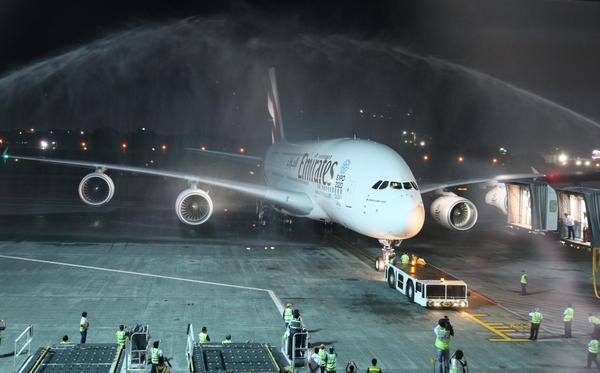
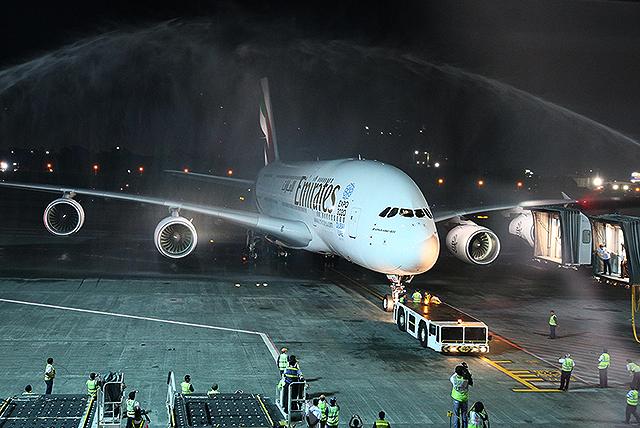
Emirates Airlines begin its inaugural triangular flight to Cebu and Clark as the Boeing 777-300ER plane touched down at 3:40pm on Wednesday at Mactan Cebu International Airport, strengthening international connectivity to two of the Philippines’ fastest-growing international hubs.

"The circular flight with rights to two domestic destination is a new trend for Emirates catering to the market demand," Badr Abbas, Emirates' Senior Vice President, said during a press conference at the Cebu International Airport. The flight operates on Dubai-Cebu-Clark-Dubai route.

Emirates flights to Cebu and Clark depart daily from Dubai as EK338 at 02:55 hours, arriving at Mactan-Cebu International Airport at 15:50 hours. The service then departs from Cebu at 17:20 hours and arrives at Clark International Airport at 18:50 hours. The return flight departs Clark at 20:20 hours, arriving at Dubai International Airport at 01:20 hours the next day.

The airline operates 25 flights weekly to Dubai in the United Arab Emirates.

Emirates Timeline in the Philippines

June 17, 1990: Emirates launched their twice a week flights on the Manila–Bangkok–Dubai route, and once a week flight on the Manila–Dubai route using an A310 and A300 aircraft interchangeably.

March 27, 1996: Emirates introduced a bigger aircraft, Boeing 777 on the route, used interchangeably with Airbus A330.

March 1, 2007: From 10 flights per week, Emirates commences its two flights daily non-stop on the Manila–Dubai route.

February 18, 2014: Emirates first flight to Clark. The airline flew daily using B777-300ER until it susspends service after six months of operations due to poor sales on May 1, 2014.

October 7, 2014: Emirates introduced A380 special commercial flight to Manila which brought home more than 300 passengers.

In 2013, Emirates invested almost $100 million through direct expenditures of ground handling company DNATA in the Philippines.

March 29, 2016: Emirates increases its Dubai-Manila (DXB-MNL) flights with additional four weekly flights.

March 30, 2016: Emirates launches its first Dubai-Cebu-Clark-Dubai circular service, marking its first entry in Cebu City and its re-launch in Clark, where we first started in 2013.

Etihad Escapes Mandatory Cebu Flights

Emirates Does Triangle

29 December 2015

Etihad Airways has successfully circumvented the Civil Aeronautics Board (CAB) "must fly Cebu rule" as it utilizes new flight entitlements granted from the latest round of Air Service negotiations between the United Arab Emirates and the Philippines.

The gulf-based carrier got a nod from CAB to add three new weekly services between Abu Dhabi and Manila from May 1, 2016, offering a total of 17 return flights per week, while its Code share partner Philippine Airlines (PAL) flies the remaining four weekly services between Manila and Abu Dhabi providing the alliance with 21 flight entitlements per week.

According to the agreement, PAL will fly Cebu - Abu Dhabi sector via its hub in Manila and vice versa.

Meanwhile, the other Emirate airline will fly daily triangular services from Dubai to Cebu and Clark onward to Dubai beginning summer of next year as a condition for it to use new Manila entitlements equivalent to four weekly flights as it expands Dubai - Manila services to 17 weekly flights. Currently, the airline operates 14 flights a week.

More fun while it blasted

27 August 2015


By Conrado R. Banal III


Those UAE airlines flying to Manila–but not to any of other international airports in country such as Clark or Cebu or Davao—must be having a lot more fun in the Philippines.

Those airlines simply demanded that the Philippine government should give them 26 additional flights per week right smack in the middle of the air traffic-infested Manila airport, which would really be a blast to them, because these would be on top of the 28 flights per week that they have already been enjoying for the longest time.

From what I gathered, the Philippine aviation authorities seemed to be ready to give in to the onerous demands of those airlines, namely, Emirates Airlines of Dubai and Etihad Airways of Abu Dhabi.

But of course the two Filipino airlines flying to the Middle East, flag carriers Philippine Airlines and Cebu Pacific, frowned upon the demand on the Philippine government made by those two foreign airlines.

If the Aquino (Part II) administration would give in to the pressure from those airlines, Emirates and Etihad would each have more than 25 flights per week to Manila, and the locals PAL and Cebu Pac reasoned that it would only mean certain death for them.

But surely the question would have to be, well, did our leader Benigno Simeon, aka BS, even know all about this deal happening behind his back?

Only a few months ago, the United Arab Emirates pushed for the new round of air talks with the Philippines, giving as their most compelling reason that the existing air agreement between the two countries was already obsolete being… well, two years old.

In the existing air agreement crafted in 2012, those two airlines, Emirates and Etihad, already succeeded in doubling their flight entitlements to the Manila airport, thus giving them 14 flights each.

And now, two years later, they want more!

In comparison, PAL had 14 flights per week to the Emirates, while Cebu Pacific had seven flights per week.

Anyway, our dearly beloved Tourism Secretary Ramon Jimenez Jr. revealed that the government would “give in”—his exact words—to the demand by the UAE government for the new talks, implying that it would be good for Philippine tourism.

But as it turned out recently, the Philippine government would not only be giving in to the holding of talks but also would be giving away all the flight entitlements that those two UAE airlines demanded.

And what would the local airlines get? Well, it seemed that the side of the local airlines happened to be not part of the main agenda in the new air talks. Talk about “reciprocity”!

Question: Did we ever have a pressing, matter-of-life-and-death need for the additional 28 flights of those UAE airlines to Manila?

As I said, at 14 flights per week each, the two UAE airlines already enjoyed 28 flights per week, while PAL and Cebu Pacific, together, had all of 21 flights per week.

Just how big the UAE market was and would ever be, perhaps could be gleamed from the official statistics supplied by that country, showing that the total population of the UAE happened to be all of 1.4 million people.

That was not even anywhere close to the estimated number of OFWs at more than 10 million already and still counting.

Thus the locals feared, and rightly so, that those new entitlements, if given by the administration to the foreign airlines, would only bleed the local carriers.

For one, the locals used their own capital, while based on reports abroad, those UAE airlines wallowed in government subsidies to the tune of $42 billion, in the form of cheap loans, cheap airport services and even outright cash.

Other governments, such as the US, Canada and Europe, already made a lot of noise over the subsidies enjoyed by those airlines from their government, with some NGOs even calling the $42-billion subsidy as just the “tip of the iceberg.”

European countries like the Netherlands, France and Germany already blocked the UAE airlines from getting new flights to any of their areas, because subsidies would make it easy for the UAE airlines to steal customers from other airlines.

Notice that the subsidized Middle East airlines already became so dominant in the Europe-Asia Pacific routes that most European carriers abandoned direct flights on those routes a long time ago.

Like it or not, subsidies would never be good for competition. In the case of the Philippine carriers, the Middle East and European routes were the virtual monopolies of Emirates and Etihad. PAL and Cebu Pacific only started to go on those routes only two years ago. The result was immediate cutting down of rates.

That was the biggest reason that the local carriers had to oppose the Aquino (Part II) administration’s grant of flight entitlements to the UAE airlines, because it would be unfair subsidized competition.

The last time I checked, monopoly was not good for competition; it would thus be criminal to burden our OFWs this way.

Manila-Clark Still Wide Open To Emirates

Says Clark Airport CEO

27 August 2015

For Emigdio Tanjuatco III, President and Chief Executive Officer of the state-run Clark International Airport Authority, he cannot understand why Emirates Airline (UAE) insists on flying the already congested Ninoy Aquino International Airport in Manila when Clark International Airport which he manage is wide open for business.

Clark International Airport continues to struggle attracting passenger traffic after Emirates terminated its flight there.

Emirates Airlines had daily flights from the Clark airport to Dubai until it pulled out in 2013 and transferred operations to Manila when they entered code-sharing flight with Philippine Airlines. The agreement has since been abrogated and the extra flight barred by the Civil Aeronautics Board (CAB).

“The new talks is already detrimental to the country’s aviation industry. Yet we are open here in Clark and they have entitlements to fly here.” says Tanjuatco.

Tanjuatco said the new talks with the United Arab Emirates gives for naught the entitlement of other regional airports in the Philippines which allows the airline to operate without violating the existing bilateral, referring to the Air Services Agreement that is currently negotiated today in Manila, with the support of the Department of Tourism.

Emirates Airlines is permitted unlimited flights to Clark and Cebu from Dubai while it allowed only 14 flights a week to Manila.

“That was exactly the intent. To funnel excess traffic to us, but the expansion has the effect of reversing that rule. ” Tanjautco adds.

Tanjuatco said Emirates should just instead use the rights to fly other airports in the Philippines like Qatar Airlines and other Korea-based airlines did and develop the market, if they were genuinely interested about the economy and overseas Filipino market, instead of getting perception that they are trying to kill competition by flooding Dubai market.

Both Philippine Airlines and Cebu Pacific flies Manila to Dubai and sees new entitlements as distortions to market capacity considering that PAL has yet to utilize all its entitlement to the United Arab Emirates.

According to PAL there are still more than 2,000 seats per week vacant to address that growth and service OFW flights. Emirates however has used all its entitlement to Manila.

Emirates said Wednesday in a statement that the added capacity would be helpful to Filipinos working and traveling overseas.

“The upcoming bilateral talks and the restoration of Emirates’ third daily flight are all in the best interest of the Philippine economy, tourism as well as that of millions of Filipino travelers,” said Barry Brown, Emirates’ divisional senior vice president for commercial operations in the Far East & Australasia region.

“The intent is good but our economy and the OFW market is not centered on Manila market alone. Majority of the OFW travelers are coming from outside of Metro Manila.” adds Tanjuatco.

Emirates Airline is the first foreign airline in Clark airport to fly long haul to Dubai.

The UAE Science

25 August 2015

What fuels the United Arab Emirates Market?

Emirates Airlines said Thursday last week the revival of third daily flights between Manila and Dubai will  be beneficial to overseas Filipino workers and tourists.

“Since the removal of the third daily flight, Emirates’ two daily flights on the Dubai-Manila route have been operating at 100 percent capacity in economy class on most  of the flights – with no seats left for international tourists and overseas Filipino workers,” Emirates said in a statement.

Emirates Philippines Country Manager Abdalla Al Zamani said that there is a “significant gap between the supply and demand for seats” in the Manila-Dubai route.

“Taking this into consideration, we are confident that the  restoration of Emirates’ third daily flight to Manila will ensure widespread and sustained benefits to all stakeholders,” Zamnani said.

Emirates’ said its commitment to the Dubai-Manila route has been a catalyst for growth in the UAE-Philippine bilateral trade and tourism to the Philippines for the last 25 years.

The UAE airline has lobbied the Tourism Department and has been successful to asked President Aquino to authorize Philippine panel to meet their counterparts to start air-services talks with the aim of expanding the capacity and meet the demand to the objection of local carriers.

But does Emirates really cater to Dubai-Manila route alone?

Local carriers Philippine Airlines (PAL) and Cebu Pacific (CEB) doesn't think so at it opposed new talks expected to be negotiated in August 27-28 in Manila after talks in January was postponed.

This time around though, both the government of the Philippines and the UAE have decided to proceed with air talk negotiations despite protest of the local carriers upon the support of the Tourism Department.

Both Philippine Airlines and Cebu Pacific has argued that the added capacity was not needed as the Philippines hasn't utilized all its entitlement to the UAE. Further, it is only the Dubai-based airline that wanted bilateral expansion. Etihad Airways of Abu Dhabi has code share relationships with Philippine Airlines.

“We call on the Philippine panel to the Philippine-UAE air talks to refrain from giving Mid-East carriers undue advantage by granting more capacity and frequency beyond what the market requires,” PAL president Jaime Bautista said.

Cebu Pacific echoed Mr. Bautista's sentiment.

“Given the significant increase in capacity over the past year, Cebu Pacific believes that a new round of air talks with the UAE should not be held until all available Manila-use entitlements are fully utilized by Philippine carriers who are ready, willing and capable of operating routes to UAE,” says Atty. Paterno Mantaring Jr, Officer-in-Charge of Cebu Pacific corporate affairs.

Air Service Agreement (ASA) between the two countries authorized their respective carriers to fly 28 flights a week between Manila and Dubai/ Abu Dhabi and unlimited rights to regional airports.

While UAE-based carriers has flown all allotted slots, the Philippines flew only 21 of said entitlements with 7 slots belonging to PAL Express not utilized.

“We hope our own government will promote fair competition and support our airlines who have invested much in re-establishing air links to the Middle East and Europe,” says Bautista.

"Should the UAE airlines get the additional entitlements they seek during the coming Philippine-UAE air talks, this will undermine the investments PAL and other airlines have made for the country in opening new routes to serve Philippine tourism and overseas Filipino workers," Bautista adds.

PAL's routes to Europe, Middle East and the US are at risk once UAE secures increased frequencies to Manila he said.

Bautista cannot understand why Emirates insists on flying to Manila when it can launch Clark and Cebu instead in growing its Philippine operations as these airports has no restrictions. 

In 2014, Emirates Airlines cancelled its Dubai-Clark route in anticipation of receiving a third entitlements at Ninoy Aquino International Airport, but the agreement with PAL was objected by Cebu Pacific prompting the Civil Aeronautical Board to cancel the deal but Emirates continued selling tickets beyond the summer season that in December 2014 it penalized the airline for selling tickets without prior authorization and it also cancelled the third flights which already exceeded their weekly maximum entitlement

Philippine Airlines was very vocal on the unfair practices employed by Emirates disguising tourism traffic from sixth and seven rights abuses for destinations to Europe.

The Department of Tourism (DOT) has been very vocal about expanding the UAE entitlements for tourism and business reasons.

Tourism Secretary Ramon Jimenez Jr. said the pursuit of air talks is in line with the government’s objective of increasing tourist arrivals from the middle east.

But data from the DOT does not support such claims as most tourism traffic growth are coming from South Korea, United States, Japan, and China. If at all, more entitlements should be negotiated in this countries according to Bautista. 


While International commercial air traffic soared by 28 percent during the first quarter of the year, these are mostly attributed to entries of other airlines Oman Air, Turkish Airlines, as well as Chinese and Korean carriers. Foreign carriers, grew by an unprecedented 47 percent, to 2.8 million passengers from 1.91 million passengers in the first quarter of 2015.

What Gives?

11 December 2014
Rights Gone Too Far
Buyers of Emirates Airlines ticket due until summer of 2015 particularly the morning flight at NAIA may have to wake up to a rude awakening as they will be axe by the airline for lack of permits to fly.

By Alex Magno

It is bizarre business practice, but Emirates airline is selling tickets up to October 22, 2015 anyway with the caveat “subject to government approval.” Buyers beware.

There is impunity shown here. The Civil Aeronautics Board (CAB) will meet today to decide on the matter of allowing Emirates to sell tickets beyond December 26 this year when its provisional flight allocation ends. Does Emirates know something others in the industry do not?

There is a complicated backgrounder to this issue.

Under the existing air services agreement between the Philippines and the United Arab Emirates (UAE), each side is allowed four flights daily between Manila and either Abu Dhabi or Dubai. That is perfectly reciprocal.

Emirates and Etihad equally share the four flights granted the UAE. Of the four flights granted the Philippines, PAL and PAL Express are entitled three while Cebu Pacific is entitled to one.

Since PAL was not using all the three flights allocated to the airline, the company agreed to “codeshare” this with Emirates. This basically allowed Emirates to use the PAL’s allocation. Fair enough.

That “codeshare” arrangement, however, expired last October. PAL has taken back its third flight allotment. CAB, however, allowed Emirates to continue with its third flight (it is entitled to only two) up to last November 26. In a fit of generosity, CAB even extended this permit for a third Emirates flight to December 26 next.

No one in CAB, it seems, bothered to ask what the basis for this strange arrangement is. It breaks the symmetry of what should be a reciprocal air service agreement. It allows Emirates to eat up the share of the Filipino airline, especially since PAL decided to use its third flight allocation.

If a Philippine airline dared to fly an additional plane to Dubai or Abu Dhabi, one beyond what the air services agreement allows, that plane will likely be confiscated upon landing. They will surely be penalized for selling tickets beyond the date the agreement allows flights.

Why then is Emirates [Airlines] allowed by CAB to illegally sell tickets for an illegal [third] flight to the prejudice of Filipino airlines?

Extra Bilateral

Emirates 3rd Flight Legal

2 December 2014

The grant of temporary rights to Emirates Airlines is legal.

Civil Aeronautics Board (CAB) Executive Director Carmelo L. Arcilla said Tuesday that they are empowered by law to grant temporary rights to airlines operating in excess capacity.

“There is such a thing as extra-bilateral rights, which are temporary rights.” says Arcilla.

The extra-bilateral rights allowed by law is limited to 30 days, but can be extended for another 30 days when warranted by the situation.

Emirates Airlines has been operating between Manila and Dubai beyond its allowable capacity of only 14 times a week since October after the Board denied with finality the code-share arrangement with flag carrier Philippine Airlines upon the complaint of Cebu Pacific. A separate motion was filed by the carrier to temporarily utilize the frequencies of PAL until March 2015 but the Board also denied the airlines request.

The Gulf carrier has since then filed a motion for reconsideration, which has yet to be heard on December 11, and for that reason the Board extended Emirates’ third flight operations until December 26 according to Arcilla.

“We decided to extend just to prevent the disruption of services,” Arcilla said.

Arcilla pointed out that they will still hear the opposition of local airlines on December 11, which could mean that Emirates third flight to Manila could end up to December 26 only, or they could fly to Clark or Cebu instead.

Talks for expansion of Air Service Agreement (ASA) between the United Arab Emirates UAE) and the Philippines is scheduled on February next year but this early the local airlines has manifested already that they are opposing such move by Emirates Airlines saying that traffic between Dubai and Manila is more than enough at this time. The Dubai based airline is requesting 14 more entitlements between Manila and Dubai.

Wrestling Emirates

To Be or Not To Be?

30 November 2014

Philippine carriers are up in arms against the Civil Aeronautics Board’s (CAB) decision after the agency approved Emirates Airlines (UAE) petition to extend their temporary permit to mount additional daily frequency to Manila beyond November 26 pending negotiation of expanded air bilateral with the Gulf State next year.

Oppositors Cebu Pacific Air (CEB) and Philippine Airlines (PAL) explained the move as a “mockery” of government regulations, bypassing limits laid down by bilateral aviation agreements.

The local airlines said CAB has no authority to grant extra frequencies under Section 3 of Executive Order No. 29.

The Philippines and the United Arab Emirates is scheduled to meet next year to expand the Air Services  Agreement (ASA) between the two States upon the request of Emirates.

The Philippine-based airlines said that CAB's decision to extend Emirates temporary rights beyond November 26 is tainted with abuse as it has no legal basis and justification to stand on other than the economic reasoning of Emirates.They said that Emirates this early has already been selling tickets until October 2015 which is not yet approve by the Board.

Emirates Airlines has used all its entitlements (14 times a week) to Manila and was begging CAB to grant them temporary permit to fly additional daily flight after the aviation regulator nullify earlier this year their code share agreements with PAL allowing them to mount the controversial third flight.

CAB allowed Emirates to operate additional seven frequencies between October 27 and November 26 despite objections from the Philippine carriers.

The local carriers objections started as early as October 13 when the CAB granted Emirates a 30-day extension through November 26 to operate the additional seven weekly flights “presumably by virtue of its authority to grant extra frequencies to any foreign carrier for a period of not more than 30 days.” They said counting the further extension, CAB has granted Emirates a total extension of 60 days now.

“We believe that the grant of these unwarranted extra flights to Middle Eastern carriers distorts competition and undermines the investments of Philippine air carriers in building a truly competitive air route to the UAE,”  Philippine-based airlines said in a joint statement.

Cebu Pacific said that while they want to get the seven idle frequency not used by PAL they are not interested in talks expanding the ASA with the Gulf State stating that the current frequency is more than enough at this time.

“If Emirates truly wants to expand its service into the Philippines, it has every opportunity to put up new flights to Clark, Cebu or other Philippine international airports outside of Manila,” their joint statement adds.

The current bilateral allows UAE airlines, Emirates Airlines or Etihad Airlines, to mount unlimited flights to Clark, Cebu, and Davao.

Emirates Airlines is applying for fourteen additional frequencies to Manila with the upcoming negotiations but PAL and CEB are not so keen in joining the talks as they are objecting to the proposal saying that it is beyond the traffic needs of the region.

“We look to CAB to work with the Philippine air carriers in growing the Philippine aviation industry and allow us to compete with foreign carriers in a level playing field,” the local airlines said.

Meanwhile, industry sources disclosed that CAB may be forced to extend the third flight of Emirates beyond December 26 because the Civil Aviation Authority (CAAP) has not yet released the regulatory guidelines on the use of A380 plane at Ninoy Aquino International Airport.

Air Services between the Philippines and the United Arab Emirates are negotiated by frequency and not by number of seats, or size of aircraft. Therefore, Emirates can technically use the A380 to Manila.

While technical studies and reports were already submitted by Airbus to aviation regulators as to its viability, there was no approval yet from CAAP permitting A380 operations at Manila airport citing daytime congestion as one major unresolved issue.

The Flight of the A380

1 October 2014

Emirates Airlines (UAE) is bringing to Manila its special A380 flight on 7 October. Flight EK334 is expected to arrive at 10:10pm. The special flight will test airport terminal operations at Ninoy Aquino International airport in preparation for upgrade airline services before the end of the year. UAE is scheduled to operate bi-class A380 service between Manila and Dubai.

Terminal 3 Is Done, Finally!

Clears Delta Airlines, KLM, Singapore Airlines, 
Emirates and Cathay Pacific transfer


31 July 2014

Delta Airlines will be the first airline to relocate in Terminal 3 today after the Transportation Department finally completed Terminal 3 project, 17 years after concession was awarded, amidst corruption scandal against its erstwhile benefactor Fraport AG of Germany.

DOTC said  Japan’s Takenaka Corp. would turn over the facility today making it 100 percent operational and later tonight Delta Airlines would be receiving its arriving passengers from the Terminal.

Terminal 3 had been operating at half its intended designed capacity since it opened six years ago catering mostly to LCC operators Cebu Pacific and PAL Express together with lone full service carrier ANA. 

Terminal 3 will now be able to welcome 3.5 million more passengers said Transport Secretary Joseph Emilio Abaya.

Abaya said the $US80 million completion work done by Takenaka can now be able to fully accommodate the relocation of five international carriers operating from Terminal 1, which also has to undergo extensive repair, retrofit, rehabilitation and upgrading works to meet future demands.

Other foreign carriers that will move to Terminal 3 are as follows:
  1. Delta Airlines........................................................ July 31
  2. KLM....................................................................... August 4
  3. Emirates................................................................. August 15
  4. Singapore Airlines................................................. September 1
  5. Cathay Pacific........................................................ October 1
The transfer of the  five airlines is expected to reduce Terminal 1’s annual passenger capacity from the current 8 million down to its design capacity of 4.5 million. Terminal 3 handles 13 million passengers per annum.

Emirates Cancels Clark Due To Heavy Losses

Ends May 1

23 March 2014

By Daniel Shane

Dubai carrier Emirates Airline is to scrap a daily service to a key air hub in the Philippines just seven months after launching the route.

Emirates will cease its daily flights to Clark International Airport from May 1, a spokesperson confirmed, following a review of its operations.

The service to Clark International, located in the Greater Manila Area, was the only long-haul route to be operated outside of the country’s primary Ninoy Aquino International Airport in the capital.

Following the service’s launch in October last year, Emirates embarked on a highly visible marketing campaign to promote the route to the UAE’s large Filipino community.

“Emirates can confirm that it is suspending its daily, non-stop service between Clark International Airport and Dubai from 1st May 2014. The decision was made after a review of the airline’s operations to ensure the best utilisation of its aircraft fleet for its overall business objectives,” a spokesperson for Emirates told Arabian Business.

“Emirates will continue to operate its three daily, non-stop flights between Manila and Dubai and is taking all necessary steps to accommodate affected passengers on alternate flights,” they added.

Earlier this year, aviation analysts warned that airlines are losing money on the UAE-Philippines route and will soon be forced to cut flights.

The Centre for Asia Pacific Aviation (CAPA) said too many carriers had entered the once-lucrative market, with 24 flights per week added in the last quarter of 2014 alone.

Despite huge traffic between the countries – there are about 700,000 Filipinos working in the UAE, the Asian country's fourth largest overseas community – airlines including Dubai's Emirates, Abu Dhabi's Etihad and three Filipino carriers had saturated the market to the point that competition had become too great.

“While there is considerable traffic between the Philippines and UAE, yields are generally low and there are large seasonal fluctuations,” a CAPA report said.

“On a year-round basis the Philippines-UAE is not an easy market to turn a profit on, particularly without any ability to sell flights beyond the UAE.

“But December and January are peak months for the Philippines-UAE market, as Filipinos working overseas typically make their trips back home during the holiday season. February and March will be more challenging months, while April will see another peak for Easter.”

The route became overcrowded during the previous few months, with three Philippine carriers entering the market – low-cost airlines Cebu Pacific and PAL Express and flag carrier Philippine Airlines.

Etihad Airways also serves Abu Dhabi-Manila with two daily flights.

Gigie Baroa: Flying high with Emirates Philippines

By Iris C. Gonzales
As published in The Philippine Star 
on October 1, 2013

MANILA, Philippines - Maria Brigitte “Gigie” Baroa’s story as Emirates Philippines country manager started with one “strange call.”

In the story, the voice on the other line asked to meet with Baroa and later on, asked her if she would be interested in joining Emirates.

This was in 1990 or one year after Baroa became the country manager for Air India.

“A year later I got some strange call. It was from somebody I totally didn’t know,” Baroa told The Star.

“’We’re from Emirates. We’re in town and we’re seeing friends and your name came up. We’ve looked at the list of airlines operating from Manila and we’d like to learn more about Air India and we’d like to meet with you,” Baroa quoted the caller as saying.

Baroa agreed to the meeting, held at the lobby of then Philippine Plaza Hotel.

“We discussed tourism industry what kind of traffic I had at Air India. Right, then and there ‘they said, would you be interested to join us?’” Baroa said, her eyes still beaming as she recalled the fateful call.

It would be the start of a career in Emirates for Baroa.

Yet at the onset, Baroa was destined to become big in the travel and tourism industry.

Tourism, for her, was simply love at first sight.

“It’s really the joy of being out in the field more than anything else. I knew from college that I would not do a desk job. I was taking economics and I could not imagine myself in a desk in a bank. My parents wanted me to be a banker. I had to think of something else. I wanted to be really good,” Baroa said.

At the time, during her college days, tourism was a big thing.

“This was the Marcos days. I was really active in school,” she said.

Together with a college friend, Baroa put up the very first travel organization in Ateneo, the Ateneo Travel Club.

“We would put up packages for domestic runs for friends, during the holidays, she said.

She eventually moved to the Asian Institute of Tourism at the University of the Philippines, Diliman.

“Tourism was a big thing. I said oh-my-God that’s perfect for me. So I moved. I finished first tourism and then a year after, I finished my economics,” she said.

From school, one of her professors asked her to work with the Andres Soriano Group or Anscor.

“At the time, they were the big guns. They still owned San Miguel, Coke…I started with their travel unit called Tours Specialist and then they set up a travel holding company to combine, in-bound, out- bound flights, conventions, events and merchandising,” she narrated.

“I was moved to the holding company called Anscors’ Tourism Development Corp. When I moved out of the company, I was already conventions manager and then I had a short stint with an exhibition company. This gave me an international experience in handling conventions here,” she said.

Her experience made her ripe for a stint at Air India, which would later become her stepping-stone to the giant Emirates.

The rest, as they say, is history.

Yet Baroa recalls that putting up Emirates in the Philippines was quite a challenge.

 “In the past, Middle East carriers were for labor traffic only. The perception was that it was smelly or only meant for cheap labor. It was difficult during our first year,” she said.

But with enough experience, Baroa carried on and pushed to bring Emirates in the radar screen of Filipino travellers.

“I was very lucky because the sales manager I had at the time was a Filipina who could speak both English and Chinese and at the time, we only had two to three flights a week via Hong Kong and of all time slots our Manila-HK had a departure of 5:30 in the morning. My Manila HK was the worst time slot,” she said.

Baroa and her team was unfazed.

“We tried out everything from fairs to promos. We tried menu tasting. We wanted to show everybody that we were okay. We were the first Middle East carrier for leisure and not just for labor. Slowly, we had people trying out our Manila-HK flights promotions. We had our door- to-door with agents,” she said.

And because hard work always pays off, the Emirates’ Manila-HK flights became quite a hit among the Chinese market and the byahera crowd or the businessmen and women who have shops in Greenhills and would often go in and out of the country for new items.

 “Later on it became such a hit that we were able to get the Chinese Binondo market. We had traffic coming from Cebu to catch our Manila - HK flight. This was in spite of the early departure. We managed to come up with something that would attract them. You get to HK at 7 am you don’t waste time. You can maximize your stay in HK compared to our competitors at the time. That was our selling point,” she said.

Eventually, the HK station had grown full-blown that it could already operate on its own.

Now, Emirates Philippines remains true to Emirates position in the global airline industry market.

“We’re already one of the big boys. We’re no longer just the little brother,” Baroa said.

Now Emirates Philippines has 21 flights a week out of Manila, three times daily.

 “With the entry of Emirates into the market, we’d like to think that we’ve raised standards. We put in entertainment. We were the first carrier to do that. We had an inflight entertainment. We were the first one to have inflight entertainment operated from special buttons from the seat, tapping on the screen. Our price is really value for money,” she said.

Today, Emirates soars even higher with the launch of its Clark-Dubai flights on October 1.

The daily flights will aim to capture the overseas Filipino workers who hail from central and northern Luzon.

 “We hope we can grow further and expand the market. Ten years ago, we wouldn’t have thought of Clark. A study was made and our planning people said Clark is now ripe. It was a very thorough study. There’s a lot of investment but we’re pretty confident after a while, market will pick up. Passengers will realize there’s a lot of convenience in using Clark. It doesn’t make sense to go to Manila when all services are available in Clark,” she said.

Indeed, with Baroa at the helm, Emirates Philippines has nowhere to go but to fly higher.

Emirates to fly Clark

Begins Flight October 1

February 18, 2013

Emirates Airlines announced that it will begin daily flights between Dubai and and Manila-Clark starting October 1 2013 using Boeing 777-300ER aircraft.

Emirates flight EK338 will depart Dubai at about 4 am and arrive at Clark International Airport at 4:40 pm. The return flight, EK339 will depart at 6:35 pm and arrive at Dubai International Airport at 11:05 pm.

The airline operates 3 daily flight out of NAIA and has been operating in the country since 1990.

“The launch of flights between Clark International Airport and Dubai will offer our passengers the flexibility of choosing from two destinations in the Philippines,” said Tim Clark, President Emirates Airline in a statement on Monday, February 18.

The new route also allows Emirates SkyCargo to provide more than 160 tonnes of additional cargo hold capacity each way per week, further supporting Philippines exports of perishables, such as dairy products, fruit and vegetables, meat, seafood and electrical and electronic equipment, and its imports of textiles, apparel, plants, flowers and chemical products.

PAL Secures Code-Share Deals to Dubai

Emirates Airlines commences Third daily flight

January 5, 2013
Flag carrier Philippine Airlines (PAL) and Emirates Airlines (UAE) has amended its PAL-UAE Confidential Memorandum Of Understanding (CMOU), more known as code sharing agreements, as it decides to continue the joint venture adding third daily flight between Manila and Dubai starting next week after both airlines found common terms.

The third daily flight will be staged in the morning and code-shared with Philippine airlines also using Boeing 777-300ER as equipment.

EK337 leaves Manila at 0845 arriving Dubai at 1350 while EK336 leaves Dubai at 1830 and arrives Manila 0630 the following day.

CAB executive director Carmelo Arcilla, said the deal was approved  last week paving the way for additional 7 weekly flights from both Emirates Airlines and Philippine Airlines under code-share bringing its total to 21 this year.

Previously, Abu Dhabi has 7 entitlements being used by flag carrier Etihad Airways, and Dubai has 7 entitlements used by flag carrier Emirates to Manila, while the other 14 entitlements was solely held by flag carrier Philippine Airlines (PAL). Both airlines have code-share relationship with PAL since 1998 allowing them to fly a total of 28 flights a week to Manila using Boeing 777-300ER planes.

The amended PAL-UAE Confidential Memorandum Of Understanding (CMOU) provides for a maximum entitlement of 21 weekly frequencies for UAE as the exclusive designated UAE carrier under Category 1 Route 1 to Dubai, while Category 1 Route 2 covering Abu Dhabi-Manila sector is also granted 21 weekly frequencies between PAL and Etihad Airways.

Negotiations between the two airlines almost failed after Emirates refused to code-share the third flight saying that it doesn't owned the additional frequencies granted to the Philippines. PAL owns seven frequencies to Dubai while UAE owns seven frequencies to Manila which they jointly served using Emirates Aircraft effective until 2014.

Controversy arose when the Civil Aeronautics Board (CAB) concluded new Air Service Agreement (ASA) with the United Arab Emirates providing additional 14 flights to the Emirate Kingdom. It granted additional seven rights to Dubai and seven more to Abu Dhabi for points in Manila.

CAB awarded last week the 14 new flight entitlements to United Arab Emirates (UAE) equally between Cebu Pacific and Airphil Express both of which have pending Airbus 330-300 orders. Airphil Express is a low cost subsidiary of PAL. None was awarded to Zest Air while PAL held on to 14 entitlements for Dubai and Abu Dhabi. PAL codeshared the routes to Dubai and Abu Dhabi via airline partners UAE and Etihad Airways (ETD) for a total of 28 flights between the two countries.

The grant of rights to Cebu Pacific also dissolves anti-trust concerns which PAL had with the Board requiring it to service the routes to the UAE.

Earlier, Cebu Pacific (CEB) filed a complaint against PAL for forfeiture of its rights  to fly the United Arab Emirates arising from non-use of bilateral air traffic rights. CEB wants to fly to the middle east starting winter season next year but their plans to expand to the region was hampered by lack or inadequate flight entitlements which were all taken by PAL and its codeshare partners. CAB rules that PAL was actively flying the route. Consequently, the government of the Philippines and the Arab Emirates expanded their Air Treaty to cover 28 weekly frequencies between Dubai, Abu Dhabi and Manila.

Previously, PAL in its Opposition letter to Emirates contend that the airline plans to introduce its own-operated flights to the United Arab Emirates by 2012 and 2014, “given the assurance that no more than 28 weekly frequencies are to be operated by each side on the agreed routes between the UAE and Manila.”

PAL codeshared the routes to Dubai and Abu Dhabi via partners Emirates and Etihad Airways (ETD) for a total of 28 flights between the two countries.

CAB Executive Director Carmelo Arcilla said Abu Dhabi has 7 entitlements being used by flag carrier Etihad and Dubai has 7 entitlements used by flag carrier Emirates to Manila, while the other 14 entitlements was solely held by flag carrier Philippine Airlines (PAL). Both airlines have code-share relationship with PAL allowing them to fly a total of 28 flights a week to Manila using Boeing 777-300ERequipments.

The Not-so Secret MOU to Dubai

PAL Cries Foul Over Emirates Refusal to Code Share 3rd Flight

November 12, 2012

Flag carrier Philippine Airlines (PAL) has asked the Civil Aeronautics Board (CAB) to reject the petition of Emirates Airlines (UAE) to add third daily flight starting January 1, 2013 between Dubai and Manila stating that the additional schedule was "counterproductive and unjustified."

The reason, UAE already fly 14 times a week, the agreement with them say so. PAL cannot fly to the gulf state because of previous secret agreement with UAE set to expire in 2014.

Negotiations between the two airlines failed after Emirates refused to code-share the third flight saying that it doesn't owned the additional frequencies granted to the Philippines.

Earlier, Cebu Pacific (CEB) filed a complaint against PAL for forfeiture of its rights  to fly the United Arab Emirates arising from non-use of bilateral air traffic rights. CEB wants to fly to the middle east starting winter season next year but their plans to expand to the region was hampered by lack or inadequate flight entitlements which were all taken by PAL and its codeshare partners. CAB rules that PAL was actively flying the route. Consequently, the government of the Philippines and the Arab Emirates expanded their Air Treaty to cover 28 weekly frequencies between Dubai, Abu Dhabi and Manila.

According to PAL in its Opposition letter to Emirates Petition (CAB CASE No. EP-59079/HED102012-261) for additional third daily flight, the airline intends to introduce its own-operated flights to the United Arab Emirates by 2012 and 2014, “given the assurance that no more than 28 weekly frequencies are to be operated by each side on the agreed routes between the UAE and Manila.” 

PAL codeshared the routes to Dubai and Abu Dhabi via partners UAE and Etihad Airways (ETD) for a total of 28 flights between the two countries.

“As code share partner, PAL honors its existing code share arrangement which remains in effect until 2014. Our objection is to the proposed unjustified and counterproductive excess of seven frequencies, or for that matter any formulation that results in an EK operation in excess of 14 frequencies per week on the Dubai-Manila route,” PAL said. 

Further, PAL said that the new PAL-UAE Confidential Memorandum Of Understanding (CMOU) already provided for a maximum entitlement of 14 weekly frequencies for UAE as the exclusive designated UAE carrier under Category 1 Route 1. Category 1 Route 2 covers Abu Dhabi-Manila sector.

PAL also said that UAEs proposed petition would undermine the earlier negotiation of a new CMOU in September that was intended to usher in a new development era where the airlines of both the Philippines and the UAE would offer their own self-operated services in an environment of fair and healthy competition.

“As the board will noted, EK’s proposed 21 times weekly service will result in a total UAE carrier operation of 36 weekly frequencies when added to the existing 14 times weekly Abu Dhabi-Manila services of Etihad Airways, the UAE’s designated carrier for Category 1 Route 2 under the CMOU,” PAL said.

UAE argued however that PAL's interpretation is flawed.

Gigie V. Baroa, UAE Philippine manager explained that while both of them are entitled to fly 7 times a week for a total of 14 flights between Dubai and Manila which they are now doing, another 7 entitlements was granted by both Arab Emirates and Philippine government last September 11, expanding bilateral services between these two points.

"The United Arab Emirates awarded this additional entitlement to Emirates Airlines" says Baroa.

“It was in the fact the agreement of the aeronautical authorities of the two governments that the pre-existing borrowing of unused entitlements could continue alongside the additional daily services granted under the new confidential memorandum of understanding of Sept. 6,” Baroa said.

PAL did not get the new entitlements nor applied for the same. The seven additional frequencies are still to be divided between Cebu Pacific and Zest Air which applied to service the routes.(Air Philippines applied for this route after blog posting)

"The requested additional frequencies will not just benefit Emirates but the Philippine carriers as well" Baroa adds citing growth demands on the market.

The other 7 entitlements on the Philippines side is yet to be awarded by CAB. The applicants for the route were Zest Airways (EZD), and CEB and they were both asking for seven flights says a CAB insider.

Dnata rebrands Philipppine business


By JAMES A. LOYOLA
August 8, 2011,

MANILA, Philippines — Emirates’ ground handling unit Dnata, the fourth largest combined air services provider in the world, has rebranded its business in the Philippines as part of its global brand realignment.

The successful contribution the Philippine business makes to dnata’s global business was acknowledged in Manila as customers, suppliers and both local and international employees celebrated the start of a new era which will see positive changes to the business over the coming months.

Dnata’s profile and reputation in the Philippines have risen significantly since 1998 – when it first established its operations in the region as ‘dnata Inc.’ – the only internationally owned ground handling agent in Manila's airport.
Services offered by dnata in the Philippines include passenger, ramp and baggage services; cargo handling and ground support equipment.

The firm has invested heavily in its Manila operations, with the purchase of new equipment, introduction of staff training initiatives and renovation of their offices.

The operations have seen significant growth during the years since, with an increase in new customers and organic growth by existing customers.

Today, dnata is one of the most successful and highly reputed handling agents in the Asia-Pacific Region with customers including Emirates, Qatar Airways, Hawaiian Air, and Air China.

“We are proud to have strong roots in the Philippines, the team here has worked hard and played an important part in establishing our reputation in the region as a respected global air services provider,” said Dnata President Gary Chapman.

He added that ‘dnata in Manila has excellent potential for growth, future success and to play its part in dnata’s global team effort to achieve its vision of becoming the world’s most admired air services provider.”

The brand re-fresh has come at a key time for the dnata team in the Philippines in particular, having recently welcomed a new General Manager Margaret Yu – who has been appointed to take the lead as the business enters this new era.

“We have more than 200 dedicated staff working at the Ninoy Aquino International Airport, a number of whom have been with the team since we first began our operations in Manila,” said Yu.

She said “the collective knowledge and experience we possess makes us a strong team and enables us to deliver the very best service to our customers. Add to that the combined knowledge, experience and reputation of the rest of the dnata family worldwide and we have a bright future ahead of us.”

Emirates goes double daily to Manila

As more triple seven joins its fleet for Asia-Pacific operations

November 5, 2009

Dubai - Emirates airline is increasing its services to the Asia-Pacific region starting next month with more flights scheduled to Bangkok, Sydney, Jakarta and Manila.

Starting in December, the Dubai-based airline will introduce a fourth daily service to Bangkok, a third daily service to Sydney, double daily to Manila and one additional service to Jakarta. With the latest addition, the airline’s operation in Asia Pacific will increase to 187 flights per week. Its seat load factor will jump by 13 per cent to the region to accommodate the expected rise in demand from said cities to its Dubai hub.

“Asian markets are rebounding with reports of resurgent traffic at key airports in the region. We are confident of seeing a recovery soon and are introducing additional capacity to serve the increasing demand.” says Richard Jewsbury, senior vice president, Commercial Operations Far East and Australasia. The airline also said that almost 30% of its revenue came from the Asia-Pacific region.

According to Jewsbury, the rise in capacity is the result of their taking delivery of new aircraft that were originally meant to keep up with market demand calculated prior to the global economic slump. For example, the latest Boeing 777-300ER scheduled for delivery this month is a bi-class seat configured plane primarily geared to serve the Philippine and Indonesian market where it will have a regular rotation with two flights to Manila and a flight to Jakarta every week.

Emirates airlines operates tri-class service (12 First, 42 Business and 310 Economy Class seats) to Bangkok and Sydney while it operates bi-class service (42 Business and 400 Economy Class seats with 16.7 tonnes of cargo capacity) to Manila and Jakarta using Boeing 777-300ER aircraft.

The airline also intends to upgrade its Asia-Pacific destinations with A380 service in the next two years starting with Bangkok and Manila where it has registered impressive growth as compared to other destinations in the region despite the global downturn. It will also open new routes in Malaysia, the Philippines and Thailand soon as new aircraft are gradually being added to its fleet.

It already received 20 new aircraft as part of the 161 aircraft orders worth approximately $52 billion dollars and is still pursuing an aggressive purchase plan despite the bleak traffic forecast by IATA.

"Emirates airlines has 53 A380 aircraft on firm order, with two of these due for delivery in December 2009. Emirates currently has five A380s in its fleet and we will receive a further 15 up till the end of November 2010. We expect to be its largest operator of the type by that time. We remain in close discussions with Airbus in relation to our order," said Tim Clark, Emirates Airlines President.

International Air Transport Association data show that revenues in the Middle East grew by 18.2 per cent in September compared to the same month last year, and the Asia-Pacific region grew 2.1 per cent.

Another Reason to fly Emirates to Europe

May 7, 2009

Adds 10kg. more of Baggage allowance in all classes

Dubai - Emirates unveiled today a 10kgs increase in its free checked baggage allowance, giving it one of the most generous baggage policies of any airline today.

Economy Class passengers now have a baggage allowance of 30kgs – up from 20kgs, the Business Class allowance has increased from 30kgs to 40kgs, and First Class from 40kgs to 50kgs.

These new, generous allowances, which are effective for all tickets issued on or after 4th May, have been implemented across the airline's extensive global network of over 100 destinations.

Carriers such as British Airways have an Economy Class checked luggage allowance of 23kgs per passenger, whilst the Economy Class allowances on Singapore Airlines and Cathay Pacific are from 20kgs per passenger.

Nabil Sultan, Emirates Divisional Senior Vice President Revenue Optimisation, said: "Emirates has moved to these new free baggage levels to further demonstrate our commitment to putting the passenger first. By offering travellers the flexibility to carry significantly more baggage we will be allowing them to take more gifts for family and friends or take advantage of the outstanding shopping in Dubai and across the extensive network of Emirates destinations."

Gold and Silver Members of Skywards, Emirates frequent flyer programme are entitled to an additional baggage allowance of 16 kgs over their ticketed allowance for Gold members and additional 12 kgs for Silver.

Codeshare passengers from Philippine Airlines travelling on Emirates operated flights are also eligible for the revised free baggage allowances. Emirates' regular rates will be applied to baggage in excess of these new allowances.[ATN]