Showing posts with label Subic International. Show all posts

Subic Fastest Growing Airport in the Country

Increase in international passenger movement grow by 4,134%

29 October 2021

 By Ruben Veloria

Subic Bay International Airport (SBIA) is the Country's fastest growing international airport in the Philippines, defying the odds of slowdown and negative growth amidst Covid19 pandemic.

SBIA has grown from a mediocre international airport to a truly functional hub after the Philippine government approved its utilization as quarantine airport gateway, together with Clark, Cebu and Davao.

“The increase in international passenger movement by 4,134 percent was attributed to the repatriation of overseas Filipino workers (OFWs) and retuning overseas Filipinos (ROFs),” said Ronnie Yambao, SBMA senior deputy administrator for operations group.

 THE frequent arrival of Philippine Airlines (PAL) flights to bring home overseas Filipino workers (OFWs) stranded abroad because of the Covid-19 pandemic has given the airport a new lease of life as a global gateway.

SBMA Port Operations Group reported that aircraft movement at Subic airport increased to 17,756, or by as much as 25 percent in the third quarter of 2021,as compared to the 14,220 recorded in the third quarter of last year.

Yambao said while most of the movement were those of domestic aircraft, a total of 55 international flights that landed in the months of July, August and September contributed substantial number of revenue for the airport. 

These also resulted in increased movement of international passengers, from just 137 in the second quarter of 2021 to 5,800 in the third quarter.


POSITIVE AIRPORT REVENUE FOR THE FIRST TIME IN A LONG WHILE
“In the third quarter of 2021 alone, the OFW flights had provided the Subic airport P1.6 million in direct income, as well as P218.7 million in income for Subic hotels,” says Subic Bay Metropolitan Authority (SBMA) Chairman and Administrator Wilma Eisma

“We are continuing with the airport rehabilitation program that we started three years ago, and the successful OFW flights now are an indication that we have made substantial progress in upgrading SBIA facilities and equipment,” she said.

Among the completed upgrades were a new Doppler very high frequency omnidirectional range distance measuring equipment (DVOR/DME), an automated weather observation system (AWOS), an area navigation approach (RNAV), and new air-ground communication system for air traffic control.

Subic airport posted an actual revenue of P62.15 million, thus surpassing its revenue target of P49.52 million by 126 percent. The third quarter income was also 32 percent higher than that recorded in the same period last year.

The airport income was broken down into P40.48 million for leases, P21.62 million for airport fees, and P48,672 in royalty income.

Since July this year, when Subic became an alternate port for OFW repatriation, a total of 27 OFW flights had been flown to Subic by the Philippine Airlines, aside from nine that were diverted to Clark Airport during bad weather.

SBMA airport manager Zharrex Santos said the airport handled Bayanihan and repatriation flights every week.

Santos said the latest PAL flight that brought in OFWs landed here in Subic on Tuesday, with 299 passengers from Abu Dhabi, in the United Arab Emirates.

According to Santos, the SBIA had handled a total of 9,159 international passengers consisting of 8,455 land-based and 421 sea-based OFWs, as well as 274 Filipino and nine foreign non-OFW passengers. (PNA)

Subic Comes Back To Life

8 July 2021
Flag carrier Philippine Airlines (PAL) is bringing Subic Bay International Airport (SBIA) on Wednesday back to life as it brought home 299 returning Overseas Filipino Workers (OFWs) from Dammam, KSA, marking the first time that a passenger flight formally arrived at the airport since 2011.
 
Subic Bay Metropolitan Authority (SBMA) Chairman and Administrator Wilma T. Eisma described PAL’s OFW flight as “a momentous occasion, as it marked the first time that the Subic airport served as an alternate entry point for OFWs wanting to return to the Philippines.” 
 
“This is also the first time that a commercial flight arrived here in Subic after a decade of drought, the last one being the Astro Air flight that arrived here in 2011,” Eisma recalled. 
 
The flight Wednesday was the second of six flights rerouted by PAL to Subic this month under the government’s reepatriation program to facilitate the return of overseas Filipinos during the pandemic. 
 
The first PAL flight that was supposed to arrive Monday in Subic but was rerouted to Clark Freeport Zone due to strong tailwinds, the SBMA said. 
 
The plane also originated from Dammam and carried 309 OFWs, two seamen, and one ROF.
 
The other PAL flights expected to arrive at SBIA are on July 15, 17, 25, and 27, with an average of 230 passengers in each of the PAL Airbus A330-300 aircraft.
 
Eisma said the OFW flights to Subic are in line with the policy of the Civil Aeronautics Board (CAB) to impose a limit for all international airports in the country to accommodate just 1,500 passengers per day. 
 
Because of this, PAL has distributed its flights to various airports to accommodate the market, she noted.

P150-M aviation school opens in Subic


22 March 2019
By Denise A. Valdez

Subic -- FIRST AVIATION Academy, Inc. (FAA), the aviation school established by joint venture between MacroAsia Corp. and Philippine Transmarine Carriers (PTC) Holdings Corp., officially opened on Thursday at Subic International Airport.

In a disclosure to the stock exchange, listed MacroAsia said FAA started welcoming aspiring pilots at its base in Subic International Airport, almost two years after the project was introduced in October 2017.

“FAA takes pride in being at the forefront of professional development for the airline industry, propelled by a comprehensive curriculum, experienced instructors and state-of-the-art equipment and facilities to produce airline-ready aviation professionals primed for flight operations,” the company said.

MacroAsia had earlier said it is eyeing to generate $17 million in cumulative revenue within the first five years of FAA’s operations, and at the same time produce more than 300 pilots. It noted the initial development of FAA costs around $3 million, which covers two single-engine light aircraft and one twin-engine light aircraft.


“Two main features that set FAA apart from other aviation schools in the country are its fleet of brand-new TECNAM planes with full glass cockpit electronic instrumentation and the Redbird MCX and TD2 G-1000 simulators. Such a training platform will enable students to develop the skill sets necessary to excel in the international aviation space,” it said.

FAA is MacroAsia’s first foray into the aviation education sector. MacroAsia President Joseph T. Chua had said in 2017 the school is expected to provide aviation manpower to foreign airlines and the Philippine Airlines (PAL), which like MacroAsia, is owned by Lucio C. Tan, Sr.

PTC Holdings, which is under the PTC Group is, meanwhile, known for its background in crew management and maritime services. Its businesses cover ship and crew management, maritime education and training, chartering and freight forwarding, among others.

MacroAsia’s net income in the first three quarters of 2018 fell 14% to P804.3 million due to one-time gains in 2017. —

Subic Needs 1 Billion To Work Again

21 September 2018


Subic International Airports (SIA) needs 1 Billion pesos of capital infusion to work again full time, according to the Transport Ministry.

Usec.for Aviation and Airports Manuel Antonio L. Tamayo said Subic Bay Metropolitan Authority (SBMA) is now in the process of setting up a multi-million rehabilitation program to procure various navigational, landing, and communications equipment for the Subic Bay International Airport (SBIA).

SBMA Chairman and Administrator Wilma T. Eisma said the agency has procured a new 51-million Automated Weather Observation System (Awos), which provides continuous, real-time information on weather conditions.

Eisma added that it has allocated some 502 million in the 2019 budget for various navigational, landing, and communications equipment that will replace the old facilities due to obsolescence.

Another 232 million worth of new equipment will also be needed for the airport terminal to work according to Eisma. These include x-ray machines, closed-circuit television, ambulance, sweeper truck, flight information display system, fire detection and alarm system, aerial platform, and pickup trucks and passenger vans.

Senator Richard Gordon earlier slammed DOTr for not using Subic Airport as alternate airport for Manila when it was closed for international wide-body traffic due to Xiamen Air aircraft incursion to the active runway.

Tamayo disclosed that Subic Airport is not really a full weather airport due to deficiency of its facilities. DOTr added that some of the airports equipment like the ILS were moved to Manila Airport in 2010 as replacement parts for its ageing ILS equipment that was knocked down by typhoon before it was replaced with a new one in 2016.

Subic airport was built in 1951 as the US Navy’s Naval Air Station Cubi Point. It was converted into a commercial airport in 1992 and transferred to SBMA under the stewardship of then Chairman and now Senator Richard Gordon.

SBMA spent almost US$100 million to upgrade and expand its runway, as it also added a $12.6-million passenger terminal in 1996. It's main anchor tenant was American cargo giant Federal Express until 2009.

The Subic airfield facility boast a 2,744-meter runway with full taxiway and can take 24 wide-body aircraft for parking at any given time, while two passenger tubes at the terminal building can process 700 passengers per hour. The airport can also accommodate almost all types of modern aircraft at more than 20 movements per hour when it was fully operational in 1998. It has since become a shadow of its past.

US Navy back in Subic

As China makes reconciliatory gestures to PH

October 26, 2012

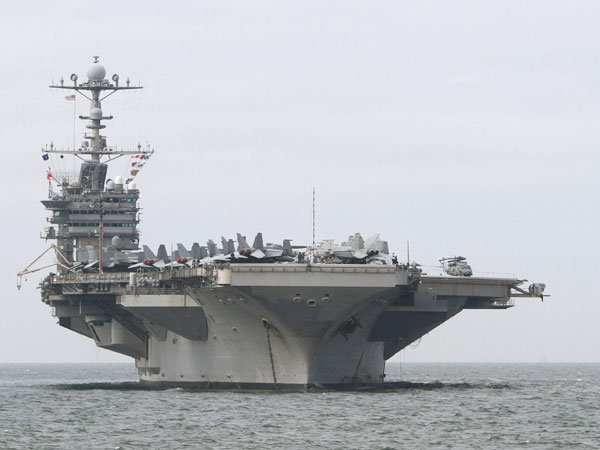
The nuclear powered US Navy aircraft carrier USS George Washington anchors in Manila Bay on Wednesday October 24. The Nimitz-class aircraft carrier together with two escort destroyers are here for a goodwill visit.


After confirming that Americans are indeed back at Subic, Chinese Vice Foreign Minister and Special Envoy of the Chinese Government Fu Ying wasted no time to call President Benigno S. Aquino III last week at MalacaƱang to impart the message from Chinese President Hu Jintao that China places great importance and value to the long-standing friendship with the Philippines.

Beijing began to have second thoughts on its expansionists plan and sent Vice Foreign Minister Fu to expressed the Chinese government’s desire to move Philippines–China relations forward to benefit the peoples of both countries.

The sudden change of tack by China in what W. Scott Thompson, geopolitics and defense expert, writing for New York Times and New Straits Times, called serious "miscalculations" on the Philippine resolve to protect its territorial sovereignty.

Thomson said that China flexed its muscle into the country after its President for nine years Gloria Arroyo, let the Chinese have whatever they wanted, in return for personal favours, like broadband project, which allegedly carried a 50 percent cut to President Arroyo before it blew up in their faces.

The United States military, particularly Admiral Samuel Locklear III, Chief of the US Pacific Command based in Hawaii, has said last July that the US is committed to develop a “minimum defense capability” for the Philippines, for which they are now building at Subic Bay transforming it into military logistic hub for Asia Pacific region guarded by three confirmed US nuclear submarines patrolling the South China Sea.

Locklear confirmed that the US Navy will have a semi-permanent rotational presence at Subic Bay, describing deployment as providing "peace of mind" for Southeast Asia amidst increase maritime insertions of Chinese Navy vessels into the South China Sea.

Navy Adm. Samuel J. Locklear III, commander of U.S. Pacific Command, arrives in the Philippines to meet with senior military officials in Manila, Sunday. The United States and the Philippines share a Mutual Defense Treaty, and the two nations work closely together through bi-lateral and multi-lateral training to enhance interoperability. U.S. NAVY PHOTO
US Air Force Brigadier General Mark McLeod of the US Pacific Command's (PACOM's) Director of logistics, engineering, and security, said that SBIA will likely be used to pre-position US logistics assets. Pacom is working with the Defense Department and the U.S. Agency for International Development to identify what materiel assets might be transferred to Subic as U.S. forces draw down in Afghanistan,.

“Part of what this office is doing is looking at the options of where we can forward locate humanitarian assistance capabilities in the theater,” says. McLeod, during an interview at the command’s Honolulu headquarters. “We want to posture them somewhere in the theater that would allow us to react very quickly.”

He said that the US was looking for a "very low-cost storage capabilities" for equipment and supplies in bulk readily available in case of armed conflicts in the Asia Pacific region.

Macleod further said that it might make more sense to forward equipment and supplies to a place where there is "easy access" as opposed to bringing it home and putting it in central storage facilities.

DFA Visiting Forces Agreement Director Edilberto Adan described the deployment as providing "peace of mind" for Southeast Asia in the wake of a series of renewed territorial disputes in the South China Sea.

Adan said the US will be developing Subic Bay International Airport (SBIA), and San Fernando Airport as military airport. San Fernando Airport is currently being used for general aviation and charter flights while Subic Bay Airport used to be the Asian hub of American cargo carrier Fedex.

While Philippine and US officials are keen to emphasise that neither increased military visits nor the rotational presence of US forces at Subic are a threat to any other country, they are clearly a point of tension with China. Several dozen USN ships have anchored in Subic Bay since April's escalation of the Spratly Islands territorial dispute between Beijing and Manila.

"We go to many places in [the] region, even the People's Republic of China itself," a senior US diplomat told Michael Cohen, a correspondent of Jane's Defence Weekly magazine. 

"All we offer is stability and security, and we certainly have shown a respect for sovereignty. We go when asked to leave, and do not claim what is not ours."

Huntington Ingalls Industries (NYSE:HII) subsidiary AMSEC recently signed an agreement in April 2012 with Korean shipbuilding giant Hanjin Heavy Industries subsidiary in the Philippines Hanjin Heavy Industries and Construction Philippines, Inc. (HHIC-PHIL) for maintenance, repair and logistics services works to the US. Navy.

Subic goes back to life

As ACI Opens Hub

July 17, 2010

Subic - Charter company Aviation Concepts Inc. (ACI) is building a hub in Subic airport as they set to take over airport hangars abandoned by courier giant Federal Express that left the Philippines in February 2009.

The Guam-based company through Aviation Concepts Holdings, an American-Canadian joint venture, is investing US$1.1-million to rehabilitate facilities at the SBIA and start operations by mid-September, said Anthony Decostes, the firm’s senior vice-president.

Aviation Concepts is famous for providing private jet charters to Senatorial and Presidential candidates in the last election. They are also involved in aircraft sales and acquisition, business aviation consulting and aircraft management services to companies and individuals.

ACI operates in Seoul, Tokyo, Shanghai, Taipei, Hong Kong and Manila and have an FAA approval to fly almost everywhere, including all oceans and polar areas. It started operations in 1996 and open Manila office in 2007.

The charter company operates a fleet of Westwind II, Falcon 50/900, Gulfstream IV/V/550, Challenger 604, Global Express and Boeing Business Jet (BBJ) which has been audited for safety by ARG/US.

“Our concept here is to basically copy what is in Guam, bring it here and expand it,” said Decostes, who also serves as AC’s country director in the Philippines.

ACI, he said, began looking at the Philippines when their Guam operations “grew exponentially, but faced problems with actual, physical growth.”

In 2007, in partnership with Universal Weather and Aviation, Inc., ACI opened the first aircraft scheduling center for business aircraft in Makati. But its growing clientele means it has to move somewhere else outside of Metro Manila and have keep its sight at Subic Bay for a bigger operations program.

“Lucky for us the SBIA was vacated by FedEx. Everything seems prepared for us — world-class aviation facilities, minimal air traffic, availability of trained workforce. Everything we need is right here in Subic,” Decostes said.

Decostes said they are committed to offer a full range of aviation services and facilities to clients. These include ground handling, maintenance repair and overhaul, FBO facility with VIP crew lounge and amenities, air ambulance, aircraft scheduling and record keeping, aircraft detailing, hangarage and technical stop services.

SBMA at odds on airport's future

Decoding Subic's financial woes

February 10, 2010

Subic — The Subic Bay Metropolitan Authority is at a loss on what to do with Subic Bay International Airport (SBIA), once the Asia Pacific home of US cargo giant Federal Express (Fedex) since 1996.

The airport, after Fedex left and transferred its Asia One logistics hub to China in February last year, has been losing 20 million not in pesos but in US dollars that should have gone to its loan amortization payments adding to its financial woes that ran in a billion pesos per year. Fedex paid $40 million (1.8 billion pesos) per year to SBMA.

With almost one billion pesos operational price tag deficit, Subic authorities are still reluctant to close it down. SBMA has been paying 500 million pesos annually to keep it open spending up to P250 million for airport operations, P150 million in debt servicing and another P100 million for maintenance cost. Now they have to pay 500 million pesos more coming from the taxpayers money.

Armand Arreza, administrator and chief executive officer of the Subic Bay Metropolitan Authority (SBMA), said that it doesn’t make sense anymore to continue its operations economically. He said that “It doesn’t even break even anymore, as it did when FedEx was still here.”

Arriza however said that they are still evaluating the airports viability and exploring alternatives for its use, which was then part of the U.S military base and formerly a Naval Station of the United States Navy before it was turned over to the Philippine government in 1994.

Subic airport serves as a secondary diversion terminal for the Ninoy Aquino International Airport in Manila with a 2,728-meter runway, modern navigational systems, and a 10,000-square meter passenger terminal that could handle 700 passengers at any given time. It has far better facilities than nearby Clark airport which is the main diversion route.

The airport can also handle 41 commercial civil aircraft from stand and remote parking locations, a capacity proven in the past few years when a fleet of Taiwanese airlines were diverted to Subic after the island-nation was buffeted by typhoons.

“There is no rush to close the airport,” Arreza said even if its losing money. “Actually, we are still marketing the airport and looking for other alternatives to make it useful.” Among the options being considered by SBMA is to turn part of the 200-hectare airport into a logistics area.

“If we convert 40 hectares of the airport’s 200-hectare area, then we can raise about $80 million for commercial development,” Arreza said.

The planned conversion of part of the Subic airport is consistent with the SBMA expansion program, which was meant to address the limited commercial and industrial space in Subic’s controlled area.

“The trend now in Subic is to move out of the central business district, and even outside the traditional boundaries, the fenced-in portion,” says Arreza.

“This 40-hectare portion could serve as an additional logistics area, while the rest could be used for commercial development,” he added.

The airport only now hosts a number of flight training schools, while its dream of attracting airlines for its hubs was largely a failure due to likability and connectivity issues to Manila, the same problems plaguing Clark's aviation growth potential. Some attempts by several airline firms failed and the airport is just servicing foreign charter flights for Subic bound tourists, particularly to its gaming and leisure industry.

SBIA records showed an aircraft movement in the airport significantly dropped from 108,686 in 2008 when FedEx still operated out of Subic, to just 57,246 in 2009. Passenger movement plummeted from 10,682 in 2008 to only 7,059 in 2009.

Subic International airport to close


As SBMA mulls converting airport
to logistics center


January 26, 2010

Quick Facts:
  • 250 million pesos annual expense for airport operations;
  • 200 million pesos annual income in 2008, 150 of which comes from Fedex;
  • earns 30 million pesos only in 2009, 25 million of which comes from Fedex until February;

SUBIC -- The Subic Bay Metropolitan Authority (SBMA) is thinking of giving up its international airport as it has reduced itself into a white elephant since the departure of US transportation giant Federal Express.

SBMA administrator Armand C. Arreza told reporters here that SBMA is eyeing the conversion of the Subic international airport into a logistics center because of the massive development of the much bigger Clark airport.

Arreza said Subic’s seaport facilities would complement the airport services of Clark which is just an hour away with the Subic-Clark-Tarlac expressway. "We cannot have two airports in areas which are just an hour apart," Arreza said.

Arreza said SBMA shoulders up to P250 million annually to have the airport running, P150 million in debt service and another P100 million for maintenance cost.

To break even, he said, the airport should be able to mount 12 to 15 flights a day.

"Even when Fedex was here, we were breaking even, and now with Fedex gone, the airport is losing money," he said.

Another advantage of Clark airport is that its landing and parking fees are free.

"We cannot compete with Clark. It is acceptable that there is another airport, so we are looking at it on the economic point of view. We are evaluating the airport," Arreza added.

Fedex pulled out its AsiaOne hub in Subic in February last year to transfer to China.

Subic airport now caters to very few charter flights and training schools.

The airport served as a secondary airport and a main diversion airport of the Ninoy Aquino International Airport. This airport used to be the Naval Air Station Cubi Point of the United States Navy.

FedEx adieu

FedEx flies out to China PDF Print E-mail
Written by Henry EmpeƱo / Correspondent
Monday, 09 February 2009 22:30

SUBIC BAY—The mighty FedEx birds have flown, and Subic might never be the same again. On Friday, February 6, starting at 2 a.m., a fleet of eight Airbus-A310s and four MD-11 aircraft made a beeline to Taxiway C of the Subic Bay Airport. Hours before, the planes were topped off with fuel, checked by technicians and loaded by hub operations agents with cargoes bound for destinations like Taiwan, Vietnam and Hong Kong.
It was a reprise of what has become a daily routine in Subic since the air cargo giant Federal Express (later to become FedEx Corp.) established its Asian hub here in 1995. Except that this time, the planes were not coming back, perhaps for good.
As the aircraft taxied for takeoff, their familiar bulk nosed through a curtain of water sprayed by a fire truck on standby—a farewell gesture that signaled the end of an era at the Subic Bay Free P wort.
The last cargo flights out of Subic on Friday actually started the transition period for FedEx’s transfer of its Asia-Pacific hub from here to Guangzhou, China, said Armand Arreza, administrator and CEO of the Subic Bay Metropolitan Authority (SBMA).
FedEx, Arreza said, has started to test-run its new facilities at the Baiyun International Airport, the main airport of Guangzhou, the capital of China’s Guangdong province, after operating in Subic for 13 years.
But the pullout, Arreza explained, was borne out of competition—not by the ongoing global recession.
“The decision was made as early as 2004, even before the global economic slowdown last year began to affect Asian economies,” Arreza pointed out.
“The market condition in China dwarfs that of the entire Southeast Asia combined,” he said, citing that China accounts for some 60 percent to 70 percent of Asia’s cargo traffic.
Moreover, China dangled to FedEx the incentive of cabotage, which would allow the American firm to handle domestic cargo in China.
“Here, the Philippine Constitution allows cabotage for domestic companies only,” added Arreza.

CARGO trolleys lay idle at the FedEx Subic hub after operations crew fi nished loading the last planes to fl y out of the Subic Bay International Airport. HENRY EMPEƑO

Lost income, lost jobs
The decision, nonetheless, would result in the contraction of SBMA’s income by about P150 million annually—the fees paid by FedEx for landing rights and warehouse rentals.
Landing fees by FedEx, in particular, made the bulk of revenue generated by the Subic Bay International Airport (SBIA), which was practically rehabilitated in 1994 to accommodate FedEx’s cargo flights.
According to SBIA records, FedEx logged in an average of 1,000 flights a month, with international flights almost double the domestic runs.
At its heyday here, the cargo firm had 12 inbound and 12 outbound flights on a regular night, with its fleet of Airbus A310s carrying as much as 35 tons each and the wide-bodied MD11s loaded with up to 89 tons of cargo each.
FedEx’s transfer to China also displaced more than 500 workers, mostly from Olongapo City, who were variously employed in sorting documents and freight, warehousing, ramp operations, as well as in aircraft maintenance, logistics distribution and ground support.
Earl Esmane, a part-time hub-operations agent from Olongapo, said the part-timers, who composed of about 70 percent of the FedEx hub crew, were paid P60 an hour for the usual four-hour nighttime shift.
The full-timers, however, received higher base pay, he said, adding that some regular employees had received offers to relocate to FedEx hubs in Hong Kong and Taiwan.
Esmane, who had completed his clearance with the company as early as last month, has yet to receive his separation pay.
However, a FedEx official said on Friday some officials would remain in Subic to oversee the completion of the firm’s reintegration program for its workers.
Farewell regrets
As the last FedEx plane took off on Friday, FedEx assistant chief pilot Joel Edmondson expressed some regrets about pulling out of Subic, saying that the FedEx hub here has been “very successful” since it was established in 1995.
He reiterated, however, that global economics dictated that FedEx had to relocate to China.
“It’s not a matter of Subic being not good enough to [FedEx],” Edmondson said. “This is an economic decision that puts us in a better position to move forward in the market.”
Ironically, it was the same market force that had brought FedEx to Subic Bay in the first place.
Noting the significant increase in the cargo market in Asia in the late ’80s and early ’90s, FedEx reportedly decided to establish a strong presence in the Asia-Pacific region, with the strategy to build an “Asia One” hub in Subic and, thereafter, adding more “spokes” to the hub.
In 1993 FedEx began negotiating with the SBMA for the use of the former US Naval Air Station in Subic—a year after it closed down as a result of the Philippine Senate’s rejection of the treaty extending the stay of US bases in the country.
The following year, FedEx signed a contract with the SBMA and the latter began rehabilitating the airport runway and procuring international-standard navigational equipment to meet its client’s requirements.
On September 1, 1995, FedEx launched the Asia One network in Subic, thereby setting up an overnight intra-Asian delivery network connecting 11 major Asian centers.
The following year, FedEx expanded its operations to include regular all-cargo flights directly linking Shanghai with its Asia-Pacific hub, thus getting the first taste of the burgeoning Chinese market.
FedEx would soon expand in 1999, adding eight more aircraft to its 12-plane fleet and signing an extension of its lease agreement from 2002 to 2007.
By 2001 the FedEx Asia One network in Subic has grown to include 19 destinations in Asia, so that in May 2004, it opted to extend its contract with the SBMA for up to August 2010, with options for three successive renewals of one year.
However, in July 2004, FedEx announced it has opted to transfer to Guangzhou by 2008, a decision that, it said, was based on an exhaustive series of feasibility studies that recognized the tremendous business potentials in China.