LGUs Remain Culprit For Domestic Closure

3 June 2020

Scene of thousands of repatriated overseas Filipino workers (OFWs) under Covid-19 quarantine, many for periods far beyond the mandatory 14 days, are seen at Naia Terminal 2 on Monday before the final leg of their homecoming, on government-funded sweeper flights.

9,959 of the 25,000 stranded overseas Filipino workers who were previously quarantined for 14 days and took test in Manila prior to domestic flight faces another 14 days quarantine at their respective destination where LGUs regulate passengers entry. Ordinary passengers are not yet allowed to fly at domestic airports.

DILG Secretary Eduardo Ano said that while most of the country are now placed in General Community Quarantine (GCQ), LGUs remain to have discretion to require QPs if the local conditions call for it.

Scheduled flight of Cebu Pacific today and tomorrow to Naga, General Santos City and Cagayan de Oro will be treated as repatriation flight subject to LGU quarantine regulations.


DOTC Helpless Against LGU

3 June 2020
“What can we do if we allow planes to fly but local governments reject them?” Transportation Secretary Arthur Tugade said during Press Briefing in Malacanang yesterday.

The Caretaker

1 June 2020

By Miguel R. Camus
Philippine Daily Inquirer


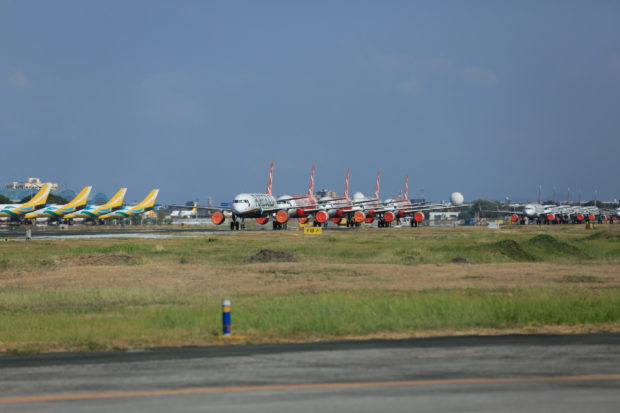
The new coronavirus that causes Covid-19 forced millions of travelers to stay home, but airline mechanics and engineers have kept themselves busy in air hubs nationwide. Their primary mission these past two months: ensuring that their sleeping fleets are in tiptop condition.

Their efforts will soon bear fruit. The government is relaxing quarantine rules in their main hub in Metro Manila on Monday, allowing local airlines to resume operations.

Throughout the lockdown, the maintenance staff of carriers such as Philippine Airlines (PAL), Cebu Pacific and AirAsia Philippines are among those at the front lines, performing essential work during the COVID-19 pandemic.

Unseen to most flyers are people like Rico Ugdoracion, maintenance operations director at Cebu Pacific.

“There’s no such thing as work from home for aircraft maintenance,” Ugdoracion said in an email to the Inquirer, adding that the major challenges for many in his team were coming to work and negotiating a number of checkpoints along the way.

Airlines strictly follow step-by-step maintenance procedures laid down by aircraft manufacturers such as Airbus and Boeing, according to Ugdoracion.


Dust, bird’s nests
Planes are made up of millions of parts, and those rendered stationary for lengths of time are just as complex to maintain as those flying regularly.

All sorts of issues can crop up in aircraft sitting idle and exposed to the elements, Ugdoracion said. Dust can get inside sensitive instruments, parts can corrode, and there are fuel leaks, flat tires and even the occasional beehive or bird’s nest.

“During the lockdown, where aircraft are parked for a long period, the regular maintenance tasks are replaced by parking and preservation procedures,” Ugdoracion said.

These preservation checks are done at intervals of seven days, 15 days and one month.

“The longer the planes stay parked, the more extensive the checks become,” an aircraft quality inspector at Philippine Airlines said in a separate interview.

Fuel tanks are loaded to at least 10 percent of their capacity, in order to keep them lubricated, he said.

According to an aircraft maintenance manual for PAL’s fleet of Boeing 777-300ERs, fuel tanks should be regularly drained and checked for corrosion. Biocides, chemical substances that kill microbes, are also put into the fuel tanks.

The batteries of most of their planes under preservation are disconnected, Ugdoracion said. These are reconnected during checks, and engines are switched on and left running for about 15 minutes.

Tire care, parts protection
Tires also need special care. To prevent flat spots from developing when idle for long, the wheel axle is regularly lifted using a jack and the wheels rotated so these do not get “out of round,” Ugdoracion said.

While planes sleep, it’s not just their engines that need to be covered to keep out foreign substances such as dust. Also needing protection are many other parts, such as auxiliary power units, drain valves and pitot tubes, which help pilots measure airspeed.
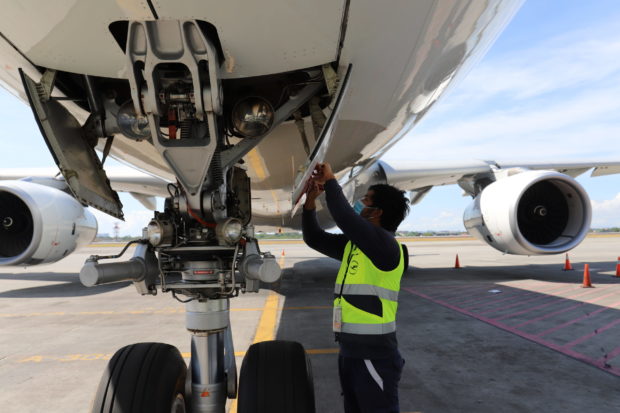
A MILLION PARTS TO MIND
Aircraft maintenance becomes more crucial, ironically, during the long period of rest for the passenger planes. The coronavirus pandemic and the ensuing lockdown have posed an unprecedented challenge for the aviation industry’s own “front-liners.” —CONTRIBUTED PHOTOS

Deep cleaning
As much care is taken inside the aircraft. PAL planes, for example, have passenger seats with monitors that are regularly checked, along with the overall functionality of the seats.

Emergency lights must always be working, and carpets are inspected for frayed edges.

Cleaning is another matter that is carried out regularly.

“Inside the aircraft, the cleaners use vacuums, cloth to wipe the seats and furnishings, and cleaning agents and disinfectants approved by the aircraft manufacturer. Full aircraft disinfection is a top priority for operational aircraft during this period,” Ugdoracion said.
Planes are also washed through a weekly “deep cleaning.” For an Airbus A320, the process requires two hours and eight people.

It is fortunate that the Philippines does not have an extreme climate, Ugdoracion noted.

Additional maintenance work is necessary in countries with freezing winters or searing temperatures, such as in the Middle East, where, he said, “even holding a tool that is exposed to the sun is a challenge.”

“In the Philippines, where it’s not too hot or cold, the weather is just perfect. But, of course, working at noon under the heat of the sun is a bit difficult, but manageable,” Ugdoracion said, adding:

“If it rains, then mechanics work with their raincoats on. The year-round [rain] is another thing.”

Most of the nearly 200 planes of PAL, Cebu Pacific and AirAsia Philippines are parked at Ninoy Aquino International Airport (Naia) in Manila and important hubs outside the capital such as Clark International Airport in Pampanga and Mactan Cebu International Airport.


Added pressure
Because of limited space and virtually zero demand during the lockdown, some of their narrow-body planes are parked on Naia’s runway 13/31.

Lufthansa Technik Philippines (LTP), an aircraft maintenance company and affiliate of PAL, witnessed the dramatic reduction of activity in the sector.

Daily flights fell to 10 per day from about 250 before the pandemic. Still, maintenance work continued for clients such as PAL, which mounted special flights to repatriate Filipinos overseas and supply crucial cargo such as food and medical equipment.

“Working during a scary pandemic situation has added pressure on us in line maintenance,” said aircraft mechanic Joseph Jemar Villanueva, who is assigned at LTP’s Manila operations.
“As part of LTP’s skeleton workforce, we understand that it is not just about doing a task but a balancing act of responsibly keeping a customer’s aircraft airworthy and released on time, as well as keeping ourselves safe and in good health condition for our family,” he added.

LTP provides its staff with full sets of personal protective gear and vitamins while sanitation booths are located at its facilities.

The maintenance steps being taken today will help the carriers ease into regular operations once the government lifts quarantine restrictions.


Dramatic changes
The flying experience will change dramatically by then.

Added health checks before departure and on disembarkation, physical distancing, mandatory wearing of face masks, health forms, and COVID-19 testing procedures are some changes that could make flying less comfortable.

But the airlines will ensure safety inside the aircraft.

Onboard meals will be handled more stringently, flight crew will wear personal protective gear, and physical distancing will be strictly implemented.

Modern planes are also equipped with so-called Hepa (high-efficiency particulate air) filtration systems that capture almost 100 percent of dust particles and contaminants such as viruses and bacteria. In other words, traveling by plane is a more sterilized experience than traveling by bus or train.

Airline officials said they were raring to restart flights. It will be up to the business managers, cabin crews, support personnel and, ultimately, flyers themselves to ensure that our airlines will keep soaring.

Air Travel Opens June 1

PAL, CEB Announces International, Domestic routes resumption

30 May 2020

Air travel in the country is scheduled to resume regular commercial operations following the Philippine government decision to upgrade Manila and Cebu to General Community Quarantine (GCQ) status beginning June 1.

Secretary Arthur Tugade disclosed Friday that airport facilities across the country is prepared to accept travelers under the new normal scheme adopted by the government.

Tugade said MIAA (Manila International Airport Authority) will determine terminal usage depending on the number of flights that will be mounted. However, only flights duly approved by the Civil Aviation Authority of the Philippines (CAAP) will be considered for slotting.

According to DOTr International operations shall continue subject to the 400 passengers a day cap imposed by the IATF for inbound flights.

DOTr said that out of twenty six (26) airlines operating in Terminal 1, twenty one (21) already submitted their flight plans. Most of these though will not be happening in the immediate future due to travel restrictions abroad.

Terminal 1 shall remain to service international commercial flights while Terminal 2 caters to all repatriation and sweeper flights and commercial domestic flights of Philippine Airlines. Terminal 3 will be used by Cebu Pacific and Air Asia for domestic flights while Terminal 4 shall remain closed.

Philippine Airlines (PAL) said they will reopen with 5-10 percent of its international network and 20-30 percent of local flights by June.

“We will slowly ramp up as demand picks up,” PAL President Gilbert Santa Maria said, noting that destinations will include transpacific flights to Los Angeles beginning June 1 and Singapore on June 3.

In the latest advisory, PAL said it will resume flights to the USA, Canada, Guam, Vietnam, mainland China, Malaysia, Indonesia, Vietnam, Hong Kong, Taipei, Singapore, Japan, the UAE, Qatar and Saudi Arabia. London and Sydney are being evaluated for resumption by the last week of June 2020.

It will not be operating any regular scheduled flights for the month of June to Auckland, Bali, Bangkok, Beijing, Brisbane, Busan, Fukuoka, Guangzhou, Hanoi, Macau, Melbourne, Phnom Penh, Perth, Port Moresby, Quanzhou (Jinjiang), Sapporo, Seoul (Incheon) and Shanghai.

Meanwhile, PAL will resume its domestic operations from Manila to Basco, Laoag, Legaspi, Puerto Princesa, Busuanga, Kalibo, Caticlan, Bacolod, Tacloban, Roxas, Tagbilaran, Cebu, Iloilo, Dumaguete, Butuan, Davao, General Santos, Cagayan de Oro, Ozamiz, Pagadian, Dipolog, and Zamboanga beginning June 8.

For Cebu hub, PAL will resume flights between Cebu and Davao.

Cebu Pacific (CEB) on the other hand will resume operations on June 2, 2020, with a limited number of domestic flights out of NAIA Terminal 3 on the following routes as approved by CAAP upon recommendations of IATF:

June 2-4 Manila-General Santos-Manila
June 3-4 Manila-Naga-Manila, Manila-Cagayan de Oro-Manila, Manila-Cebu-Manila

CEB international flights remain suspended from June 1 to 30, 2020.

Air Asia Philippines are likewise preparing flight resumptions on June 3 upon approval by DOTr and CAAP. Routes flown will be Manila to Cebu, Tacloban, Tagbilaran, Cagayan de Oro, Bacolod, and Davao. The airline will also fly Clark to Davao, Tacloban, and Cagayan de Oro. Other routes remain suspended.

Gov't Defers Fees For PH Carriers

23 May 2020

The Department of Transportation (DoTr) will implement a one-year moratorium on take-off, landing, and parking fees of local airlines to cushion the impact of the coronavirus pandemic in the aviation industry and its stakeholders, according to its Transport Secretary.

“We are continuously coordinating with airline companies so that we can come up with programs to configure even the aircraft in our airports,” Transportation Secretary Arthur Tugade said.

March data from the Civil Aviation Authority of the Philippines (CAAP) showed that deferred charges for local carriers total about P58 million a month.

Local airlines operating under CAAP will save about P37 million a month in terms of deferred take-off, landing, and parking fees. The airlines can pay the deferred charges within a year after the strict quarantine orders are lifted.

Secretary Tugade also said that the airport authorities has likewise extended the implementation of rental holidays and the deferment of the collection of rental fees for airport concessionaires, which means that airport rental fees falling within the quarantine period will be deferred. Airport concessionaires can begin paying their rental dues once the quarantine orders are lifted.

The order covers all concessionaires that are renting/leasing spaces in the terminals of airports under the jurisdiction of CAAP, Manila International Airport Authority, Mactan-Cebu International Airport Authority, and Clark International Airport Corporation.

According to Secretary Tugade, the sector is gearing up to ensure readiness in event of a “worst-case scenarios,” like the possible long-term stoppage of airline operations and closure of airports.

“We need to be prepared for any possible scenario and to employ all possible countermeasures including what may appear to be drastic and extreme ones,” Secretary Tugade adds.

PAL Post US$56 Million in 2019

PAL Holdings Infuses $30 Million more To Keep airline afloat

22 May 2020

Flag carrier Philippine Airlines (PAL) has posted an operating profit of US$56.6 million (₱2.87 billion) last year, reversing 2018’s US$120 million (₱5.98 billion) operating loss, according to PSE disclosures of the company.

PAL total revenue grew 2.7% to more than ₱154 billion, driven by a 4.2% increase in the passenger segment revenue to ₱134 billion. Ancillary revenue fell 5% to ₱10.7 billion, while cargo fell 8.2% to ₱9.38 billion.

Expenses declined 3% to nearly ₱152 billion, due to introduction of new aircraft to fleet.

Net loss widened from Ps4.33 billion in 2018 to Ps10.3 billion, partly due to the adoption of a new accounting standard.

Cash and cash equivalents stood at ₱15.1 billion as at 31 December 2019, up from the 6.98 billion on 31 December 2018.

PAL president Gilbert Santa Maria also disclosed that PAL Holdings will infuse an additional ₱15.2 billion into Philippine Airlines, making it safe from imminent bankruptcy as the airline bleeds losses nearing $1 billion (₱50.6 billion) resulting from the worldwide COVID-19 pandemic which has grounded air travel.

Santa Maria said one-third of the capital infusion, or about ₱5 billion, was released this month to keep the airline afloat on the second quarter.

The cash infusion into PAL makes the airline safe from immediate bankruptcy due to liquidity problems, according to PAL president Gilbert Santa Maria.

PAL ended 2019 with 97 aircraft, unchanged from the previous year.


PAL Flies Longest Route Ever

22 May 2020


Flag carrier Philippine Airlines (PAL) flew its longest non-stop flight ever, flying Miami to Manila on a special charter flight to pick up 347 stranded overseas Filipino Workers.

The Boeing 777-300ER (RP-C7772)took the milestone flight flying as PR5112 clocking 16 hours and nine minutes longer than its longest commercial flight to New York, traversing 9,316 miles.

PR5112, left Manila just after midnight (12:14 A.M.) and landed at around 4 P.M. Miami time.

PR5112 was headed by Capt. Rommel Quizon, First Officer Joseph Marvin Jumaquio, Second Officer Jose Miguel Cajucom, and Second Officer Elijah Len Alcantara.

The New Normal

2 May 2020

When travel by style is simply normal beginning May 16.