Aviatour Piper Down

DILG Secretary Dead, Aide survive

August 18, 2012


A Piper Seneca PA 34-200 (RPC-4431) plane owned by Aviatour, a Cebu-based aviation company crashed Sunday off the waters of Masbate killing all but one passenger.

The plane was piloted by Jessup Bahinting, Aviatour chairman and CEO, and Kshitiz Chand, a Nepalese national, and was supposed to fly to Naga City frorm Mactan Cebu International Airport. The secretary’s aide, Senior Inspector Jhun Abrasado survived and was rescued.

The plane was on final approach to Masbate Airport before it fell short of the runway after declaring distress call and emergency landing around 4:30 PM.


New Singapore ASA talks fails

As Philippines refused further grant of fifth freedom rights out of Manila

August 17, 2012


Air talks between the Philippines and Singapore bogged down Thursday because of unresolved issues involving fifth freedom rights particularly to North Asia.

"Parties could not agree on 5th freedom traffic rights. The parties adjourned tonight and agreed to resume talks after six months," Carmelo Arcilla, Civil Aeronautics Board executive director said.

Arcilla said neither the Philippines nor Singapore was opposing the enforcement of Fifth Freedom Rights but both countries feel that “there is no balance to both interests.”

“The parties feel they need to come up with a better balancing package that would result in a better balancing of rights. What value would it give us? Will the operations of our airlines be affected if their carriers would fly to those countries when in fact our local carriers are already flying to those destinations?”

Fifth Freedom refers to the right to carry passengers from a carrier’s own country to a second country, and from that country to a third country.

As of late only Singapore based - Jetstar Asia is utilizing the fifth freedom rights for flights from Singapore-Manila to Tokyo and Osaka.

At present, there are 43,487 seat entitlements granted to Singapore and another 43,487 for the Philippines.

The Singapore air panel wants all Singaporean carriers to transport passengers from Singapore to Manila and pick up passengers to China, Japan and Korea and vice versa.

The Philippines, for its part, is asking that local carriers be allowed to fly to some parts in Europe, India and Middle East after they have mounted flights to Singapore from Manila.

Singapore also wanted the early implementation of the Open Skies Agreement between the two state capitals but the Philippines declined to open Manila airport further.

Skyjet test Philippine Skies

As CAB Grants it TOP


August 17, 2012


SkyJet Airlines, of Magnum Air Inc., has been granted Temporary Operating Permit (TOP) on August 3 by the Civil Aeronautics Board (CAB) to start flying the Philippine Skies on regular scheduled flights.

The airline has pending application for regular flights to Basco in Batanes which remained frozen for lack of necessary permit from CAB and oppositions by Seair. It can however ferry passengers on chartered flights.

Skyjet operates a lone BAe 146-200 RP-C5525 (msn E2031, ex EI-CNQ of Cityjet) under wet lease arrangements with Lionair Subic Philippines. It has options to expand fleet courtesy of Lionair which has two BAE146-200s,  72-seater BAe 146-100 aircraft, and a Dornier 328 jet.

The original flight scheduled to start on April 8 was pushed back to start on the first week of October 2012 to comply flight requirements mandated by the Civil Aviation Authority of the Philippines (CAAP).

Magnum Air Chief Executive Officer Dr. Joel Mendoza said that they will also fly the plane to Virac in Catanduanes; Catarman, Northern Samar; and Surigao in October.


Clark, from Gateway to LCC port


Clark: shifting from air gateway status to top low cost airport for Manila

Luc Citrinot

16 August 2012

With Cebu Pacific, AirAsia Philippines, AirPhil Express and SEAir adding capacities at Clark Airport (Philippines), the rather modest airfield is on the verge of a boom in passengers’ traffic.

CLARK FREEPORT – Victor Jose Luciano dreamed it for a long time. The hopes of  Clark International Airport Corporation (CIAC) President and CEO are now turning slowly into reality. The Filipino airport is in the midst of an unprecedented traffic boom due to the arrival of AirAsia Philippines and the strengthening of SEAir’s (Southeast Asian Airline) network following its take-over by Singapore-based low cost airline Tiger Airways. Numbers speak for themselves: last year, passengers at Clark-Diosdado Macapagal International Airport (DMIA) reached 767,000 passengers including 725,023 on international flights. This was a growth of or a 19-percent increase for the year 2011. Growth is accelerating this year, following the arrival of AirAsia Philippines.

The total number of passengers at Clark International Airport (CIA) increased by 54% in the first half of 2012 to 548,000 passengers, authorities revealed a few weeks ago. For the first time, Clark will overpass the million mark with numbers likely to range between 1.1 and 1.25 million passengers. According to seats capacity data, low cost airlines account already for about 90% of total capacity at Clark with the largest share being taken by the AirAsia Group (AirAsia Philippines has 33% of all capacities while AirAsia Bhd from Malaysia adds another 10% to the total). It is followed by SEAir (17%) and AirPhil Express- a subsidiary of Philippine Airlines (16%). Cebu Pacific has only 13% as it main operation to Manila is at the main airport NAIA. Clark welcomes for now only two legacy full-service carriers, Dragonair and Asiana.

AirAsia is also now present on international routes with flights to Hong Kong, Macau and Kuala Lumpur. The airline is likely to add flights to other AirAsia major gateways such as Bangkok, Jakarta as well as Singapore. The airline flies also to Puerto Princesa, Kalibo and Davao. SEAir stepped up its presence at Clark Airport at the end of July. The carrier fliers currently five routes (Bangkok, Hong Kong, Kalibo, Kuala Lumpur and Singapore) and will increase its presence during the winter timetable.

Victor Jose Luciano is now confident that Clark Airport is likely to reach 5 million passengers a year before the end of the decade. It will then request to expand the terminal which currently has a capacity for 2.5 million passengers. The CEO unveils that plans have been approved to construct a low cost terminal inspired from the LCCT terminal in Kuala Lumpur. The terminal would be able to accommodate ten million passengers a year to a cost estimated at US$ 47.5 million dollars. The bidding process for the second phase of the expansion of the existing terminal already started with a completion of the new facility due by 2015.

Clark Airport has been long seen as Manila new international gateway replacing overcrowded NAIA, Manila’s main international airport. Grand plans in the previous Filipino administration predicted a future development for 50 million passengers. But plans have now been scaled back as they are deemed as unrealistic due to financing constraints. A major handicap for Clark Airport to become Manila’s principal gateway is its distance to the city. Clark is located some 85 km away from Manila city centre. Although, a brand new highway links the airport to the outskirts of the city in less than an hour, congestion on Manila roads is so horrendous that it takes another hour and a half to reach Manila city centre or Makati. Busses commuting between Clark and Manila generally tell their passengers that the ride would last up to two hours and a half on average.

For long, Mr. Luciano talked about a dedicated high-speed rail link. Five years later, not a single rail track has been laid to Clark Airport and the rail remains a distant dream. The access issue will still determine for long the fate of Clark as Manila’s new international gateway. However, it will not hamper anymore DMIA transformation into the largest low cost airport of the Philippines.

Philippines confirms T/A-50 purchase


MICHAEL COHEN
JDW Correspondent

Manila

The Philippine Department of National Defense (DND) has chosen the Korean Aerospace Industries (KAI) T/A-50 to fulfill the Philippine Air Force's (PAF's) requirement for a light attack Trainer.

Philippine officials said they would like to have two of 12 T/A-50s in country immediately to begin pilot training.
  • The Philippines has announced the acquisition of 12 KAI T/A-50 light attack/ lead-in-fighter trainers in its first fast jet procurement in years

  • Manila is also in negotiations to buy second-hand Italian Navy frigates and corvettes and utility/light attack helicopters from France and Italy

The government has requested the delivery of 12 aircraft from KAI, the DND said in an announcement on 1 August in Manila. It also announced that negotiations had almost finished for the purchase of two Maestrale-class frigates from the Italian Navy and released details of plans to procure four Eurocopter AS 550 Fennecs for the PAF, with an option for a further six.

Defense Secretary Voltaire Gazmin said the Philippines would request the immediate delivery of two T/A-50s to expedite training.

"We plan to negotiate so we can get the immediate delivery of two airframes to start the long-overdue process for training so that when the rest of the 10 arrive, our pilots get out there and start training,"Gazmin said.

The T/A-50 is an armed version of the T-50 Golden Eagle lead-in fighter trainer.It is equipped with a General Dynamics M197 20mm three-barrel Gatling-type internal cannon and an ELTA EL/M-2032 fire control radar, and has achieved weapons certification for the Raytheon AGM-65 Maverick air-to-ground and AIM-9 Sidewinder air-to-air missiles.

The terms of the deal were not announced. However, Indonesia signed a contract for 16 T/A-50s in May 2011 valued at approximately USD400 million.

Gazmin said the Maestrale-class frigates to be retired by Italy will boost Manila's ability to defend its territorial waters, particularly the South China Sea (West Philippine Sea). The two Italian vessels, which would be the Philippines's first missile-armed and modern anti-submarine warfare (ASW)-capable ships, are expected to be part of the government-to-government agreement that is now being finalized. Gazmin said the frigates could arrive in the country after being refurbished in late 2013.

Officials are waiting for the enactment of the PHP75 billion (USD1.7 billion) Armed Forces of the Philippines (AFP) modernization law -  which has already been passed by both houses of Congress and is now awaiting specific stem selection, Which Gazmin said is expected by the end of 2012 - to continue negotiations with Italy. Along with the two frigates, which are worth PHP 11.7 billion, negotiations are under way for two Minerva- class corvettes or other offshore patrol craft, which the Italians are also offering to Manila.
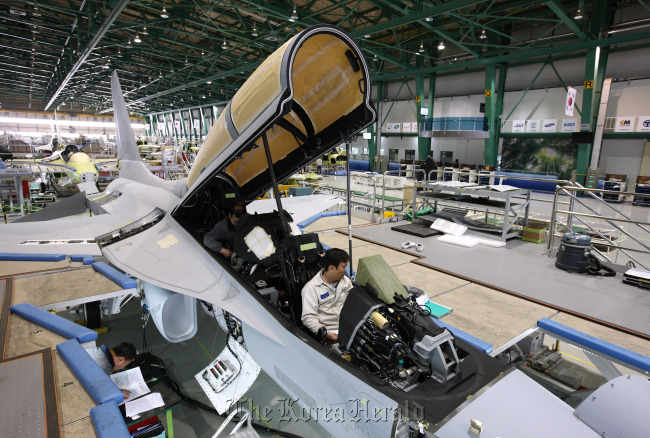
Employees work on a TA-50 trainer jet on the production line of the Korea Aerospace Industries Ltd. plant in Sacheon, South Gyeongsang Province. (Bloomberg)

IHS Jane's has also learnt that the Philippine Navy is evaluating Oto Melara's advanced 76mm smart munitions, such as the DART (Driven Ammunition Reduced Time of Flight) guided projectile, for its fleet of former UK Royal Navy Peacock-class patrol vessels and its ex-US Coast Guard Hamilton-class cutter.

DND spokesman and Assistant Secretary of Defense Paul Galvez said that due to availability issues with the preferred option - the AW109E Power Attack Helicopter - Manila had chosen to procure four AS 550 Fennecs this year. The Fennecs are reportedly part of a cancelled or reduced order from an unspecified Middle Eastern Country that IHS Jane's believes could be Libya. In 2007 Paris said it was in negotiations to sell 10 Fennecs to Tripoli as part of a EUR4 billion (USD4.8 billion) package that also included 14 Dassault Rafale multirole fighters, eight Eurocopter Tiger combat helicopters and 15 EC 725 transport helicopters.


Galvez said the Fennecs were needed urgently to provide air cover for Philippine forces conducting counter-terrorism and insurgency operations while the PAF's McDonnell Douglas MD530 Defender light attack helicopters are upgraded under a service-life extension programme (SLEP).

The commander of the PAF said the AW109s would be procured at a later date and would be operated by the Philippine Marines/Navy.

Gazmin said that 60 per cent of 140 contracts negotiated under the AFP's recapitalization programme have been agreed, with the rest dependent on the enactment of the AFP modernization law. According to the spokesman, by the end of 2012 Manila also expects the delivery of 21 refurbished UH-1H helicopters, "two to four"attack helicopters and two multipurpose assault craft.

A version of this article appeared August 8, 2012, on page 4 in the U.K. edition of IHS Jane's Defense Weekly, with the headline: Philippines confirms T/A-50 purchase.

Turbulent Times at Manila's International Airport

August 14, 2012

Philippine President Has Vowed to Upgrade Capital's Much-Loathed Air Hub, but Challenges Could Keep Some Overhauls on Standby

[image]
Travelers wait for flights at Manila's Ninoy Aquino International Airport. The run-down and underfunded air hub is routinely mired in delays and is overly congested. The government is working on an array of overhauls.
 Reuters

MANILA—The airport code "MNL"—for Manila's Ninoy Aquino International Airport—can strike fear into the hearts of even the most hardened business travelers.

With its long snaking lines, tatty departure lounges and congested, overlapping runways, Terminal One at Ninoy Aquino is regularly voted as one of the world's worst airport terminals in online polls. It didn't help that two people were injured when part of the terminal's ceiling collapsed last year.

Now, sorting out the problems at Manila's international gateway—along with many of the Philippines' other notorious infrastructure problems—is emerging as a top policy priority for President Benigno Aquino III as he tries to propel his country onto a faster growth track to compete with better-equipped rivals such as China, Thailand and Malaysia.

The congestion crisis at NAIA partly reflects a boom in air travel across Asia. Budget carriers such as AirAsia and Cebu Pacific have opened up foreign travel to legions of first-time passengers.

Bumpy Ride

Manila's airport has a rocky past and an uncertain future.
  • 1981: Terminal One opens.
  • 1983: Activist Benigno "Ninoy" Aquino Jr. is shot and killed after arriving at the airport.
  • 1991: Terminal One reaches full capacity. Passenger levels continue to grow.
  • 1995: Construction begins on Terminal Two.
  • 1997: Construction begins on Terminal Three, but is soon bogged down by corruption allegations and legal disputes.
  • 1999: Terminal Two opens but is used exclusively by Philippine Airlines.
  • 2003: The former air-transport chief seizes the control tower in a protest. He is killed by police.
  • 2008: Terminal Three opens for some flights but most international carriers remain at Terminal One as congestion worsens.
  • 2012: President Benigno Aquino III announces plans for a fund to help finance improvements at the airport and elsewhere.
Source: WSJ research

But the delays—around a third of flights leave behind schedule—also expose chronic underinvestment in the Philippines economy, which analysts say Mr. Aquino and his government will have to fix in order to build on the country's strong performance in recent months. Gross domestic product grew 6.4% in the first quarter from the year-earlier period and the benchmark stock-exchange index breached records.

For years the Philippines lagged behind China and most of the rest of Southeast Asia in posting rapid growth. Corruption, bureaucratic red-tape and poor infrastructure deterred local and foreign investment, economists say.

Over the past several months, though, Mr. Aquino's efforts to trim out graft and waste from government spending have helped secure a series of credit-rating upgrades. Those efforts have reduced borrowing costs and freed up more government cash to improve rundown infrastructure, much of which was built during earlier eras of growth in the 1960s and 1970s.

In May, Mr. Aquino announced plans for a new government-backed fund to help finance infrastructure projects. The Philippines' state-run pension fund this week said it is ready to pump 50 billion pesos, or $1.2 billion, into the fund to help build rail links, expressways and new airports. Another pension fund for state workers aims to contribute another $300 million to the fund, which will be managed by a unit of Australia's Macquarie Group. The idea is to select projects that deserve investment and then use the government funds as a starting point to attract more private cash, with Macquarie helping spur the projects along.

Earlier efforts by Mr. Aquino to promote infrastructure—including other public-private partnerships—have moved slowly. Just one project for 2 ½-mile road has been bid out since Mr. Aquino was elected in 2010. The government aims to get the ball rolling on eight other projects this year, however.

That Manila is even in a position to contemplate accelerating construction of flyovers and train networks is a sign of fresh confidence, analysts say. "Our usual limits to growth in the past have revolved around the government's budget deficit," says Luz Lorenzo, a Manila-based economist with Maybank Investment Bank. "Now it's the speed of implementation."
Sorting out the Philippines' air links—especially its international terminals—is one of the biggest challenges.

Its main international airport has been the setting for some of the most dramatic events in the country's recent history. Mr. Aquino's father was shot and killed at Terminal One of the international airport—built three decades ago—in 1983 in still-unexplained circumstances when he returned to the country to challenge late dictator Ferdinand Marcos. The airport was later renamed in his honor. Last year, airport authorities refused to let former President Gloria Macapagal Arroyo board a plane here. She is now facing trial on corruption charges, which she denies.

In 2003, the Philippines' former air-transport chief seized the airport's air-traffic control to support a failed coup attempt, and was shot dead by a SWAT team. That fiasco contributed to Manila airport losing its Category 1 status with the U.S. Federal Aviation Administration, effectively preventing new routes from opening between the Philippines and the U.S. Other international agencies quickly followed suit, limiting the Philippines' direct air links with the rest of the world. 

The airport's physical appearance and amenities, meanwhile, have continued to deteriorate. The website "The Guide to Sleeping in Airports" (sleepinginairports.net) listed Terminal One as the worst airport terminal in the world for long transits in 2011. According to the site, passengers complained about long lines and a vendor who reportedly was selling water out of used containers and pretending to break fake seals on the bottles when opening them. "The current administration should hire a bulldozer and a ramming team and start tearing it apart," said one reviewer on the site. 

Airport officials note that refurbishments have begun and that they are doing the best they can with the funds they have at their disposal. 

There are two other terminals. One is reserved solely for use by unprofitable Philippine Airlines, while the other is only partially completed after a long-running corruption scandal and is mostly used for domestic flights.

"It's all so disorganized," said Brian Miller, who was hoping to make a Thai Airways flight at Terminal One recently after waiting to check in for more than an hour. "It's like nobody thinks we have planes to catch."

Aviation authorities are now improving computer systems to handle tasks such as tracking the number of hours pilots have flown and stepping up security to help regain coveted Category 1 status at MNL. The government is also encouraging airlines to stagger flights where possible to reduce congestion on Manila's runways, which unlike the runways at most airports, intersect. That prevents planes from landing and taking off at the same time, even as demand for air travel surges.

Transport Secretary Mar Roxas says the government has given the go-ahead to construct two new rapid-exit taxiways to help quickly clear aircraft from the runway at a cost of about $14 million. Longer term, though, both the government and Philippine-based carriers are looking at clearing out from Ninoy Aquino International Airport. Already under way: A $1 billion expansion of Clark International Airport in the site of an old U.S. Air Force base.

"The airport sits on a 2,000-hectare area compared with NAIA's 440 hectares and already has two existing parallel runways. Clark would be able to handle more passengers and aircraft at any given time," Mr. Roxas wrote in a recent primer on Manila's airport dilemma. Already, budget carrier AirAsia's Philippines unit and other smaller airlines are flying from Clark.

To help get passengers out to the airport at Clark, which is about 50 miles from Manila's Makati financial district, a journey that can easily take over two hours, the government is laying plans for a high-speed rail system. But some analysts say that project could take years to complete given the difficulty of executing the necessary land appropriations. Philippine Airlines, meanwhile, is looking at another alternative: building its own dedicated air hub.Now half-owned by industrial conglomerate San Miguel Corp., Asia's oldest airline is looking at investing in an entirely new airport complex on some of San Miguel's land just south of Manila's city center.

A version of this article appeared August 13, 2012, on page A9 in the U.S. edition of The Wall Street Journal, with the headline: Turbulent Times at Manila's International Airport.
Bell 412s of the Presidential Airlift Command (PAF) carrying President Aquino made a diversion landing at SCTEX exit due to lowering cloud visibility. The choppers were supposed to land at the AFP Northern Luzon Command headquarters in San Miguel, Tarlac. The President proceeded by land to flood stricken areas in Tarlac and Pampanga.

CAB sets Mideast talks

For 5J, Z2 Regional Expansions


August 7, 2012


The Civil Aeronautics Board (CAB) is set to conduct air talks with United Arab Emirates on September 5 and 6 and Kingdom of Saudi Arabia on September 24 and 25 to get additional seats for the middle east as Cebu Pacific and Zest Air failed to grab entitlements from legacy carrier Philippine Airlines.

CAB Executive Director Carmelo A. Arcilla said the UAE is also interested for the talks as they want to bring in the first commercial A380 operations into the country as early as next year.

The current Air Services Agreement (ASA) with the UAE limits the seat allocation equivalent only to daily Boeing 777-300 services. Both Etihad and Emirates airlines intend to add third daily flights to Manila.

CAB will also have air talks with Singapore on August 15 and 16.

Meanwhile, Zest Airways was granted additional weekly allocations to South Korea equivalent to 3,060 seats, while Cebu Pacific and Philippine Airlines (PAL) were each allotted 3,220 more per week.

The Philippines and South Korea successful conducted air talks on April 2 and 3, expanding ASA entitlements to 28,500 from the existing 19,000 seats.

PAL previously asked CAB for additional 3,500 seats per week on top of an existing 7,550-seat allocations on April 18, while Cebu Pacific sought an additional 3,780 seats per week on April 20 to add to its existing allocation of 5,760 seats per week and Zest Airways applied for  for additional 5,596 seats per week on April 24 on top of the existing 2,700 seats.

Malaysia, Sri Lanka, Papua New Guinea and Vietnam enjoys unlimited air rights to carriers from all points in the country except Manila pursuant to Executive Order No. 29 signed last year further liberalizing the air industry.