Mactan loses 4 International destinations in 2008


As Airport grapples for foreign Tourists


30 July 2009

CEBU CITY – Mactan Cebu International Airport (MCIA) disclosed that it lost four international connections last year as traffic drops in third and fourth quarter due to worldwide recession which resulted to dwindling international passenger traffic.

Cebu Pacific suspended flights to Macau, Bangkok, and Taipie, while both Cebu Pacific and Philippine Airlines suspended flights to Incheon, South Korea due to low traffic volume. Flight to Incheon was restored lately this year.

Danilo Francia, MCIA general manager said that the airport was really feeling the heat of the global recession as international flights dropped by 4%. He was however bullish on the prospect of growth this year with the introduction of more flights by Silk Air to Singapore.

Meanwhile, a bomb joke prompted the grounding of Silk Air flight M1-541 bound for Singapore for almost four hours Tuesday afternoon after an unknown person sent a text message to airport manager Francia warning on the presence of a bomb on board the Airbus A-320 plane.

The plane which carried 127 passengers on board was supposed to take-off from Cebu at 1:45PM until Francia received the message which read: "Mga kapatid, Allahu Akbar. Ipagdasal natin ang kaluluwa ng kapatid natin namatay sa pagsabog ng Silk Air minuto ngayon patungo Singapore allahu akbar - JI."

Supt. Joselito Salido, head of PCAS, said they took the bomb threat seriously specially that the word ‘Allahu Akbar’ was spelled correctly. The extremist Jiyah Islamiyah is a terrorist group that has been responsible for bombing spree in Mindanao with the objective of creating a mega-muslim state in South East Asia which include Singapore. They are very capable of doing the threat says Salido.

The pilot was immediately informed and instructed to abort take-off and park the jet at taxiway “Charlie” near runway 22 while the Police Center for Aviation Security (PCAS), the Special Reaction Unit (SRU) of the PNP searched the plane accompanied by bomb-sniffing dogs.

Passengers were immediately ordered to disembark and were ferried by bus to the terminal building. Francia said the passengers’ pieces of luggage were taken out of the cargo hold and individually inspected by the K-9 squad and arranged on the taxiway for identification by their respective owners.

Then the passengers were taken by bus from the terminal back to where the airplane was parked, to identify their belongings.

After an almost two-hour search, the Airbus 320 plane was cleared to fly at 5:45 p.m.

Mactan is the second gateway to the Philippines next to Manila. It handled 3.9 million passengers in 2008.

Super Cobra coming to PAF fleet

July 26, 2009

Attack Helicopter Acquisition Project

Super Cobra Deal

The Philippine Air Force will be adding 6-8 brand new Bell AH-1W Super Cobra attack helicopters to its fleet next year in a defense deal worth $68 million (3.2 billion pesos) as part of a negotiated deal with the United States Government.

President Gloria Arroyo has ordered the Defense Department headed by Secretary Gilbert Teodoro Jr. to expedite the acquisition of brand-new attack helicopters after meeting with US Defense Secretary Robert Gates, so that these could be delivered before she steps down in 2010.

Meanwhile, Defense Undersecretary General Antonio Romero said in press briefing at Camp Aguinaldo that they are now waiting for the Philippine Air Force’s (PAF) final decision on the type of helicopters they want delivered.

He said the Air Force was given the choice to either buy MG-530, the upgraded version of the current MG-520 already in use by the military, or the Super Cobra attack helicopters used by US forces in Iraq and Afghanistan.

“I cannot give you for now details about the specifications of a Super Cobra but I can assure you this is a very powerful attack aircraft with multiple weapons,” Romero said.

The Bell attack helicopter is worth $10 million dollars at list price. But a Defense official privy to the deal but doesn't have the permission to speak on the transaction said that the Philippines will received 8 export equipment should the government decides for its procurement. Inside sources diclosed that the procurement plan will be included in the agenda between President's Arroyo and Obama discussion in July 30 on her state visit to Washington to seal the deal.

The Air Force had been given three options to consider, the first of which is whether to retain the technical specifications of what they want for an attack helicopter, or reduce the number of aircraft they need to half, or buy second-hand MG-530 aircraft.

The choice was made apparent after the failed bidding on the AHAP procurements.

If the Air Force opts for the Super Cobra, Romero said that the approved budget is good only for four to six units, while if the MG-530 were chosen, 12 second-hand units can be purchased.

But if the technical specifications would be changed, this needs the approval of Defense Secretary Gilbert Teodoro which is unlikely after the scandal that rigged its bidding committee, which led to the cancellations of NCAP procurments, and if the option is to purchase refurbished units, this should be approved by the President.

The last two options however appeared to be a close door to the President having manifested the purchase of brand new attack equipments for the Air Force after getting support from Secretary Gates.


Night Capable Attack Helicopter Acquisition Project
MG-530 Anomaly.
The planned purchase of 1.2 Billion attack helicopters was supposed to have been delivered last year but was temporarily shelved by Secretary Teodoro and the previous award subsequently nullified after the Department’s awards and bidding committee (BAC) found merits in the complaint by a losing bidder, Poland's PZL-Swidnik, of anomalous bidding for an order that was pegged at that time at P1.2 billion ($30 million) for six night-capable attack helicopters. Investigators later found credence of the complaint to be not in accordance with approved Air Force Specifications .

At the heart of the issue is a requirement for the selected helicopter to have a payload of at least 1,360kg (3,000lb). PZL-Swidnik, which had offered its Kania design has a Max takeoff weight of 3,550 kg (7,826 lb) more than the minimum specifications but the MG530F offered by Asian Aerospace which had a Max takeoff weight of 1,361 kg (3,000 lbs) won despite shortcomings in MDHI's bid. The MG530F - a military version of the MD530F - has a payload of only about 680kg which is too light as compared to the competition.

Ariston delos Reyes, an undersecretary at the Philippines Department of Defense who is leading the investigation found the allegations of corruption in the selection of the MD Helicopters MG530F true in a report submitted to Secretary Gilberto Teodoro Jr. on the first week of February 2009. Asian Aerospace was also banned from participating in government projects for at least one year with a warning of permanentcy on the next infraction.

The selection committee members, comprising of both DND and PAF officials appeared to extrapolate the MG530 capacity by projecting higher payloads but cannot ascertained when asked how "they exactly arrived at that conclusion" which appears to be without basis at all.

Administrative and criminal charges were readied and filed against those responsible. General Romero was among those investigated in connection with the anomalous bidding. Several officials of the Department of National Defense are now facing graft and falsification charges before the Ombudsman over the scrapped bidding.


NCAP and AHAP purposely made failures?
Under the NCAP procurement, the Air Force should have acquired six (6) night capable attack helicopters but its bidding failed due to incompetence and machinations of some of its technical evaluation committee with inclination to a local supplier affiliated with local agent of Douglas Company.

While under the AHAP procurement plan, The Air Force is to acquire fourteen (14) brand-new Attack Helicopters as part of the Special Allotment Release Order (SARO) No. D-07-06412 for FY-2007 and SARO No. D-07-05905, in accordance with the Armed Forces of the Philippines (AFP) Modernization Program.

These helicopters is supposed to be capable of performing Close Air Support (CAS) during day and night, and navigate safely during inadvertent Instrument Meteorological Condition (IMC). Furthermore, they shall be equipped with armaments and avionics systems suitable for said flying conditions.


Second failed bidding and options.
On March 10, 2009, the second bidding for the night-capable attack helicopters failed again for lack of qualified bidders to the proposed specifications.

For this reason, Teodoro hinted that following the failure of the procurement process, they are considering the purchase of second-hand helicopters with the same night capability to provide the air force with the same number of units it needs for its operations and that means entering into a negotiated deal with foreign governments.

“If the President approves it, we could buy second hand helicopters instead of new ones with the P3.2 billion that we have for that,”says Secretary Teodoro.

Another option, Teodoro said, is to recommend for the lowering of the lot requirement for the said aircraft to make the budget fit the new price in the market, which he did not specify.

“One option is to adjust the Special Allotment Release Order (SARO), and lessen the required number of units because of the budget that we have,” he said.

Teodoro said the air force needs the helicopters for firepower platform that could withstand the rigors of operations as well as in transporting troops and essential equipment needed in the frontlines.

Teodoro said further that a top-of-the-line attack helicopter presently costs around $83 million, which is about P3.7 billion. The best choice would probably be the Cobra helicopter pegged at $10 million. The President also has made her mind on what is to be bought.

The PAF has 24 Nomads, 18 OV-10 “Bronco,” 12 MG-520 attack helicopters, four C-130 “Hercules” transports and three squadrons of UH-1H helicopters.

He said there really is a present need for the AFP to procure helicopters and cargo planes, especially now that the air force only has two C-130 cargo plane working after the other one crashed in Davao last year.

The multi-billion peso Capability Upgrade Program (CUP) is a component of the Philippine Defense Reform Program instituted in 2003 as a comprehensive project aimed at enhancing the equipment and capability of the AFP within a period of five years, starting from 2005 to 2010.


AH-1W Super Cobra

The AH-1W is a twin-engined upgraded and improved AH-1 flown by the United States Marine Corps (USMC). Super Cobras are also in service the Tawainese and Turkish militaries. The AH-1 'Whiskey Cobra' has enhanced avionics and can carry a wider range of weapons than the standard AH-1.

The AH-1W has been in service with the USMC since 1985. 4 Squadrons of Super Cobras accompianed the USMC's push into Kuwait during the 1991 Gulf War where they proved highly effective in the anti-armor role. 1 sortie alone resulted in 60 iraqi tanks destroyed.

It's projected that the Super Cobra will stay in service for another 10 years until it is completely replaced by the AH-1Z (a further set of upgrades to the AH-1, including 5-blade rotors, advanced sensors and countermeasures)

ah1 cobra helicopters
USMC AH-1W super cobra
AH-1W FEATURES

  • 20mm M197 cannon turret with 110 degree field of fire
  • wire-cutting blades postion around the cockpit to deal with the threat of high-tension wires - a real problem at low altitude
  • aluminium bodywork
  • twin engines (a must for operations over water)
  • 2-blade steel/aluminium tail rotors
  • night vision & electronic sensors allow for all-time / all-weather operations

AH-1W Super Cobra Specifications

flir and laser designator
The AH-1W's chin houses the Night Targeting System, Laser Designator and the Forward-Looking InfraRed (FLIR) sensor. The gunner uses this sensor suite to aim and fire the host of anti-tank missiles, rockets and 20mm cannon in a typical AH-1W loadout.
Crew 2 - With Pilot seated above and behind Gunner
Engines 2 1212-kW General Electric T700-GE-401 turboshafts
(1,625hp each)
Dimensions L - 58 ft
W (wingspan) - 10ft 7inches
H - 14ft 2 inches
Weights 4627 kg (empty)
6691 kg (max loudout)
Max Speed 352 kph
Range 395 km
Armament M197 three barrel 20 mm cannon (750 rounds) @ 650 rounds per minute
TOW wire guided missiles
Hellfire laser-guided anti-tank missiles
FFAR rockets
Sidewinder air-to-air missiles
Avionics Night Targeting System (NTS) (FLIR, laser-designator)
AN/APR-39(V)2 Radar Warning Receiver
AN/ALE-39 chaff and flare dispensor


ah1-s cobra helicopter
US Marines AH-1W Super Cobra armed with Hellfire laser-guided missiles and HYDRA rocket pods.

Manila dominates Philippines traffic


As Cebu Pacific and Philippine Airlines vie for domestic dominance

July 25, 2009

Image: 36 millionth passenger
At Ninoy Aquino International Airport (the main international gateway to the Philippines) lucky passenger Grace Geloca - (green t-shirt) looks bewildered as she claims the impressive prize from James Go, JG Summit Holdings’ CEO (owners of Cebu Pacific), Gloria Macapagal-Arroyo, (President) and Lance Gokongwei, Cebu Pacific’s CEO.

The Philippines consists of over 7,000 separate islands in the western Pacific Ocean and with an estimated population of over 90 million, air travel is playing a critical part in the country’s rapid economic development. According to OAG data there are currently 38 airports offering scheduled services. Of these just six offer international flights and three of them have just two weekly international services. This leaves Ninoy Aquino International Airport in Manila (MNL), Mactan-Cebu (CEB) and Diosdado Macapagal (CRK) as the only real international gateways. Diosdado Macapagal is also known as Clark, a reflection of its former life as Clark Air Force Base before the eruption of Mount Pinatubo in 1991.

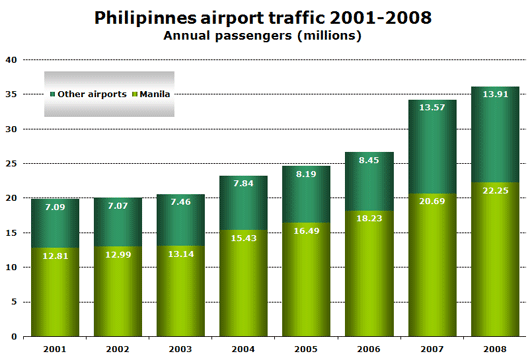
Chart: Philipinnes airport traffic 2001-2008
Source: CAAP

Traffic growth has been impressive in recent years though the 2006 figure for ‘Other’ airports would appear to be an underestimate as Cebu’s traffic data appears to be missing for much of the year. In 2007 Mactan-Cebu handled just over four million annual passengers while Clark processed just over half a million passengers.

Cebu Pacific and PAL dominate domestic markets

Domestic air travel is dominated by two major airlines, Cebu Pacific and Philippine Airlines. Between them they account for over 85% of the scheduled domestic capacity.

Airline Frequency share Capacity share Domestic routes
Cebu Pacific 44.6% 47.3% 50
Philippine Airlines 34.0% 38.3% 37
Zest Air 11.7% 9.2% 18
Air Philippines 4.1% 3.9% 7
Seair 5.5% 1.1% 7
Source: OAG Max Online for w/c 6 July 2009

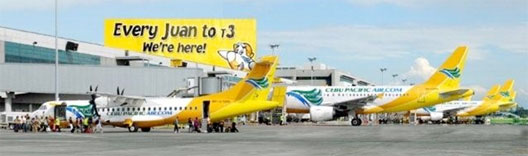
Cebu Pacific's position is impressive given that it only started operations after local deregulation in 1996. It now operates a fleet of some 30 aircraft, a mix of A319/A320s and ATR 72-500s. Zest Air (formerly known as Asian Spirit) will soon be launching several new routes from Cebu to further increase its market share.

The busiest domestic airports after Manila and Cebu are Davao (DVO), Iloilo (ILO), Caticlan (MPH) and Cagayan de Oro (CGY). Both Davao (1.7 million) and Iloilo (1.1 million) handled more than one million passengers in 2008.

Image: Cebu Pacific
Cebu Pacific moved all its domestic and international services into Manila’s (once unused) Terminal 3 last year. The fleet comprises 21 A319 and A320s and 8 ATR 72-500s - all fly to 32 domestic and 14 international destinations.

Hong Kong leading international market

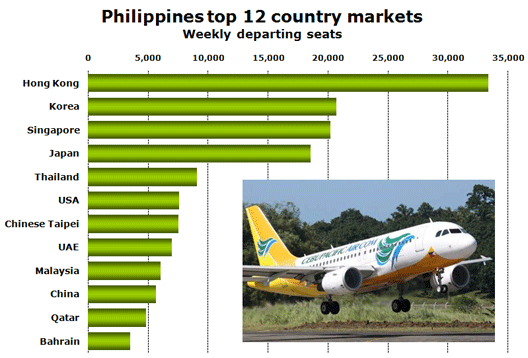
A total of 23 countries can be reached non-stop from airports in the Philippines. The leading country market is Hong Kong with 130 weekly departures. Cathay Pacific, Cebu Pacific and Philippine Airlines all offer at least four daily flights from Manila, while Cebu Pacific also operates daily from Cebu and Clark.

Chart: Philippines top 12 country markets
Source: CAAP

Non-stop flights to the US are provided by Philippine Airlines to Honolulu, Los Angeles and San Francisco, while the airline also serves Vancouver. The MEB3 (Middle East Big Three) airlines are all present and correct with at least daily departures to Abu Dhabi, Doha and Dubai, while Gulf Air and Saudi Arabian also serve Manila from their home bases.

The only non-stop service to Europe is currently provided by KLM which operates daily flights to Amsterdam.

How to breeze through airport security checks


No photo
GOTCHA By Jarius Bondoc
July 24, 2009

Airport security checks can be a hassle, but not if you know what to do. Dan Tardecilla of the Office of Transportation Security says they want passengers to cross the checkpoints easily, onto safe flights. Officers in the country’s 84 airports are trained to screen efficiently. But travelers too must help simplify the process by familiarizing themselves with it. Dan’s tips:

Pre-departure

• Know your terminal. NAIA has four. Terminal-1, the old MIA, serves all international airlines, except PAL and Cebu Pacific. Terminal-2, or Centennial, has only PAL, in separate wings for domestic and international flights. Cebu Pacific domestic and international fly out of Terminal-3, the newest, along with PAL Express and Air Philippines. Zest Air and Sea Air operate from the Domestic Terminal.

• Allow enough time before departure for security screening and check-in. For international, two to three hours before departure is best. All airports have two security checkpoints, at the terminal entrance and before the boarding gates. Airline check-in personnel also follow international standards in screening passengers and baggage.

• Have the airline ticket and acceptable ID (passport, driver’s license, etc.) ready before entering the terminal.

Baggage

• Before using, look inside all pockets and remove items prohibited in air travel (firearms, bladed weapons, etc.). Pack carryon and checked luggage yourself, so you know what’s inside in case of questions.

• Organizing a bag’s contents by layer facilitates visual checks. Screeners take more time checking and clearing cluttered bags. Pack smart; innocuous items can appear as threats in an X-ray image. Load your bags one foot apart on the X-ray conveyor belt.

• Do not wrap gifts; screeners may unwrap them for inspection. If flying to international destinations, follow the rules on duty-free items, like liquor and wine. Shop personnel will assist you on destinations that have restrictions on certain items.

• Security officers are on the lookout for liquid explosives. To avoid delays, pack all liquids in your checked luggage. If you must carry liquids, aerosols, creams or gels, the containers must not exceed 10 ml, packed inside a 20 x 20 cm transparent re-sealable plastic bag. Only one bag per passenger, this must be separately placed in the service tray for X-ray. Declare any exempted liquids (medicines, breast milk, etc.) to the screener.

• Screeners may request you to switch on laptops, digital cameras, and other electronic devices.

• Ask your airline customer service about items disallowed on board aircraft. When in doubt, leave it out. Bringing banned items not only may delay you and other passengers, but also require a police investigation.

Clothing

• Dress plainly. Screeners need to identify metals detected at checkpoints. If the metal detector alarms as you pass through, you will be required to undergo further screening, by hand wand or frisking.

• Before entering screening area, put loose change, keys, mobile phones, jewelry, and other metal objects inside the pocket of your jacket or carryon (that will pass through X-ray).

• At final checkpoint, travelers are required to remove shoes (aside from metal objects) and place these on the tray for X-ray. Slip-ons are easier to take off and put back on without having to sit down.

• Wearing bullets, dud or live, as amulet or lucky charm is barred.

• Avoid wearing bulky clothes, boots with laces, and other apparel that will make it difficult for the security officer to screen you properly.

• Think before you speak. Belligerent behavior, inappropriate bomb jokes, and threats will not be tolerated. You might miss your flight if taken in for questioning.

E-mail: jariusbondoc@workmail.com

Cebu Pacific expects to post profit this year

As it reels away from $30 million loss in 2008

Written by Lenie Lectura
22 July 2009

GOKONGWEI-LED Cebu Pacific may post a turnaround this year from a net loss of P3.26 billion last year, despite forecasts of a bleak second-half performance.

In a talk with reporters yesterday, Cebu Pacific president and chief executive officer Lance Gokongwei said passenger traffic and revenues both grew from the period January to June this year. But the remaining months of the year could be “tough,” he said.

“Our revenues for the first half of the year grew by about 20 percent. We are profitable,” said Gokongwei. The airline is due to report its financial performance next month.

He said Cebu Pacific is “very close” to meeting its target of 9 million passengers this year. In fact, passenger traffic grew by 30 percent to 4.4 million since the start of the year until June, registering 4.4 million. Gokongwei said this was aided by the removal of fuel surcharge for both domestic and international flights. Cebu Pacific passengers now pay only for the fare and government taxes.

“Consumers are price sensitive. When you reduce the prices, definitely more will avail. The market, in fact, grew by 30 percent,” said Gokongwei.

The airline celebrated its first-year anniversary of moving its entire operation to Terminal 3 of the Ninoy Aquino International Airport (Naia) yesterday. The transfer of its domestic and international operations bodes well for the airline as it resulted in a 23-percent passenger growth in 2008. “We expect to increase our passenger numbers from 9 million this year to 15 million in 2013,” he added.

Cebu Pacific transported 6.74 million passengers last year. With more planes arriving, coupled with cheaper fares, the airline is confident that it will report a net profit this year.

While Gokongwei acknowledged that the remaining months of the years could be challenging to Cebu Pacific, he is nonetheless confident that the airline will post profit this year.

“The next six months is going to be tough. We expect that because there’s off-peak season, higher fuel prices and low yields. But we still expect to be profitable,” said Gokongwei. Fuel cost is the single-largest cost for Cebu Pacific.

Cebu Pacific currently operates 21 brand-new aircraft from the A320 family with an average fleet age of just 1.9 years. It expects the delivery of two ATRs this year and two Airbus planes next year.

“We expect 15 more Airbus to be delivered from 2011 to 2014. But for this year until 2014, 17 Airbus and two ATRs will come in,” said Gokongwei.

The airline is also looking at new routes this year, particularly Brunei. “We applied for rights to fly to Brunei. We are also looking at additional routes in Japan and in South Korea,” added Gokongwei.

PAL troubled by Flight Cancellations on its Long Haul Routes

Obsolete image

By Juan Mercado

SAN FRANCISCO—“See for yourself,” the Philippine Airlines friend suggested. “Those digs about ‘plane always late’ or shabby service are history.”

They are?

PAL’s slogan is “Asia’s first airline.” Historically, that’s right on the button. It is equally true that early monopoly and avarice dissipated that edge. So were our leads in education, public health, a free press, etc.

Thus, for three decades that shabby reputation saw us and others keep PAL at arm’s length. We hop-scotched all over Asia then as a United Nations officer, invariably on other carriers. For flights to the United States, parents’ passes came from a son, a Northwest Airlines pilot.

“Before our knees give way, let’s revisit grandkids in San Francisco,” we told the wife. From jobs in different time zones, children were gathering there. They gifted us with round-trip business class tickets for July 10 on PAL.

We’re grateful they did. Our obsolete image of PAL crumbled on this trip. The airline has reacquired its competitive edge. Most staffers were efficient and warm. Food wasn’t the slop that one dimly remembered.

We almost missed this tutorial, though. Blame soured booking. “Your parents must fly on July 12 instead,” the lady told our son when he paid for the tickets. She garbled scheduling, and her costing math flopped.

That meant just an additional thousand pesos. Or was it two? “May I pay the excess recomputed fare in dollars?” our son asked. No, snapped the lady. Her attitude was: that’s your worry.

“Nada te turbe / Todo se pasa,” Teresa of Avila says. Let nothing disturb you/ All things are passing.” A sour lemon turns up in every bushel.

Swift fouled-up baggage recovery in San Francisco dulled that acrid experience. Jet lagged, I hefted a similar-looking but wrong bag from the carousel.

“No problem, sir,” said the young man on our return to PAL’s counter. “It will be up in 10 minutes,” he cheerfully added.

And it was. “The wrong bag?” he asked. Our daughter called the name stenciled on the bag. Ms (name deleted) picked it up.

“That’s my ex-wife,” the PAL official said with a wry smile. It’s all in the family. How Pinoy.

That’s a good landing, for a flight that took off 15 hours late. “Don’t worry, sir,” PAL called early on. “You’re rebooked for tomorrow.” They e-mailed the new ticket within half an hour.

Was it yesterday when Garuda’s man at Sukarno-Hatta airport in Jakarta said: “Your 8 a.m. flight is delayed until 4 p.m.” “Today or tomorrow?” we asked. Haryono Suyono, who became minister in President Suharto’s government, explained the mess: “Garuda means great airline under Dutch administration.”

“Punctuality is the courtesy of kings,” Louis XIII once said. A mint-new President Corazon Aquino stunned meetings by coming on the dot. Imelda Marcos would sweep in one or two hours late. That’s “Filipino time.”

“What’s that?” a UN colleague asked. He was being posted in Manila. “It’s like daylight saving time. Only it operates backwards.”

From “15 Ways To Beat Filipino Time,” we read to him “Learn algebra.” He looked puzzled. “If x is the time to leave the house and ETA is the estimated time of arrival, then x = ETA plus one hour and a half.”

Other suggested methods: (a) “Conserve water. Don’t take too long in the shower.” (b) “The first call you’ll receive is not a signal to leave the house. It means you’re already 30 minutes late.” (c) “Avoid the photo-finish arrival. That’s five minutes before the person waiting for you decides to go home.”

But it doesn’t work in airlines, business and 21st-century transactions. Time is money. Delays can swamp firms in red ink.

Flying from Japan’s $2.6-billion Ibaraki Airport costs less, Forbes magazine notes. But what passengers gain in money, they lose in time. It takes an hour and a half to reach Ibaraki by train and bus from central Tokyo. You can fly from Haneda to Sapporo in that time.

On the bullet train’s 40th anniversary, the company apologized for registering an average delay of six seconds. Japan Airlines worried that recent mishaps may have stemmed, “in part, from its excessive focus on keeping to schedule,” The New York Times reported.

“Japanese should relax... But they rush to catch a train even if another is coming in two minutes,” notes Shigeru Haga, professor of transportation at Rikkyo University. “There is no flexibility in our society; people are not flexible, either.”

Is there on the Pinoy side of the spectrum “extreme flexibility”? Why do Filipinos abroad show up on time and meekly line up? At home, we jump queues in movies, malls, parking lots—even when receiving Holy Communion. Perhaps, the shrinks can tell us.
“Northwest Airlines had the best on-time performance among US legacy carriers over the last two months, followed by Hawaiian Airlines, the US transport department says,” I told our NWA pilot-son as he greeted us in San Francisco. “Congratulations.”

He waved that aside with a joke. “Probably, it’s because we don’t take off on Filipino time?”

(E-mail: juanlmercado@gmail.com)

Connecting Flight that never arrived
Caused Travel headache for 141 passengers at airport

RICHMOND - About 141 passengers spent a long day at the Vancouver International Airport. A Philippine Airlines flight that was supposed to come in from Las Vegas and connect in Vancouver -- never made it due to mechanical [engine flameout] issues.

The passengers were told to stay in the airport because their luggage and paperwork has already been processed.

Arrangements were finally made to fly them out of Vancouver and to Manila at about 1:55 a.m. on Saturday. The original flight was supposed to land late Friday night, it then got delayed to 6 a.m. Saturday. [The Las Vegas plane never came. They were carried from another flight coming from Manila].

Technical Problems haunts PAL's Long Haul operations

By Simon Hradecky
July 11, 2009
Vancouver (Canada) - Philippine Airlines Airbus A340-300, registration RP-C3430 from Manila (Philippines) to Vancouver,BC (Canada), was overhead the Pacific when the crew decided to shut one of the four engines down. Oakland Oceanic Control advised Vancouver about the shut down at about 20:00Z. When the crew checked in with Vancouver center, they advised no assistance and emergency services were needed. The airplane landed safely on Vancouver's runway 26R 83 minutes later.

The Canadian TSB reported on Jul 20th, that the crew noticed a low oil pressure indication for engine #3 (inner right, CFM56) and shut the engine down. Maintenance found oil droplets at the lube pump filter drain during an engine spin. The plug was re-tightened, the engine checked with no metal found in the oil, an engine run performed without any leaks, and the aircraft returned to service.

---
Additional notes:
The A343 stayed in Las Vegas for two days for mandatory repair works before it flew back home.

PAL Reports $301 Million loss for 2008

Blames fortune on costlier jet fuel

By Darwin G Amojelar
July 21, 2009

PHILIPPINE Airlines (PAL) said it posted a net loss in the fiscal year ending March this year due to higher fuel expenses.

The Lucio Tan-owned airline company said net loss amounted to $301 million in the fiscal year ending March from a net profit of $30.6 million in the same period last year.

The country’s flag carrier said revenues rose by almost 10 percent to $1.6 billion during the period.

The airline carried close to nine million passengers during the year, which was nearly 20-percent higher than the previous year. It had a load factor of 76 percent.

PAL’s total expenses at end-March this year were higher by 20 percent compared with the previous year as a result of high fuel cost.

In the third quarter ending December, PAL reported a net loss of $219.86 million due to mark-to-market losses from its fuel hedging contracts.

The International Air Transport Association (IATA) said Asian carriers, which included PAL, would register a total estimated industry loss of $10 billion for 2008.

By end 2009, PAL is expecting the arrival of its two, brand new and fuel-efficient B777-300ER aircraft from Boeing Co., Seattle , USA .

Earlier, PAL Holdings Inc. said Trustmark—the majority shareholder of the company—will repurchase up to $143 million zero-coupon notes and bilateral loans due in 2011.

Trustmark owns 84 percent of PAL Holdings.

PAL Holdings’ notes due in 2011 amounted to $160 million while loans outstanding reached $60 million.

The company’s debts will be repurchased between $50 and $58 million, including an early tender premium of $3 million from the price of $47 million to $50 million.

Kalibo International closes airport

Cancels 16 domestic and international flights

July 20, 2009

KALIBO – The Civil Aviation Authority of the Philippines (CAAP) ordered the closure of Kalibo International Airport (KIA) yesterdayfrom 4 p.m. until 7 a.m. today after loose asphalt debris was reported floating on the recently resurfaced-runway causing cancellation of flights and stranding more than 3,000 domestic and international passengers.

Flight Safety.
CAAP ordered the closure of the airport as a precautionary measure to avoid aircraft accident resulting to Foreign Object Debris (FOD) on the runway, the same runway object that caused the crash of Concorde in Paris, France in 2001.

The asphalted aggregates that was recently laid to the runway the night before was known to have disintegrated by the weight of the aircraft after it made its landing roll early morning Sunday.

Improper curing of the resurfaced runway was attributed to weather conditions causing it to break and disintegrate says Percy Malonesio, Kalibo airport manager. The airport experienced heavy downpour earlier affecting the bonding strength of the laid asphalt.

FOD is any object that does not belong to the airplane, and includes object such as animals and birds, stones and other aircraft parts that can result to aircraft damage, or engine ingestion resulting to engine damage or instability of flight that might cause accident, or airport and airline personnel injury.


After the Concorde crash in 2001, the U.S. Federal Aviation Administration (FAA) and International Civil Aviation Organization (ICAO) issued a guideline to all regulatory aviation bodies (FAA Advisory Circulars 150/5380-5B, Debris Hazards at Civil Airports, and 150/5370-2C, Operational Safety on Airports During Construction) requiring a daily, daylight inspection of airplane maneuvering areas and removal of FOD.

The airport closure is necessary to clean and repair the damaged areas says Malonesio who promises to reopen the airport at 7AM today.


Cancelled Flights.
Cancelled flights were three Kalibo-bound flights of Zest Air, namely Flights Z2-875, Z2-883 and Z2-897, all of which were supposed to depart the Ninoy Aquino International Airport at 2:20 p.m., 3:40 p.m. and 4 p.m. on Sunday. Three return flights to Manila, Z2-874, Z2-882 and Z2-896 -- scheduled to arrive at NAIA at 4 p.m., 6:20 p.m. and 6:40 p.m. respectively -- were also cancelled.

Also cancelled were four flights of Philippine Airlines, namely PR-324, PR-325 and PR-326, which were supposed to leave NAIA at 3:45 p.m., 4:05 p.m. and 6:30 p.m., respectively. Another flight, PR-323, left NAIA at 1:07 a.m. but was diverted to Iloilo airport and was now on its way back to Manila.

Seven Kalibo-bound Cebu Pacific flights were also cancelled, 5J-341, 5J-343 and 5J-345, set to leave NAIA 3 at 3:30 p.m., 4:25 p.m. and 5:10 p.m. on Sunday. Three return flights to Manila, 5J-338, 5J-342, 5J-344 and 5J-346 -- the last three which were to arrive early Sunday evening -- were also cancelled.

Michelle de Guzman, Cebu Pacific corporate communications manager, said they had two extra flights yesterday to accommodate the passengers of their three Manila-bound flights affected by the airport closure.

Cebu Pacific had seven flights from Manila to Kalibo and their returning flights, and one flight from Cebu to Kalibo and its returning flight that were cancelled.

International flights to Taiwan and Korea was also cancelled due to the airport closure.

Traffic diversion.
Kalibo airport has seen busy operations lately after much of Caticlan passenger traffic was diverted by major domestic airlines in July 9, 2009 after its runway was shortened by CAAP to avoid another accident at the airport. PAL, Cebu Pacific, and Zest were protesting new airport guidelines being implemented in neighboring Caticlan airport in Aklan.

Airlines complained of the landing weight limitations imposed by the Civil Aviation Authority of the Philippines (CAAP). The CAAP designated the Caticlan airport as a one-way airport, which means take-off should be towards the sea, and landing in the opposite direction.

New International flights.
In another development, Malonesio disclosed that Kalibo will soon serve nine direct international flights weekly from the airport with new flights and airline operators. Zest Air and Asiana will be introducing direct flight from Seoul, South Korea from July 27 while China Eastern Airlines is expected to land at the KIA before the end of the year.

“Aside from these flights, the Mandarin Airline still continue to land in Kalibo directly from Taipei in Taiwan,” said Malonesio.

Kalibo International Airport has the following International airlines as operators--- Mandarin Airlines, China Airlines, and soon to be Asiana and China Eastern. Of the local airlines, PAL, CEB and Zest, only Zest Airways flies international flight out of Kalibo to Seoul, South Korea. Most of the passengers are bound to world famous Boracay Island.

First foreign airline.
Kalibo International witnessed the arrival of its first international airline in June 14, 2008 when the maiden flight of Mandarin Airlines from Taipei, Taiwan touched down the Kalibo International Airport Saturday. Boeing 737-800 flight AE7265 left Taipei at 4:20 PM. and reached Kalibo at 6:40 PM.

Mandarin Airlines’ supervisor for passenger handling Richard Ma said many Taiwanese want to visit Boracay Island. “They like to travel to the Philippines because the service standards are very good,” Ma added.

The Mandarin Airlines’ Kalibo-Taipei flight is the fourth Philippine destination of the airline. It also has flights from Taipei to Cebu, Subic and Laoag. Established on June 1, 1991, the Mandarin Airlines services regional short-haul international and domestic routes.

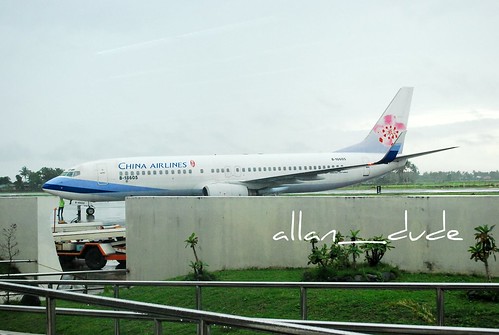
Its second international operating airline is China Airlines which landed at the airport in November 27, 2008. The E-190 flight CI-7913 with 90 passengers arrived at 9:30AM and operates on a twice a week service.