Zest Air Adds four International Routes from its hub

Flies Shanghai and Incheon from Cebu Adds Chengdu and Taipei from Kalibo

July 11, 2011

Kalibo - Budget airline Zest Air flies more international points out of Kalibo International Airport as it began yesterday its first inaugural flight out of Taipei, Taiwan and Chengdu, China.

The airline is scheduled to fly the route from kalibo to Taipei, Taiwan, and Chengdu, China once every 5 days.

Zest Air already flies direct to Seoul, Busan, and Shanghai out of its Kalibo hub. It recently add Shanghai and Seoul from its Cebu hub two days ago.

ZestAir chief operating officer Alfredo Yao said the expansion is part of the airline's 10 billion fleet expansion plan this year design to increase capacity and enable it to carry three million passengers this year from last year's figure which was recorded at 1.23 million.

According to ZestAir, it will eventually add frequency to the route after receiving more aircraft on order from European manufacturer Airbus.

The airline expects to have three (2) more A320s before the end of the year, with one arriving in August and another one in November. It recently received a new frame early this month increasing its Airbus fleet to eight which is now being used for China and Taiwan flight.

ZestAir plans to end 2011 with 10 Airbuses in its fleet and with projected revenues of P6 billion. By 2012, the airline plans to add another four aircraft to its fleet, and intends to have as much as 25 Airbus 320 planes by 2015.

Other airlines with international flights out of Kalibo International Airport, either in charter or regular flights, are Philippine Airlines to China and Korea, China Airlines, Mandarin Airlines, and Spirit of Manila for Taiwan, and Shanghai Airlines for Shanghai.

Airphil express is scheduled to fly maiden flight from Shanghai to Kalibo by October 2011 replacing PAL and joining other airlines to make international call at the airport.

10 Ways to Make Airport Security Faster

July 9, 2011

By Jessica Hulett

Everyone now knows that a short flight doesn’t mean a short amount of time out of your day. We have learned to tack on an extra hour or two to allow for airport security screening before boarding our flight. Time is valuable to us all, so, this problem definitely needs addressing. Here are 10 ideas that have been suggested, and in some cases,implemented, for making airport security more time efficient.

Low risk travelers. It has been suggested that frequent flyers be pre-screened and allowed a more minimal security check than other passengers. This could greatly minimize the time it took to get passengers through security checkpoints.

Free bag check. There is the sense that people are carrying more baggage onto the planes in order to save the costs of checking their baggage for flights. If passengers could check one bag free for their flight, there might not be as much carry-on baggage to screen.

Shoe scanner. Creating a scanner that would allow a person to keep their shoes on, and walk over the scanner, would eliminate some of the hassle created by passengers needing to remove their shoes and then put them back on again.
Bin conveyor. An automated bin return conveyor system has been developed and is in use in some airports. Every little bit of automation helps, when it comes to saving time.
Prior identity verification. Implementing a system for verifying the identity of individuals whose names are similar to those on the terrorist list prior to their arrival at the airport is another suggestion that is being considered and should not be that difficult to develop.

3-D luggage scanners. These devices which make it easier for personnel to spot explosive materials in baggage have been in installed in some airports already. With less uncertainty, hopefully, the luggage will get passed through quicker.
Slow lanes and fast lanes. Allowing those with minimal carry-ons and who are familiar with the screening routine to go through a separate express lane, has also been suggested as a means of speeding up the process, and making for happier travelers.

Proper staffing. It can be very frustrating for a passenger to wait in long lines to get through the security checkpoint simply because they don’t have the proper amount of staff on duty to man all the checkpoints.
Directional information. Even when there are additional checkpoints open, passengers are not always aware of this. Better directional signage might help alleviate the develop of overly long lines.

Improve airport design. This is not a viable option for many airports, but for those that are rebuilding or renovating, some re-design in the security area could help immensely. San Diego has taken this step in the design for their new terminal building.

Of course, passengers can do their part to make the process move faster also. Simply educating yourself on the requirements and being prepared when you arrive at the airport can make a big difference.Wear shoes that slip on and off, and have your liquids properly packaged and pulled out of your bag before you reach the checkpoint. A little adjustment from both directions could speed up the process significantly.

Gas-short Grumman crashes in Compostella

Pilot Error Again!

July 7, 2011

The Grumman aircraft (Ag-Cat G164A)owned by the Aerowurkz Aerial Spraying Services, with registration no. RP-R 5859, crashed early morning Wednesday at the Isalom banana plantation in Compostela Valley, Davao del Norte, when its pilot Capt. Luciano Edgil disregarded a flight dispatcher’s warning that his aircraft was low on fuel and can only take an hour’s flight.

The pilot was immediately brought to the hospital for treatment.

The Civil Aviation authority said the aircraft was spraying chemicals over the Isalon banana plantation when the plane lost power due to gas starvation.

Initial investigation revealed that there were two aircraft of the same type but with different engines, with the first aircraft having fuel allocation good for two hours of flying and the other for an hour.

Despite the dispatcher’s warning, Edgil made a pass and utilized the aircraft with limited fuel good for an hours flight which subsequently run out of fuel and crashed. He was not hurt, Melvin Dagon, CAAP Investigator said.

The pilot who had figured several accidents in the past might lose his license because of this accident which was clearly a pilot error, the investigator said.

"Capt Edgil will be asked to report to Capt. Amado Soliman, Aircraft Accidents Unit head, after his confinement in the hospital for personal evaluation of his license." Dagon added.

Aerowurkz Aerial Spraying Services Company engages in aerial spraying activity for crop growers, particularly big banana plantations in Mindanao.

Will Tiger Airways Australia’s grounding impact on Philippine and (planned) Indonesian, Thai operations?

July 6, 2011

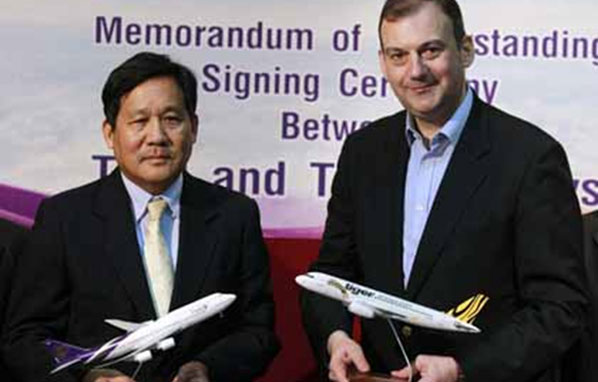
Thai Airways’ President Piyasvasti Amranand and Tiger’s President and CEO Tony Davis agreed an MoU for setting up Thai Tiger Airways last August. Hopefully Tiger can eventually shake-off its woes caused by its Australian grounding and continue expanding through joint-venture – the only vehicle for growth in regulated Asian markets.

Thai Airways’ President Piyasvasti Amranand and Tiger’s President and CEO Tony Davis agreed an MoU for setting up Thai Tiger Airways last August. Hopefully, Tiger can eventually shake-off its woes caused by its Australian grounding and continue expanding through joint-ventures – the only vehicle for growth in regulated Asian markets.

Before Tiger Airways Australia’s alarming grounding, the airline group appeared to be following the AirAsia path to regional growth by investing in airlines in other countries. The airline had agreed to purchase a 33% stake in Mandala Airlines (in Indonesia), itself grounded and undergoing “financial restructuring”. In Thailand, Tiger plans to set up a joint venture with Thai Airways called Thai Tiger, in which Tiger Airways would hold 39%. Finally, in the Philippines, Tiger has purchased 32% of SEAIR. At the end of April, Tiger announced that SEAIR would start operating up to five daily domestic jet flights (using Tiger Airways A320s) between Manila and Cebu, followed by three daily flights between Manila and Davao. However, after local airline protests, the plans appear to be on hold as neither of the routes appear on Tiger Airways’ route map or in SEAIR’s schedules.

Generating 45% of Tiger’s revenues but 50% of costs

Tiger Airways began operations from Singapore in September 2004 before launching flights with its Australian subsidiary from Melbourne in November 2007. Both airlines operate 180-seat A320s of which the company currently has 26. In total, Tiger Airways Holdings Limited flew just under six million passengers in its last financial year, at an average load factor of just under 86%.

Figures revealed in Tiger Airways’ recent annual report for the year ending 31 March 2011 show that while the Singapore operation is profitable, the Australian operation is not. While the Australian operation now generates 45% of the company’s revenues, it also accounts for 50% of its costs. Tiger reported that in FY11, Australia represented a “challenging operating environment” with “one-offs” including “natural weather events and AVV (Melbourne Avalon) start-up costs”. It concluded that “network review likely to see more route suspensions” and that the carrier should “focus on profitable flying rather than growth”.

6.5% of domestic market from 18 routes

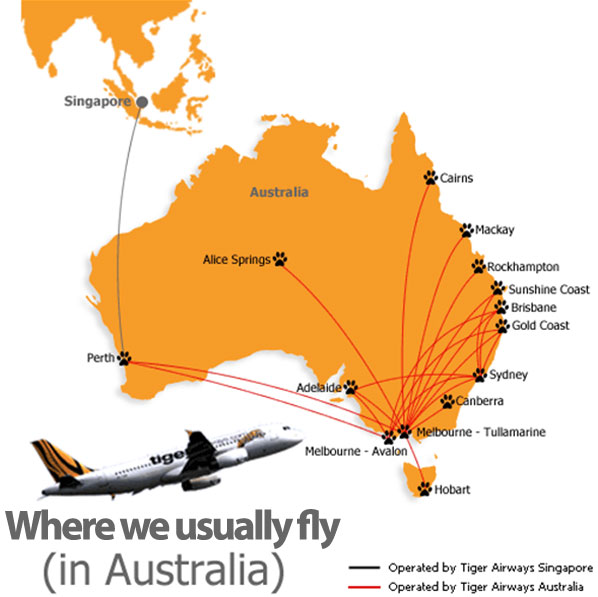
According to OAG data for June 2011, Tiger Airways Australia is the fourth-largest domestic carrier in Australia (based on weekly seats) with 6.5% of the market, well behind Qantas (42.8%), Virgin Australia (26.0%) and Jetstar (17.1%). Since it uses 180-seat A320s for all its services, Tiger Airways Australia’s share of domestic movements is lower, at just 4.3%, and ranks only fifth as it also falls behind Regional Express (REX).

According to its on-line booking tool, the airline’s network has recently consisted of 18 routes, of which 12 involve Melbourne Tullamarine (MEL) airport, six involve Sydney and two involve Melbourne Avalon.

From To (weekly frequency)
Melbourne (MEL) Adelaide (28), Alice Springs (4), Brisbane (21), Cairns (6), Canberra (7), Gold Coast (13), Hobart (7), Mackay (4), Perth (13), Rockhampton (3), Sunshine Coast (6), Sydney (56)
Melbourne Avalon (AVV) Perth (6), Sydney (7)
Sydney (SYD) Adelaide (7), Brisbane (14), Gold Coast (14), Melbourne (56), Melbourne Avalon (7), Sunshine Coast (6)
Source: Tiger Airways on-line booking tool for travel w/c 11 July 2011.
Bold routes are those that appear twice, once from each end of route.

It was only last November that Tiger started flying from Avalon Airport, a secondary airport for Melbourne, initially to seven destinations. Three (Alice Springs, Mackay and Rockhampton) were dropped within weeks of starting (although, in effect, they merely returned to Melbourne Tullamarine Airport), while Adelaide, Brisbane and Gold Coast services were axed at the beginning of June, leaving just Perth and Sydney services from Avalon at the present time.

With eight daily flights between Sydney and Melbourne (Australia’s biggest domestic route with almost eight million passengers in 2010), this one route now accounts for 25% of Tiger Australia’s entire network capacity.

Tiger Airways Holdings Limited has responded to the crisis (which saw Tiger Airways’ shares fall, as Qantas and Virgin Blue saw their share price rise) by appointing the Divisional Vice-President of Cabin Crew Operations at Singapore Airlines, Chin Yau Seng, to the position of Executive Director. Remember, Singapore Airlines, is the single biggest investor in Tiger Airways Holdings Limited, and does not want to see its hard-earned and legendary reputation tarnished in any way by events unfolding in Australia.

Where we usually fly (in Australia) - Tiger Airways

GMA used to own PNP chopper

Sold as Brand new

July 6, 2011

By Christina Mendez

Sen. Panfilo Lacson implicated yesterday former President and now Pampanga Rep. Gloria Macapagal-Arroyo and her husband Juan Miguel Arroyo in the anomalous purchase of three helicopters of the Philippine National Police (PNP) in 2009.

The senator said he obtained documents indicating that the Arroyos were the former owners of the helicopters “forcibly” sold and priced as brand-new to the PNP for P105 million.

“The First Couple were so powerful at that time that ramming the used helicopters down the throat of the police was easy and effortless,” Lacson said.

Lacson said the couple and other officials who may be involved can be made liable for plunder.

“And since the proceeds could exceed the P50-million threshold in a series of acts, those liable are candidate for a plunder case under our existing laws,” he said.

Bolstering Lacson’s claims, an independent source told The STAR that one of the choppers had logged 500 flying hours in 2008 alone or a year before the supposed purchase.

“If it was brand new (in 2009) why would its batteries conk out barely a year while the PNP was using it?” the source said.

The PNP source, however, refused to say who were the supposed first owners of the chopper before it was passed off as brand new to the police force. “The matter is still under investigation,” the source said.

The PNP is reportedly trying to negotiate with the supplier to replace the aircraft with brand new ones before Lacson made the anomaly public.

“The PNP was shortchanged, it seems,” the source added, but officials were mum on the alleged hand of the Arroyos in the anomalous purchase.

Sources revealed that the supposed PNP procurement came before a certain group tried to sell a secondhand Bolkow helicopter to the PNP, but the leadership turned it down since it was below procurement standards.

In a statement, Lacson revealed that initial findings would indicate that the previous and original owners of the pre-owned – yet sold as brand-new – light police operational helicopters are the Arroyos.

“While it’s bad enough that the two units were overpriced and therefore grossly disadvantageous to the government, passing them off as brand-new smacks of brazen deceit and utmost bad faith,” the former police chief added.

Lacson had initiated an investigation into alleged misrepresentations in the P105-million purchase of light operational helicopters by the PNP’s elite Special Action Force (SAF).

Senate Blue Ribbon committee chairman Teofisto Guingona III and Lacson have filed Senate Resolution 518 to take a closer look at the acquisition of the helicopters from Manila Aerospace Products Trading Corp. (MAPTRA).

On July 9, 2009, the PNP Negotiation Committee recommended the awarding of the contract to MAPTRA for one Robinson R44 Raven II and two Robinson R44 Raven I helicopters.

But it was later learned that MAPTRA had been engaged in the business only in June 2009. Also, it was learned the supposedly new choppers were “pre-owned” as far back as March 2004.

On the other hand, Lacson said that while the PNP officials involved in the deal were complicit partners, they are the least to blame in this anomalous transaction.

Lacson is said to be keen on pinning down the Arroyo couple and a former Cabinet member who lorded over the police force during the past administration in the helicopter procurement anomaly.

Philippines to lease modern jets, watercraft from US

By Aurea Calica
The Philippine Star

July 05, 2011

Defense Secretary Voltaire Gazmin said yesterday the Philippines is working on a lease agreement for modern planes and naval ships with the United States within the year to improve the country’s ability to guard its territory.

“We’re looking at modern equipment that are not excess defense articles. The equipment are there but there’s nothing final yet,” Gazmin told reporters in MalacaƱang after he attended the oath taking of Transportation Secretary Manuel Roxas II and the signing of the memorandum of agreement between the Philippine government and the Cordillera Bodong Administration-Cordillera People’s Liberation Army.

Gazmin said Washington gave assurance that it would study the Philippine proposal and see what equipment could be available for Manila.

“They are trying to see the available ones that we can operate because when you talk of new equipment, you talk of operational cost, with the very limited budget that we have, we will see what we can afford,” Gazmin said.

The defense chief said funds for the lease of military planes and ships would come from the Armed Forces of the Philippines’ modernization funds.

He said his department would seek additional budget depending on the country’s needs.

“We want long-range aircraft patrols as well as watercraft, including those with high-caliber weapons to guard our territory,” Gazmin said.

Recently, the US assured the Philippines that it was ready to help the country “defend itself” from territorial incursions amid reports of Chinese intrusions into the disputed West Philippine Sea.

Foreign Affairs Secretary Albert del Rosario had announced the proposal to lease military equipment after his visit to Washington to meet with American officials.

The AFP had submitted a list of equipment needed to boost the country’s maritime border patrol capabilities.

PNP Ravens in Hot Air

Senate Probes helicopter procurement

July 5, 2011

By Cecille Suerte Felipe

Sen. Panfilo Lacson urged yesterday the Philippine National Police (PNP) to cooperate in the investigation of police procurement of P105-million worth of supposed brand new light helicopters that turned out to be secondhand aircraft.

“I would like to ask the PNP for its cooperation in connection with the Senate inquiry in the coming days,” said Lacson during his speech at the regular flag raising ceremony of the PNP in Camp Crame in Quezon City.

Lacson and Sen. Teofisto Guingona III pressed for an investigation on the procurement since the supplier of the helicopters, Manila Aerospace Products Trading Corp. (MAPTRA), made it appear – with the knowledge of the PNP – that the choppers delivered were new.

Lacson said the plan was for the purchase of three light helicopters for the PNP-Special Action Force’s Air Unit. The procurement was planned on May 8, 2009 and the deal awarded on July 9, 2009.

He said that then PNP chief Director General Jesus Verzosa approved the supply contract worth P104.985 million.

The PNP purchased one Robinson R44 Raven II and two Robinson R44 Raven I helicopters.

Interior and Local Government Secretary Jesse Robredo welcomed the Senate inquiry, saying the rumors about the irregularities in the procurement of the helicopters have been persistent.

Robredo said the National Police Commission (Napolcom) is currently investigating the controversy and the department would cooperate with the Senate probe.

Robredo said the procurement was made by some police officials who have retired from the service and prior to the term of current PNP chief Director General Raul Bacalzo.

“Even if they (police officials) are retired, it doesn’t mean they will not face the consequences,” said Robredo.

Lacson said a brand new helicopter could cost only about P16 million to P17 million. He said two of the three helicopters were not new and no enhancement was made to them, like setting up of infrared.

Lacson said more information would be uncovered during the Senate inquiry.

PNP spokesman Chief Superintendent Agrimero Cruz Jr. said the police force is ready to cooperate in the investigation.

Air Force to buy new six trainer jets

For F-16 or F-18 MRF aircraft

July 3, 2011

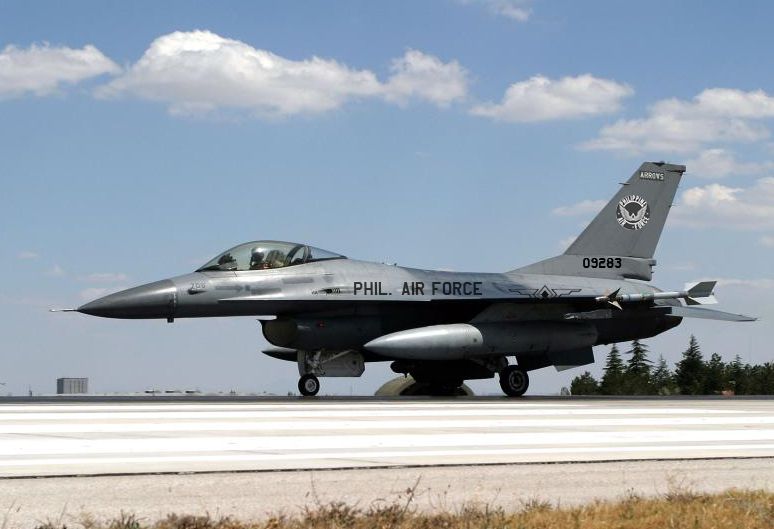
The Philippine Air Force will have new six trainer jet fighters for interdiction missions against intruders into Philippine waters and air space, Defense Secretary Voltaire Gazmin said Friday at the Air Force’s 64th anniversary celebrations.

The marching orders to acquire immediately new trainers came from President Benigno Aquino after Russian made Chinese SU-27 intruded into Philippine Airspace and harassed two PAF aircraft that were conducting reconnaissance patrol and another oil exploration team at least nine times off Palawan region.

A team from the Philippine Air Force recommended an initial six multi-role planes to be acquired within the term of President Benigno Aquino III says Armed Forces chief Gen. Eduardo Oban Jr. The PAF will use it as advanced lead-in fighter trainer (LIFT).

He said the Air Force was looking at either Korea’s TA-50 Golden Eagle or Italy’s M-346, to be bidded out next year.

The TA-50 is a joint venture program of Korea Aerospace Industrie (KAI) and Lockheed Martin of the United States, with a price tag of USD $25 million, close to the F-16C/D variants valued at USD $27 million from US Air Force stocks. A brand new F-16 cost USD $55 million. The TA-50 Golden Eagle design was largely derived from the Lockheed Martin F-16 Fighting Falcon, being similar on the use of a single engine, speed, size, cost, and the range of weapons system.

Meanwhile, the Italian made Alenia Aermacchi M-346 of the Finmeccanica Group is a twin engine, two seat aircraft, a deriva­tive of the Russian Yakovlev Yak-130. It has a price tag of USD$20 million.

The Aermacchi M-346 has a “Fly Away” price tag of about USD $15 million per plane, while the TA-50 settles at USD $21 million based on Singapore and Indonesia offer.

The T-50 and M-346 are considered to be among the best advanced trainer jets on the global market. Both Singapore and the UAE bought the M-346 for their training needs while Indonesia opted for the T-50.

The trainer aircraft is intended to ensure pilots to be properly trained to fly new generation fighters like the F-16 or F-18.

Foreign Secretary Albert del Rosario met with Secretary of State Hillary Rodham Clinton last week to discuss military deals with US surplus hardware which include a fighter aircraft affordable to the Philippines.

Industry insider at the Department of Defense quoted the aircraft as either F-16 or F-18 which Del Rosario gave US defense officials depending upon the award of the trainer jets next year. The PAF is expected to have its first Multi Role Fighter (MRF) ready by 2016.