PAL to Introduce Europe flight by 2010


Eyes London next Summer!

15 August 2009

London
- Philippine Airlines (PR Holdings, PSE) has filed with the UK's Department for Transport (DfT) an application for an operating permit to fly regular scheduled flight between London Heathrow Airport and Manila International Airport, Dft said over the weekend.

The airline which last flown in 1998 is returning to Heathrow on the same weekly frequency it previously operates almost 12 years ago. The application states that the airline will fly using the Boeing 777-300ERs' on the route on a thrice a week service initially commencing summer of next year says International Aviation and Safety Division (IASD) of DfT. No further information was disclosed.

Airport Co-ordination Ltd. (ACL) which also received PAL's application for airport slot categorise its status as "new entrant" says Peter Morrisroe, Managing Director of Airport Coordination. He further confirmed that the time schedule for the airline has not been fixed yet as its requested landing and take off slots at London Heathrow is still being evaluated by ACL. Its docking point was however confirmed at Terminal 3. Request for additional information was denied.

Financial services firm Deloitte & Touche valued a peak-time Heathrow slot at an all-time high of £25 million in 2008 but the recession forced the numbers to settle around £10-15 million in 2009.

ACL is the regulatory authority responsible for slot allocation and schedule facilitation at Europe's busiest airport. According to ACL, an airport slot is the scheduled time of arrival or departure available or allocated to an aircraft movement on a specified date at an airport as allocated by them.

The United Kingdom and the Philippines recently amended its Air Service Agreement in July 9, 2009 expanding the frequency to 14 flights per week between the two countries, inclusive of daily flights between the two capitals.

Virgin Atlantic does not fly to Manila while British Airways ceased flight operations in 2000. There is no indication that the two British carriers will fly the route in the immediate future thereby making Philippine Airlines as the only operator for the route.

There are more than 200,000 registered Filipino migrants in Britain in 2008 based on the figures released by the Home Office.

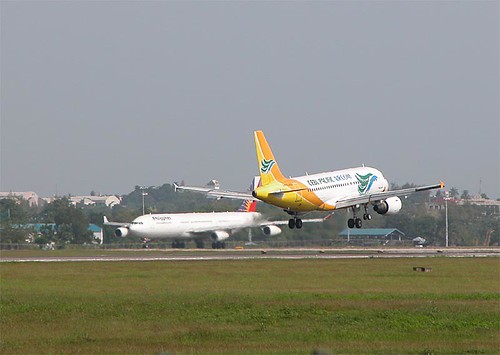

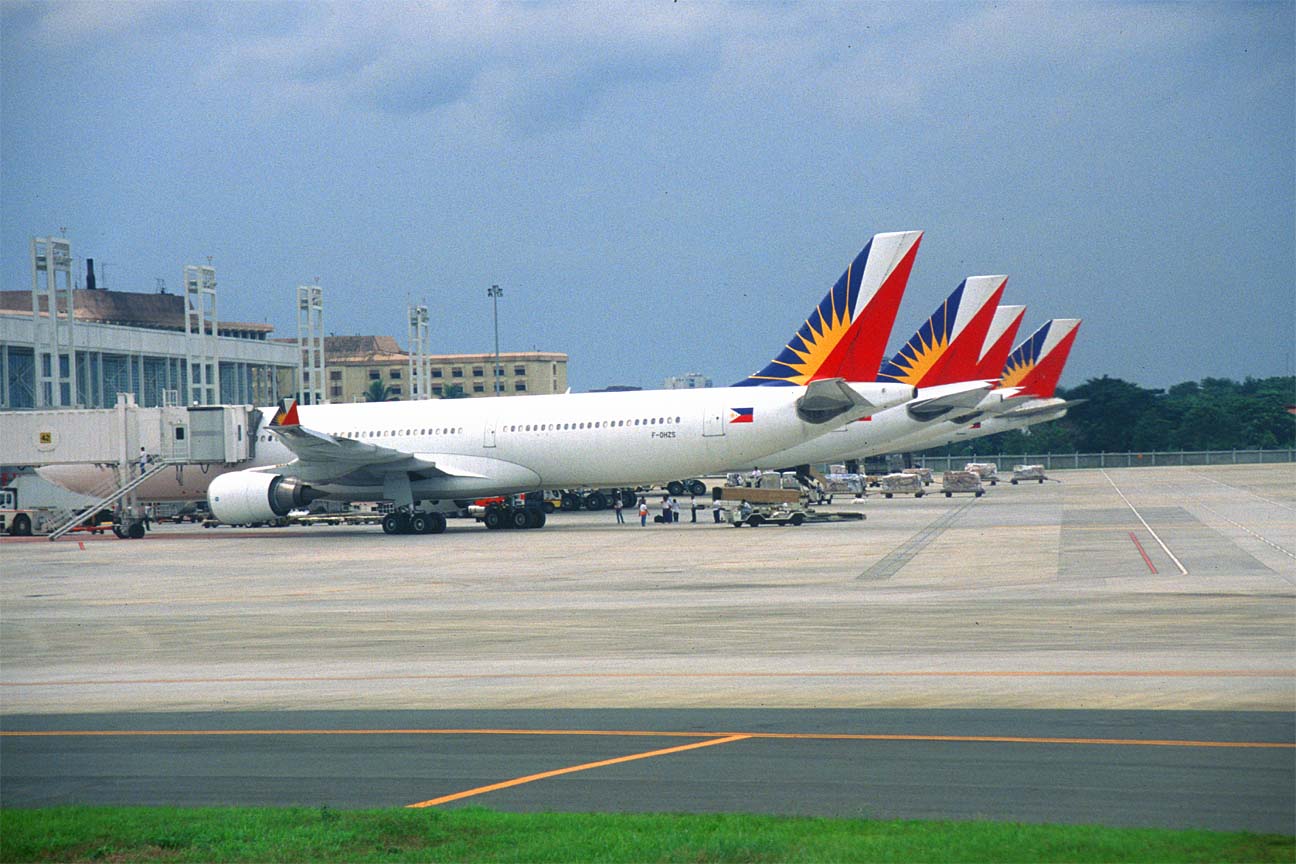
Domestic pasengers at 7.5 Million on first half of 2009


Fueled by Aggressive Airline Pricing Strategy


11 August 2009

The Philippine domestic passenger air traffic rose 31 percent in the first six months of the year to almost 7.6 million compared to almost 5.8 million recorded in the same period a year ago. The phenomenal growth in its domestic traffic have been attributed to the airlines’ aggressive pricing strategies. The total load factor or the number of seats occupied during a flight rose to 76 percent in the first quarter from 75.6 percent in the same period last year.


Cargo traffic is however down 1.08%, from a total of 60,275,261 kilograms (kg) that were recorded in the first half of 2009 as against 65,185,354 kg reported in the same period last year. Of the number, Cebu Pacific transported 31,620,955 kg; PAL, 27,231,331 kg; Pacific East Asia Cargo, 815,096 kg; Air Philippines, 407,100 kg; and Seair 200,779 kg.


PHILIPPINE DOMESTIC AVIATION DATA
TOP DOMESTIC AIRLINES IN THE PHILIPPINES
As of June 2009
RANK
AIRLINE NAME
CODE
ALLOCATED SEATS
CARGO PER Kg
LOAD FACTOR
PASSENGERS CARRIED
1
Cebu Pacific
5J
4,335,526
31,620,955
83
3,614,966
2
Philippine Airlines
PR
3,993,671
27,231,331
80
3,207,060
3
Air Philippines
2P
335,392
407,100
76
254,244
4
Zest Airways
Z2
594,612

73
433,576
5
Seair
DG
117,155
200,779
71
83,132
TOTAL
9,376,356
59,460,165
76.6
7,592,978
Source: Civil Aeronautics Board

Yes, Love can stop a plane from flying!

August 9, 2009

Davao City
- For Davao International Airport, it was a regular Friday night of operations as PR flight 822 prepares to depart for Manila at 10PM, the airlines last flight. For the Airbus 320 Pilot Captain De Guzman, it was a routine red eye flight check for a 90 minutes flight. But for Dubur Mollik, a 21 year old Bangladeshi national, it was his only chance to reconcile with the love of his life.

In a similar scenario to the last episode of Friends, the television series of Warner Brothers, It was a long night for Dubur as he endure finding sense to know what love is and when he finally manage to find his heart he stood up and begged the flight attendants to get-off the plane. He was talking to somebody on the phone but definitely it was no Regina Phalange (Phoebe Buffay's alter ego), or because there's no left phalange on the plane.


But the boarding gates was already closed by tired agents and the pilot was already preparing his final check for take-off as he planned to be home by midnight, while the groundcrews tow the aircraft away from its stand hoping to call it a day.

Finding futility to his request to deplane, Dubur started to cry. “He was crying and begging the crew to allow him to get off the plane,” says Superintendent Elias Abad, chief of the Aviation Security Group (ASG), quoting stories from the flight captain, the crew and several passengers.

Knowing love himself, the Pilot finally agreed to grant his wish after failing to appease Dubur, but the long delay started apprehensions on other passengers that they too started disembarking the plane.

“Many got mad and argued with the captain about his decision,” said Marj Reyes, one of the passengers.

As a security precaution, the foreigner's luggage had to be removed from the aircraft and the Aviation Security Group had to run a security check once more.

As it turned out, Dufur has a lover's quarrel with his Filipino girlfriend who were vacationing in Davao. He decided to leave ahead of their August 28 flight for Kuwait where they both work. Dufur was already on the plane when he suddenly realized that he could not possibly leave without the woman he loves so he begged the crew to allow him to get off the plane.

The girl was called and the two lovers were reunited at the ASG office a few hours later said Superintendent Abad whom he spoke with and the Filipino girlfriend assured him that Dufur Mollik is a good person.

He told the couple not to fight anymore and to see him in his office before their scheduled flight on August 28. “I just want to make sure they’re together when they leave and the incident will not be repeated,” Abad said in jest.

Asked if the foreigner faced any charges, Abad said Mollik did not commit any crime so he was free to go after the investigation.

Abad said he asked PAL if it was filing a civil case against Mollik for economic loss because only half of the original passengers decided to push through with their flight, "but they too decided not to file any case."

"Who says this can only happen in the movies?" Abad Added. --- with reports from Dennis Jay Santos.


PAL raising capital to P20B


by Jenniffer B. Austria

Philippine Airlines Inc., owned by tobacco magnate Lucio Tan, is increasing its authorized capital stock to P20 billion from P16 billion after posting a huge loss last year.

“[PAL] is currently exploring various options to raise additional capital to help improve its equity position after the loss incurred in the fiscal year 2008-2009. By increasing the authorized capital stock, the company will have additional shares available for future investors,” PAL said in a filing with the Securities and Exchange Commission.

PAL has an authorized capital stock of P16 billion divided into 20 billion common shares with a par value of P0.80 a share.

PAL plans to reduce the par value of the shares from P0.80 to P0.20 and later increase its authorized capital stock to P20 billion, divided into 100 billion common shares at par value of P0.20 a share.

The airline firm has not finalized the number of common shares to be offered to potential investors.

PAL reported a net loss of $301 million in fiscal year ending March, a reversal from a profit of $30.6 million in the previous year.

Revenue rose 8.7 percent to $1.6 billion on higher passenger sales.

Expenses, however, jumped 23.4 percent, or $361 million, due to higher fuel cost.

“The rise in fuel cost by 77.7 percent over the last year’s figure of $470 million was a result of an increase in the average fuel price per barrel of $89 in 2008 to $123 million in 2009,” PAL said.

The flag carrier launched several initiatives to counter the impact of high energy prices, including the creation of a fuel conservation watchdog within the company, and reduced the free baggage allowance on trans-Pacific routes.

PAL is a subsidiary of PAL Holdings Inc., a listed company.

The flag carrier flies to the most popular domestic airline routes and to international and regional points that are either mostly visited by Filipinos or a good source of visitors to the Philippines.

PAL’s route network covered 29 points in the Philippines and 31 international destinations, including Guam, Honolulu, Las Vegas, Los Angeles, San Francisco, Vancouver, Melbourne, Sydney, Fukuoka, Nagoya, Osaka, Tokyo, Pusan, Seoul, Hong Kong, Macau, Beijing, Shanghai, Xiamen, Taipei, Bangkok, Saigon, Singapore and Jakarta.

Mindanao Airport upgrade completed by yearend


By Darwin T. Wee

ZAMBOANGA CITY — Rehabilitation of the three main airports in Zamboanga Peninsula is expected to be completed at the end of the year, the Mindanao Economic Development Council (MEDCo) has said.

This city’s international airport, along with those in Dipolog City in Zamboanga del Norte and in Pagadian City in Zamboanga del Sur, will soon be equipped with modern facilities, MEDCo chairman Virgilio L. Leyretana, Sr., said in a phone interview late last week.

Rehabilitation of the region’s airports will provide Zamboanga Peninsula greater accessibility and connectivity with the rest of the country.

"This will enhance the movement of people and goods at reduced costs," Mr. Leyretana said.

Data from MEDCo showed the rehabilitation of the three airports will cost over P1.4 billion.

The projects involve concreting, extending and widening the airports’ existing runways and aprons; construction of new flight service stations and powerhouse buildings; construction of new administration buildings; and construction of perimeter fences.

The Pagadian City Airport, which has suspended its operation in the past three years due to a defective runway, is expected to be operational in December, Mayor Samuel S. Co claimed.

Erlinda Delos Reyes, Dipolog City Airport manager, said five of the 10 projects in her facility are now completed.

One project is ongoing while the remaining four projects are still in the preconstruction stage.

The ongoing project covers the extension of runway, construction of perimeter fence and continuation of shore protection.

"The completion of this infrastructure will significantly improve tourism in the province and will make tourist destinations more accessible," said Allan Ranillo, chairman of the Zamboanga del Norte Regional Tourism Council.

Outside of Zamboanga Peninsula airports, those in the island provinces of Sulu and Tawi-Tawi — also in western portion of Mindanao — are expected to be fully operational next month.

The projects are partially funded by the United States-funded Growth with Equity in Mindanao (GEM).

The P230-million worth Jolo airport had its runway extended from 1,200 meters to about 1,845 meters, while the P200-million Sanga-Sanga (Bongao) Airport will have a 1,900-meter runway from the previous 1,600 meters, said Manuel T. Jamonir, infrastructure specialist of GEM.

Aside from the expansion and widening of the existing runways, the Sulu and Tawi-Tawi airport improvement projects include the rehabilitation of passenger terminal facilities that will be equipped with baggage conveyors and x-ray machines.

MEDCo said other airports in Mindanao that are expected to be finished within 2010 are those in the cities of Ozamiz costing P215 million; Cotabato, P327 million; Butuan, P592 million; and Surigao, P197 million. Only the P7.8-billion Laguindingan airport in Misamis Oriental will be completed beyond 2010.


NEW PAGADIAN AIRPORT. Two years after their last flight from this airport, locals of Pagadian city and Zamboanga del Sur expect to have an upgraded airport by December 2009, with operations targeted to commence in September. As of the latest Mindanao Super Region Monitoring Report of MEDCo, about 94.9 percent of the Php379.46 million airport upgrading project has already been implemented. Also shown here (inset) is a photo of an unfinished portion of the runway extension component taken last May.

Zest Air eyes DMIA as hub for int’l flights


August 3, 2009

Budget airline Zest Airways Inc. (Zest Air) intends to make the Diosdado Macapagal International Airport (DMIA) in Clark its hub for its international flights starting September this year.

Victor Jose I. Luciano, president and CEO of the Clark International Airport Corp. said that Zest Air will start its commercial flights in DMIA in September this year.

At present, Zest Air’s domestic flights are based at the old domestic airport in Manila except for one flight in Clark for Caticlan.

The airline also plans to mount flights to Hong Kong, Incheon in South Korea, Macau, Xiamen and Shanghai in China and Bangkok in Thailand.

Zest Air’s application for rights to fly the Middle East, particularly Kuwait and UAE is pending approval by foreign governments while its request to fly to Australia is currently applied following new bilateral agreement between Australia and the Philippines.

Zest Air would be able to mount international flights with the starting delivery of two brand new Airbus 320 in October this year.

This is in addition to the first A-320 it purchased earlier. The company is also buying 2 Boeing 767-300 aircraft to bring its total fleet to 11 aircraft by yearend, flying to major tourist destinations in the country.

This is part of the $150 million second wave of capital expansion. Last year, the company invested $170 million.

At present, Zest Air flies to Caticlan, Busuanga, Calbayog, Catarman, Marinduque, San Jose and Virac from Manila. It started flying new routes to Iloilo, Legaspi, Naga, Puerto Princesa, Davao, Kalibo, Tacloban and Tagbilaran.

The Zest-O group of companies, owned by businessman Alfredo Yao, acquired Asian Spirit, a small airline company based in the Philippines last year, and is carrying out an aggressive expansion program amid worldwide economic downturn. (BCM)

Canada's new visa rule contradicts flight policy

As it denies additional Entitlement to Philippine Airlines

August 2, 2009

Vancouver- Canada recently lifted the transit visa with the hope of attracting new carriers and travelers to consider Canada's struggling airports adversely hit by global recession. Already, passenger traffic at Vancouver airport is down by 14.6%.

Nationals from the Philippines, Indonesia, Thailand and Taiwan traveling with Philippine Airlines, China Airlines and Cathay Pacific Airways were made eligible to participate on the exemption program.

Foreign travelers going through Vancouver International Airport en route to or from the U.S. will no longer need a Canadian transit visa, according to a government announcement this week.

"Removing the requirement for a Canadian transit visa will make Canadian airports more attractive for international travelers going to and from the United States," Immigration Minister Jason Kenney says. "This will help airports expand their business, which will in turn have a positive impact on the local economy."

However, Its new policy of enticing airlines to consider Canada as Transit point contradicts its close door policy on opening more its skies to Asian Carriers particularly Philippine Airlines which announced reduction of flights to the western gateway due to disagreements with lease payments on the use of Air Canada's entitlement.

Canada does not have an Open Skies agreement with any Asian country. Virtually all of the Canada‘s bilateral agreements with Asian countries are restrictive, limiting which airlines should be allowed to serve particular airport pairs, how many flights should be allowed and how airfares should be regulated.

Philippine Airlines was granted additional landing rights by the Canadian government at Vancouver airport in May 30, 2008 equivalent to only 6 days a week from the previous entitlement of 4 times a week. According to the Ministry of Transport, the new ASA will provide greater market access options for airlines from both countries but so far remains restrictive.

“We have been asking the Philippine government to negotiate with Canadian government for an additional entitlement of fourteen times a week since 2005 but only two were given to us” Jaime Bautista, PAL president said.

PAL currently flies to and from Canada with seven entitlements as it borrows one flight from Air Canada, which is not utilizing its entitlements. It flies to Vancouver daily while four flights has connections to Las Vegas in the United States. However, the borrowed entitlement will end this October.

Bautista said the additional flight entitlements should allow PAL to revive its operation in Chicago and New York on a four-three split while the other three will go to San Diego, California. But since they are not permitted by the DOT to introduced new route while the FAA downgrade is in effect they are constrained to stop at Vancouver.

ACA's current dispute with PAL appears to anchor on its use of the triple seven in November that is bigger than the current A340-300 which accommodates 264 seats. Apparently, ACA is negotiating for more from what PAL is presently paying for the right to use the B777 which seats 350.

Air Canada's objection to Philippine Airlines expansion in Vancouver is very well founded.
While ACA only flies to Hong-Kong, its restraint is benefiting the airline from the current capacity shortage situation on the direct flight to Manila because they route many of Air Canada passengers to/from Manila either via Seoul with its code-share partner airline Asiana, which in turn is using the B747 on the route to the Philippines as compared to Korean and Philippine Airlines A330 service, or Hong-Kong on Cathay Pacific where they have interline agreement.

The 2008 Air Services Agreement with the Philippines list seat capacity as one of the negotiating points in the Confidential Annexes and changing capacity will definitely mixed up things from the present set-up says an Air Canada employee who does not want to be identified. According to the Ministry of Transport, PAL was hoping to fly to Canada twice daily in 2010.

Meanwhile, Canada's Ministry of Transport Policy Report on Bilateral Air Services Agreement in Asia-Pacific Region which was submitted in December 2008, suggest that Canada‘s current bilateral ASA's "do not serve the economic interest of Canada by imposing constraints on the growth of Canada‘s trade, investment, tourism, logistics, education and other related industries as well as constraining growth opportunities for the air transport sector itself."

"This economic costs imposed by the restrictive bilateral ASAs are especially high in British Columbia, where the economy depends heavily on trade, investment, tourism and the export of education services to Asian countries".

Analysis on Open Sky policy with the Philippines translates in the long run with a 24% reduction in fare and 39% increase of passenger volume within one year according to the report. Its flag carrier which has 6 triple seven on order has been very vocal to make Vancouver its hub in North America as it intends to open connecting routes to San Diego, New York and Chicago soon.

With the Canadian government re-considering open skies agreement with China, South Korea and the Philippines in 2010 leading to the Vancouver Winter Olympic games, PAL's expansion plan to North America remains to be seen as it announces further deferral on the delivery of its four long haul aircraft in 2013.

The Philippines have a significant economic and social ties to British Columbia. The total trade between Canada and Philippines reached $1.2 billion in 2007 ($458 million export and $765.7 million import). 30% of Canada‘s export to Philippines goes through BC. There has been steady increase in the number of travelers from Philippines to BC over the last decade reaching 35,883 in 2006.

The bulk of PAL's flights from the Philippines to Canada are booked by overseas Filipino workers. There are 80,000 Filipinos living in Vancouver. The load factor for the flights has been over 90 percent despite the global recession. Air Canada does not have any immediate plan to use its flight entitlements to open direct flights to Manila due to the shortage of long-haul aircraft.


CAAP Official Dismissed for Graft

August 2, 2009


AVIATION officials have dismissed Daniel Dimagiba, deputy director of the Civil Aviation Authority of the Philippines, for misconduct and graft, the agency said yesterday.

It said the dismissal meant Dimagiba forfeited his benefits and was now disqualified from the government service.

Dimagiba issued a license to One Sky Aviation Services Inc. without authority, misrepresented himself with foreign aviation authorities and international organizations, and ordered flight instructors to change the failing grades of two pilots to passing, the agency said.

“These particular acts led to a formal investigation by the Civil Aviation Safety Authority of Australia that confirmed the illegal acts and thus embarrassed the Philippine government,” the agency said.

It said Dimagiba’s actions also “put the Philippines on the spot” because they drew the ire of the European Union Safety Committee in Brussels.